
What Is Progression Fantasy? Questions Answered
Progression fantasy is a subgenre of fantasy where the story revolves around characters steadily growing in power through effort, training, and challenges. Unlike traditional fantasy, it focuses on measurable, step-by-step growth, often using structured systems like ranks (e.g., Copper to Gold) or skill mastery. Readers enjoy the genre for its clear sense of achievement and the "zero-to-hero" journey.
Key Points:
- Core Theme: Characters progress in power through defined systems, such as cultivation, ranks, or skills.
- Appeal: Satisfying underdog stories where victories are earned, not given.
- Examples: Cradle by Will Wight, Arcane Ascension by Andrew Rowe, Shadow Slave by Guiltythree.
- Similar Genres: Overlaps with LitRPG (game-like mechanics) and cultivation stories (spiritual energy).
Progression fantasy thrives on clear goals, measurable character growth, and defined power systems, making it a favorite for readers who enjoy structured, effort-driven narratives.
Core Features of Progression Fantasy
Measurable Character Growth
At the heart of progression fantasy is the idea of measurable power gains that readers can follow as the story unfolds. Characters don't just grow stronger - they do so in a way that's clearly defined and easy to track. For example, they might climb through ranks like Copper, Iron, Jade, and Gold or acquire specific abilities after completing grueling training arcs.
A good litmus test for this genre is the "Book Comparison Test." If the protagonist in Book 3 could easily overpower their Book 1 self, you're likely reading progression fantasy. This kind of growth is a cornerstone of the genre. A lot of the narrative is dedicated to training, meditation, studying, and breaking down techniques, all of which are crucial for overcoming obstacles. This structured growth often ties directly into defined power systems.
Defined Power Systems
Progression fantasy thrives on structured and systematic growth, where advancement follows clear, logical rules. Characters know exactly what steps to take to level up - whether it’s gathering mana, mastering a new technique, or surviving a trial. This approach creates a sense of fairness, where both successes and failures feel grounded in the established mechanics of the world.
The magic systems in these stories often have a scientific edge, with rules and laws that characters can manipulate or exploit to enhance their abilities. This consistency gives the progression a logical foundation, making every achievement feel earned.
Clear Goals and Objectives
Progression fantasy also leans heavily on well-defined, long-term goals. These objectives drive the protagonist’s relentless effort and give purpose to their growth. Whether it’s defeating a seemingly invincible foe, ascending to a higher realm, or simply staying alive in a perilous world, these goals provide the motivation behind their journey.
Such objectives also introduce urgency and stakes, shaping the narrative and giving readers a clear sense of how far the protagonist has come from their modest beginnings. Without these goals, the progression can feel directionless, but with them, every step forward resonates with meaning.
sbb-itb-2566684
How Character Progression Works
Different Forms of Progression
Character progression in stories often falls into two main categories: inner progression and outer progression. Inner progression is all about personal growth - things like leveling up stats, advancing cultivation ranks, or expanding mana reserves. Essentially, it’s the protagonist getting stronger through their own hard work. Outer progression, on the other hand, focuses on the external world - building kingdoms, forming alliances, or gaining influence.
For example, Shadow Slave by Guiltythree is a great showcase of inner progression. The protagonist grows more powerful by completing trials and experimenting with magical artifacts. In contrast, Overlord leans heavily on outer progression, with its narrative centered on territorial conquests and establishing dominance across the land. Many stories mix these two approaches, combining personal growth with external achievements to craft more layered and engaging plots.
These frameworks pave the way for the specific methods characters use to gain power, which we’ll dive into next.
Common Progression Methods
Most stories rely on structured power systems, with characters earning their growth through distinct methods. Take Cradle by Will Wight, for instance. Here, cultivation is key - characters refine their body, mind, and spirit, unlocking stronger abilities at each new level. Similarly, Arcane Ascension by Andrew Rowe features mages increasing their mana capacity and raising their Attunement Level, which grants access to new powers.
Some stories introduce more unconventional systems. In Mother of Learning by Domagoj Kurmaic, the protagonist is stuck in a time loop, using the endless repetition to gain decades of experience and master complex spells that would normally take a lifetime. Meanwhile, The Stormlight Archive by Brandon Sanderson offers a unique twist: Knights Radiant progress by swearing specific oaths. Each new vow not only elevates their rank but also unlocks additional magical abilities. Whether it’s through trials, mana mastery, or strategic alliances, these methods shape the journey and keep readers hooked.
What Is Progression Fantasy? (And Why Everyone’s Obsessed With It)
Progression Fantasy vs. Similar Genres
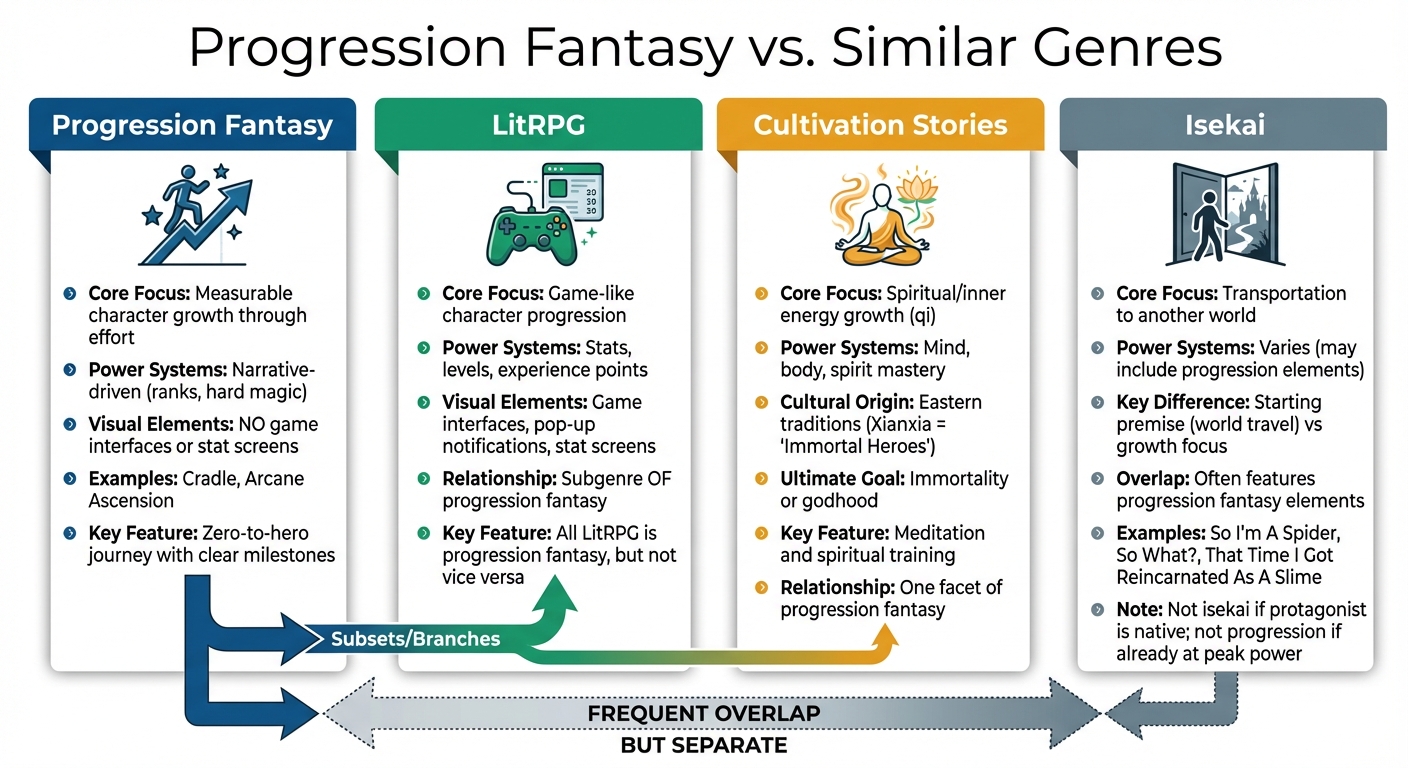
Progression Fantasy vs LitRPG vs Cultivation vs Isekai Genre Comparison
Progression Fantasy vs. LitRPG
Progression fantasy and LitRPG share a common thread: measurable character growth. However, LitRPG is technically a subgenre of progression fantasy. This means that while every LitRPG story features character progression, not all progression fantasy narratives include the game-like mechanics that define LitRPG. In LitRPG, growth is tracked through elements like stats, levels, and experience points, often displayed through game-like interfaces. On the other hand, progression fantasy leans on narrative-driven systems - think hard magic or rank-based hierarchies like "Copper to Gold" - to show advancement. Unlike LitRPG, progression fantasy avoids overt game interfaces, so you won’t find pop-up notifications or stat screens.
Progression Fantasy vs. Cultivation Stories
Cultivation stories are another branch of progression fantasy, focusing on the systematic growth of a character’s inner, spiritual energy. These tales often revolve around mastering the spirit, mind, and body to achieve higher stages of power. A hallmark of cultivation stories is the concept of harnessing vital energy, or qi, through meditation and intense training. The ultimate goal? Immortality or even godhood. As author Luke Chmilenko puts it:
"Xianxia - which loosely translates to 'Immortal Heroes', is a Chinese 'high fantasy' genre that focuses on characters enduring trials to ascend to godlike status".
While cultivation stories fall under the broader umbrella of progression fantasy, they represent just one facet of the genre. Cultivation draws heavily from Eastern traditions, whereas progression fantasy can take place in any universe with flexible power systems. These systems might involve numeric leveling, mana reserves, or mastering new skills - without necessarily relying on spiritual or energy-based elements.
Progression Fantasy vs. Isekai
Both progression fantasy and isekai often feature characters who grow stronger over time, but they approach this growth from different angles. Isekai stories begin with a character being transported to a new, fantastical world, while progression fantasy focuses on the steady, earned journey from zero to hero. The two genres frequently overlap; for instance, in many isekai tales, the protagonist starts with minimal power and must train or level up to survive, blending elements of progression fantasy.
That said, the genres don’t always align. An isekai story doesn’t qualify as progression fantasy if the protagonist is already at their peak and undergoes no meaningful growth. Similarly, a progression fantasy doesn’t fit the isekai mold if the protagonist is native to their world and never experiences dimensional travel. Stories like So I'm A Spider, So What? and That Time I Got Reincarnated As A Slime illustrate the overlap, featuring reincarnated characters who must work their way up through challenges and growth. These comparisons highlight how each genre tackles growth and adversity in its own distinctive way.
How to Identify Progression Fantasy
What to Look For
Progression fantasy stands out through its focus on the protagonist's growth in power as the heart of the story. The narrative often revolves around clear stages of development, marked by distinct power levels with names like Copper, Iron, Jade, or Gold. These stories dedicate substantial time to showing how power is earned - whether through rigorous training, meditation, or studying magic. It’s all about effort and determination, not luck. A classic hallmark of the genre is the "Zero to Hero" journey, where an underdog works their way up to becoming one of the most powerful individuals in their world. This steady, measurable growth creates dynamic and engaging storylines.
Settings and Story Worlds
Progression fantasy isn’t tied to the typical medieval castles or high-fantasy landscapes. It thrives in a variety of settings. You’ll find stories set in urban environments, like Street Cultivation, or futuristic worlds, as seen in Iron Prince. Some narratives take place in magical academies that approach magic with a scientific lens, while others explore time loops, like in Mother of Learning. There are even worlds where game-like systems dictate reality. No matter the setting, what truly defines the genre is the clear, measurable growth of the protagonist over time. A good way to spot this is by observing how much characters evolve across a series.
The Book Comparison Test
One simple way to identify progression fantasy is to compare the protagonist’s abilities from one book to the next. If their power or skills in later volumes significantly outshine what they had in earlier ones, you’re likely reading progression fantasy. However, some titles, like Harry Potter or Mistborn, may blur the lines. While they feature growth, their narratives don’t always focus on clear, quantifiable power increases as the central theme.
Conclusion: Getting Started with Progression Fantasy
Main Points About the Genre
Progression fantasy thrives on measurable character growth that drives the storyline. In this genre, the protagonist typically begins with little to no power and gradually gains strength through rigorous training, meditation, or honing specific skills. What makes progression fantasy stand out is its focus on quantifiable advancement - whether through levels, ranks like Copper or Iron, or distinct cultivation stages. Unlike other genres where training arcs might be a side note, here they are integral to the plot. As author Luke Chmilenko puts it:
"Progression Fantasy is a subgenre of both Fantasy and Science Fiction that focuses on the 'journey' of the characters as they increase in power, skill, and ability over the course of the story".
This genre leans on well-defined systems that make every milestone feel earned. Readers get to experience the satisfaction of seeing an underdog rise to the occasion, conquering seemingly insurmountable challenges through sheer grit and determination. It's this steady, tangible growth that gives progression fantasy its unique charm.
Books to Try
Now that we've covered the essentials, let’s dive into some must-read titles. A great starting point is Will Wight's Cradle series, a fan favorite known for its fast-paced narrative and crystal-clear progression system. Often called "book crack" for its addictive storytelling, the series has garnered millions through crowdfunding efforts for special editions and animations.
For fans of magical academies and dungeon adventures, Andrew Rowe’s Arcane Ascension offers a fresh take with intricate puzzles and a fascinating "attunement" system. If you're looking for something with a slice-of-life twist, Pirateaba’s The Wandering Inn combines immersive world-building with a strong focus on skill development.
Many of these titles are accessible through Kindle Unlimited or as free web serials on platforms like Royal Road, making them budget-friendly choices. Audiobook versions are also gaining popularity, with top-notch narrations adding an extra layer of enjoyment. By September 2025, Publishers Weekly reported that Aethon Books and Vault Comics had joined forces to adapt progression fantasy works into graphic novels, highlighting the genre’s massive sales and growing mainstream appeal.
FAQs
What makes progression fantasy different from traditional fantasy?
Progression fantasy sets itself apart from traditional fantasy by centering on steady character growth and well-defined power systems. In this genre, characters are constantly working to enhance their skills, abilities, or power levels, often through measurable progress like leveling up or mastering specific techniques.
On the other hand, traditional fantasy leans more toward static worlds, innate talents, or external conflicts, placing less focus on the protagonist's step-by-step personal development. The clear goals and structured growth arcs of progression fantasy make it especially appealing to readers who love seeing characters evolve and tackle challenges in a systematic way.
What makes a story a progression fantasy?
Progression fantasy revolves around character growth and development as its core theme. In these tales, protagonists usually begin with little to no power or skills, gradually advancing through their journey by embracing challenges, rigorous training, and sheer determination. Their progress often follows well-defined systems - like levels, techniques, or abilities - that clearly map out how they evolve and improve.
These stories are driven by clear goals and high-stakes challenges, where characters endure grueling trials, fierce battles, or intense training sessions that push their limits. The focus on steady improvement and hard-earned success makes the journey toward becoming stronger a central and captivating aspect of the genre, drawing readers into a deeply satisfying narrative experience.
Why is clear character growth essential in progression fantasy?
Clear character growth lies at the heart of progression fantasy, offering readers clear markers to follow a protagonist's journey. Whether it's about acquiring new abilities, advancing levels, or mastering a detailed power system, this measurable progress keeps the narrative both engaging and rewarding.
By presenting the protagonist's development in a way that can be tracked, the genre creates a sense of accomplishment and momentum. This structured evolution helps readers connect more deeply with the character's challenges and victories, making their journey feel both immersive and fulfilling.