
Progression Fantasy vs LitRPG: Key Differences
Progression Fantasy and LitRPG are two genres focused on character growth but differ in how they approach it. Progression Fantasy emphasizes personal development through effort, training, and skill mastery, often without explicit game-like mechanics. LitRPG, however, integrates video game elements like stats, levels, and system notifications into the story, making progression measurable and explicit.
Key Points:
- Progression Fantasy: Growth through training and ranks (e.g., Cradle). No stats or level-up screens.
- LitRPG: Growth tied to game mechanics like health bars and XP (e.g., The Land). Stats are central to the narrative.
- Overlap: Some stories blend both, combining LitRPG systems with Progression Fantasy storytelling.
Quick Comparison:
| Feature | Progression Fantasy | LitRPG |
|---|---|---|
| Mechanics Visibility | Subtle or implied | Explicit (e.g., stats) |
| Focus | Personal growth, training | System mastery, numbers |
| Examples | Cradle | Dungeon Crawler Carl |
If you enjoy immersive storytelling with character-driven growth, try Progression Fantasy. If tracking stats and game mechanics excites you, LitRPG is your genre. Many titles blur the lines, offering a mix of both styles.
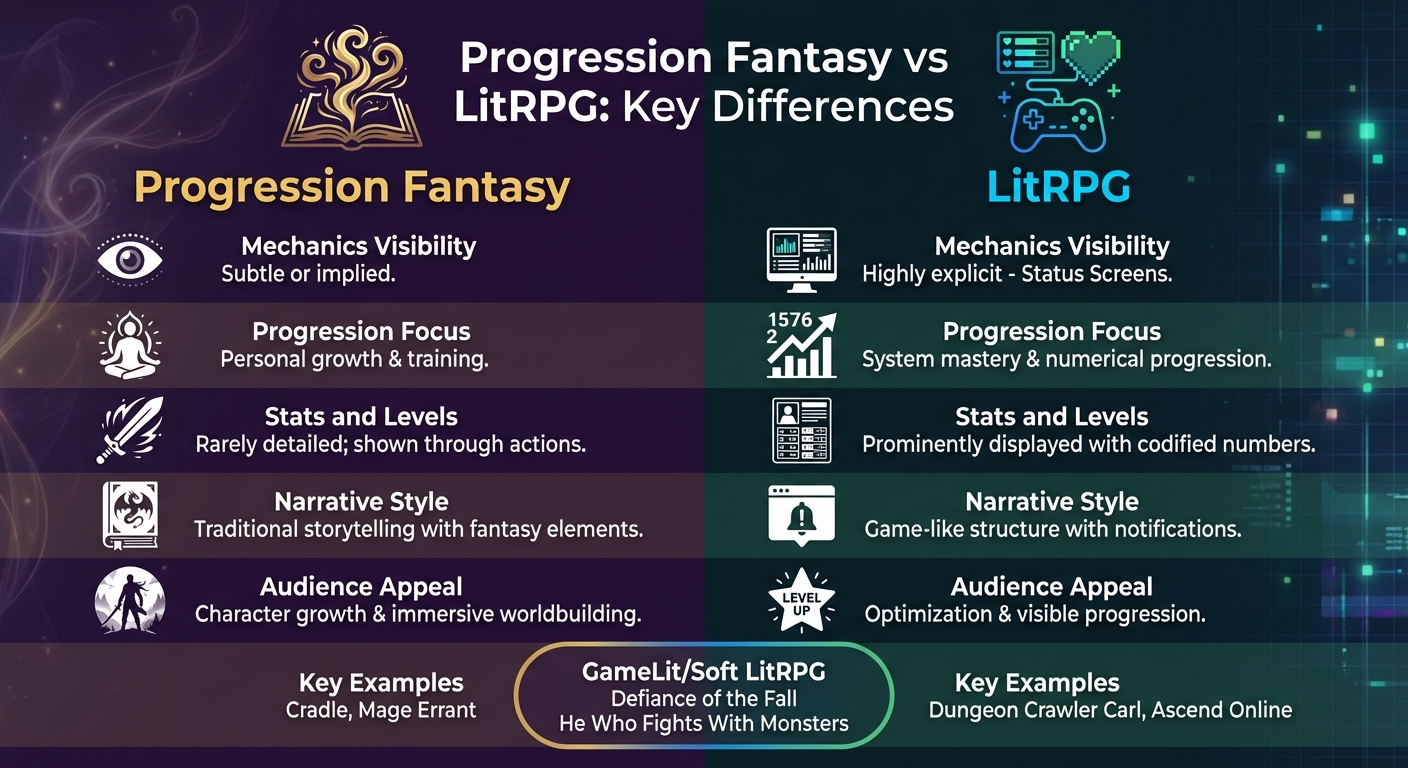
Progression Fantasy vs LitRPG: Key Differences Comparison Chart
From Isekai to Dungeon Core to Progression Fantasy: A Deep Dive into LitRPG and GameLit Book Genres
sbb-itb-2566684
What Are Progression Fantasy and LitRPG?
Both genres revolve around characters growing stronger over time, but they take very different paths to showcase that growth. Let’s dive into what makes each genre unique.
What is LitRPG?
LitRPG, or Literary Role-Playing Game, combines storytelling with game mechanics. This genre emphasizes elements like status screens, numerical stats (e.g., strength, intelligence, health points), and other game-like features as key parts of the narrative. The term originated in late 2013 during a brainstorming session between Russian author Vasily Mahanenko and editors at EKSMO publishing house. Luke Chmilenko defines LitRPG as:
"A LitRPG shall, involve a story or character, that exists in a game world or world with obviously stated game mechanics. Ie: damage notifications, status screens, stats, health/mana bars, etc."
What sets LitRPG apart is its focus on these game systems, weaving them into the story in a way that feels integral rather than secondary. For example, in Matt Dinniman's Dungeon Crawler Carl series, the protagonist navigates a world governed by strict RPG rules, complete with stat blocks and leveling mechanics. The genre’s appeal lies in the satisfaction of mastering these systems - watching numerical stats climb steadily over time.
The popularity of LitRPG has grown significantly. By March 2025, the genre reached a new milestone when This Inevitable Ruin (Book 7 of Dungeon Crawler Carl) hit #2 on The New York Times Audio Fiction best-seller list.
What is Progression Fantasy?
Progression Fantasy also centers on a character’s growth, but it takes a different route. Instead of relying on game-like mechanics, the focus is on personal development through training, meditation, and mastering skills. The term "Progression Fantasy" was coined in 2019 by authors Andrew Rowe and Will Wight to describe stories that share some similarities with anime and LitRPG but lack explicit video game elements. According to Wikipedia:
"The defining trait of progression fantasy is that the accumulation of power is a primary driving force of the narrative, rather than a subplot."
Rather than using digital stat screens or experience points, Progression Fantasy often marks advancement with rank titles or milestones. The genre emphasizes character growth through the narrative itself - focusing on the struggles, breakthroughs, and triumphs that come with hard work. This creates an immersive experience where the journey of becoming stronger feels deeply personal and rewarding, even without the numerical clarity of LitRPG.
How Each Genre Uses Mechanics and Structure
Character growth plays a central role in shaping both the pacing and the overall reader experience in different genres. The way this growth is handled ties directly to the unique narrative styles of each genre. In LitRPG, progression is made explicit and measurable, while Progression Fantasy leans on a more story-driven and qualitative approach.
LitRPG Mechanics
In LitRPG, game mechanics are woven directly into the story's framework. These mechanics are diegetic, meaning they exist as part of the narrative world itself, allowing characters to interact with visible systems such as levels, skills, or abilities. Luke Chmilenko captures this concept succinctly:
"The character must progress in some obviously stated way. Ie: levels, skills, abilities, notifications, ranks, etc."
The level of detail in these systems plays a big role in how impactful progression feels. Author Andrew Rowe highlights this:
"In a story where characters range from Level 1 to a maximum of Level 20... every individual level is likely to feel more impactful than in a story... where you might have character levels reaching into the thousands".
For instance, moving from Level 5 to Level 6 in a tightly designed system feels far more significant than jumping from Level 432 to Level 433 in a more sprawling system.
At its core, LitRPG thrives on system mastery. Characters often optimize their builds, exploit mechanics, or find creative ways to navigate the rules of the world. Within this genre, popular subgenres include:
- System Apocalypse: Where game rules replace or reshape reality.
- VRMMO: Featuring dual narratives that alternate between virtual worlds and the real world.
Next, let’s explore how Progression Fantasy approaches growth without relying on visible game systems.
Progression Fantasy Mechanics
Progression Fantasy takes a more narrative-driven route, focusing on power growth that unfolds naturally through the story. Instead of numeric levels, characters often achieve progress through titled ranks - like "Foundation" or "Gold" in Cultivation stories - or by overcoming challenges that were once beyond their abilities.
This genre emphasizes training arcs and the mastery of techniques. Characters grow through effort, whether that means meditating, consuming elixirs, or learning from mentors. Progress feels earned rather than handed out by a system.
Popular subgenres within Progression Fantasy include:
- Cultivation: Centered on strengthening the body, mind, and spirit through practices like meditation.
- Magic Academy: Focused on structured learning environments where characters gain knowledge and skills.
As forum contributor sunandshadow points out:
"When writing progression fantasy, pacing is very important. You don't want to give the MC new skills too frequently, and you want to put them back in the position of underdog occasionally; you lose a lot of your suspense and reader sympathy if your character has things too easy".
LitRPG vs Progression Fantasy: Side-by-Side Comparison
Understanding the differences between LitRPG and Progression Fantasy becomes easier when you compare their defining traits side by side.
Feature Comparison Table
Here's a breakdown of the key features that set these two genres apart:
| Feature | Progression Fantasy | LitRPG |
|---|---|---|
| Mechanics Visibility | Subtle or implied | Highly explicit (e.g., Status Screens) |
| Progression Focus | Emphasis on personal growth and training | Mastery of systems and numerical progression |
| Stats and Levels | Rarely detailed; shown through actions | Prominently displayed with codified numbers |
| Narrative Style | Traditional storytelling with fantasy elements | Game-like structure with notifications and interfaces |
| Audience Appeal | Focus on character growth and immersive worldbuilding | Satisfaction from optimization and visible progression |
| Key Examples | Cradle, Mage Errant | Dungeon Crawler Carl, Ascend Online |
In essence, LitRPG thrives on explicit game mechanics - think stat sheets and damage pop-ups - while Progression Fantasy leans on storytelling to convey power through actions and achievements. Now, let’s explore how these genres sometimes intersect.
Where the Genres Overlap
Some stories blur the lines between LitRPG and Progression Fantasy, creating hybrids often referred to as GameLit or Soft LitRPG. These works combine the system-driven progression of LitRPG with the narrative depth of Progression Fantasy.
Take Defiance of the Fall by JF Brink (TheFirstDefier), for instance. It’s set in a System Apocalypse scenario where Earth is transformed by game mechanics like levels and stats - hallmarks of LitRPG. At the same time, it incorporates cultivation elements and Eastern-inspired power systems typical of Progression Fantasy.
Another example is He Who Fights With Monsters by Shirtaloon. While it uses a game-like interface to showcase the protagonist’s abilities, the story places a strong emphasis on character development and intricate worldbuilding rather than solely focusing on optimizing stats.
These crossover titles strike a balance, appealing to readers who enjoy visible progression but also crave rich storytelling. As authors continue to experiment, the line between these genres grows increasingly fluid, offering something for fans of both styles.
Common Misconceptions and How the Genres Have Changed
One of the biggest misconceptions about Progression Fantasy and LitRPG is that they are completely separate genres. In reality, LitRPG is often seen as a subgenre of Progression Fantasy because it revolves around characters becoming stronger, using game-like stats to track that growth. As author Luke Chmilenko explains:
"All of LitRPG is considered progression fantasy due to the nature of how the characters of the world get stronger or improve on their skills".
Another misunderstanding is the belief that Progression Fantasy always requires numbers, levels, or character sheets. While LitRPG leans heavily on these elements, Progression Fantasy can focus on a character's journey of growth and improvement through training and effort, without relying on explicit game-like interfaces.
The way these genres are written has shifted significantly over time, partly because the term "Progression Fantasy" is a relatively recent addition to the literary world. Coined in 2019 by authors Andrew Rowe and Will Wight, the term emerged to fill a marketing gap for books that shared similarities with LitRPG but didn’t include in-game mechanics.
In earlier iterations, LitRPG stories were dominated by Virtual Reality MMORPG settings. However, modern trends have moved toward "System Apocalypse" narratives, where game mechanics begin to override the laws of the real world. This shift reflects readers’ growing appetite for stories with higher stakes. Additionally, authors are experimenting with alternative ways to show character growth, such as using "titled levels" like Copper, Iron, or Jade, instead of relying on constant numeric updates.
These changes have created a broad spectrum of storytelling styles, ranging from purely narrative-driven Progression Fantasy to stat-heavy "Hard LitRPG", with numerous hybrids in between. This evolution continues to expand the possibilities for both genres, offering readers an ever-growing variety of stories.
Conclusion: Which Genre Fits Your Preferences?
When it comes to choosing between Progression Fantasy and LitRPG, it all boils down to how you prefer your characters to grow and evolve. If you're drawn to stories with a traditional narrative arc - complete with training montages and a deep dive into magical systems - Progression Fantasy might be your go-to. It’s perfect for readers who love seeing characters develop through discipline, meditation, and mastery.
On the flip side, if you’re a fan of tabletop games, MMORPGs, or tracking character stats in RPGs, LitRPG offers that same thrill. It’s packed with explicit mechanics like levels, experience points, and system notifications that mark every milestone in the character's journey.
But here’s the thing - you don’t have to pick just one. These genres often blur the lines, blending the rich storytelling of Progression Fantasy with the stat-driven mechanics of LitRPG. Many hybrid titles strike a balance, incorporating system elements to enhance the narrative rather than disrupt it. This fusion appeals to fans of both styles, offering the best of both worlds.
Think about what excites you most. Do you love following a character’s transformation from an underdog to an unstoppable force through sheer effort and skill? That’s Progression Fantasy in a nutshell. Or do you crave the immersive vibe of a game-like world, where every skill upgrade and challenge feels like leveling up in an RPG? That’s where LitRPG shines.
Why not sample both? Dive into a Progression Fantasy like Cradle or a LitRPG like The Land and see which style clicks with you. With new titles popping up all the time and a growing community of readers, there’s no shortage of stories to explore. Whether you prefer one genre or enjoy a mix, both promise an exciting journey with plenty of twists and turns to keep you hooked.
FAQs
What are some well-known examples of stories that mix elements of Progression Fantasy and LitRPG?
Some stories expertly weave together elements of Progression Fantasy and LitRPG, creating a captivating mix of personal growth and game-like systems. These hybrids often showcase protagonists who improve their abilities through perseverance and overcoming obstacles - a signature trait of Progression Fantasy - while also incorporating LitRPG staples like skill trees, stat sheets, and level-ups.
This blend resonates with readers who crave both the emotional depth of character development and the structured, measurable mechanics of LitRPG. More and more contemporary authors are diving into this crossover, crafting immersive narratives that strike a balance between the two genres. As a result, this trend is gaining momentum within the speculative fiction community.
How has LitRPG grown in popularity, and what trends are shaping the genre today?
LitRPG has been gaining traction lately, merging classic storytelling with elements straight out of video games - think leveling up, stats, and skill trees. This mix has drawn in a broad audience, especially those who love gaming and speculative fiction.
The genre is evolving, with new subgenres branching out into fresh settings and themes. Writers are weaving game mechanics more intricately into their plots, offering readers a richer experience. There's also a growing appetite for stories that dive deeper into character development and craft imaginative worlds, making the genre more exciting and layered than before.
What are the main reasons someone might prefer Progression Fantasy over LitRPG, or vice versa?
Readers gravitate toward Progression Fantasy because it emphasizes character growth and the journey of self-improvement. These stories follow a protagonist’s transformation from being weak or inexperienced to achieving strength and mastery. Through hard work, training, and overcoming obstacles, the characters evolve, making this genre a favorite among fans of traditional fantasy who enjoy tales of personal development.
In contrast, LitRPG caters to those who love gaming-inspired narratives and virtual worlds. These stories weave in explicit game mechanics - like levels, stats, and system notifications - offering a structured, game-like experience. LitRPG often strikes a chord with video game enthusiasts or readers who appreciate rule-based systems embedded in their fiction.
The choice really depends on what excites you more: the satisfaction of character-driven growth in a classic fantasy setting (Progression Fantasy) or the thrill of exploring game-inspired worlds packed with mechanics and structure (LitRPG).