
5 Tips for Balancing Power Levels in LitRPG Combat
Crafting a balanced LitRPG combat system is all about maintaining tension and making progression feel earned. Overpowered characters or broken systems can ruin immersion, but a well-designed structure keeps readers engaged. Here’s a quick breakdown of the five key strategies:
- Tiered Progression: Use milestones to create impactful power spikes while maintaining steady growth.
- Level Caps & Stat Requirements: Restrict overpowered gear and abilities to ensure progression feels earned.
- Class Balance: Design unique growth paths for each class so all roles have moments to shine.
- Dynamic Combat: Introduce environmental challenges, teamwork, and objectives beyond raw stats.
- Earned Power Gains: Tie mechanical progression to emotional growth and ensure every victory feels deserved.
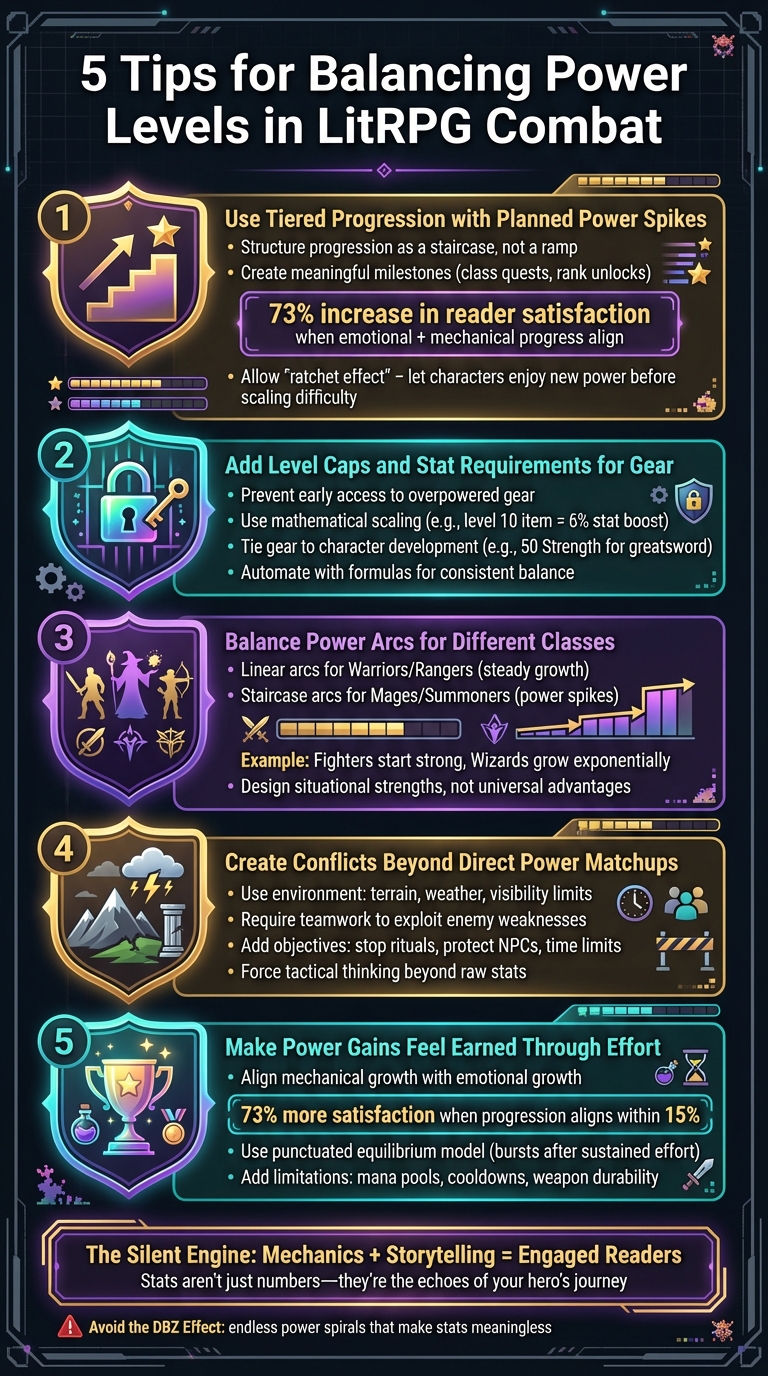
5 Key Strategies for Balancing LitRPG Combat Systems
Balancing the RPG GRIND and the STORY ⚔️ Matt Dinniman writing LitRPG masterclass
sbb-itb-2566684
1. Use Tiered Progression with Planned Power Spikes
Picture tiered progression as a staircase rather than a smooth ramp. Characters advance steadily, but they occasionally hit a barrier that demands a key achievement to move forward. Once they break through - whether it’s completing a class quest, reaching a stat milestone, or unlocking a new rank - they experience a big power boost before settling back into gradual improvement again. This structured design ensures that power surges feel impactful and meaningful.
This method avoids the common issue of characters leaping from novice to expert too quickly. For example, in Ascend Online, progression is divided into clear milestones like Beginner, Base Class, and Advanced Class. Each milestone introduces a steeper growth curve, making the power gain feel earned while keeping the game balanced. Similarly, He Who Fights with Monsters uses an exponential rank system, where advancing from Bronze to Silver delivers a massive boost, including resistance to lower-tier attacks.
The trick is to hint at these tiers early on. Clark Rowenson, author of The Magic Engineer, emphasizes the importance of planning and foreshadowing:
"A big part of avoiding the DBZ effect and other mistakes is planning these things out in advance. Another part is foreshadowing."
By planting early hints, the eventual power spikes feel more rewarding.
Interestingly, research shows that aligning emotional and mechanical progress leads to a 73% increase in reader satisfaction. This means characters feel like they’ve truly earned their power, creating a stronger connection with the audience.
To keep things balanced after a power spike, it’s crucial to let characters fully enjoy their newfound strength. Game developer Philipp refers to this as the "ratchet" effect - giving players a chance to dominate old threats before the "treadmill" of enemy scaling catches up. These moments of dominance make the hard-earned power feel worthwhile, rather than immediately resetting the difficulty curve.
2. Add Level Caps and Stat Requirements for Gear
Level caps and stat requirements act as a checkpoint system to keep game progression balanced and rewarding. These mechanisms prevent players from gaining access to overpowered gear too early, which could disrupt the gameplay experience. Imagine finding a legendary sword at level 5 that triples your stats - it would completely erase any sense of challenge or narrative tension. Clark Rowenson, author of The Magic Engineer, puts it perfectly:
"That's why you'll often see level caps and stat requirements which automatically put a gate on those huge spikes in power. So, at your level, finding a piece of legendary gear isn't going to suddenly break your character."
The trick lies in ensuring gear is properly scaled. This involves using precise mathematical calculations rather than guesswork. For example, if a level 10 item should provide a 6% stat boost, you can calculate the exact armor or damage values needed to achieve that. This approach ensures that each piece of equipment aligns with character growth, keeping gameplay balanced and engaging.
To streamline this process, automate gear scaling with formulas that factor in level multipliers and rarity modifiers. This ensures that every item drop is appropriately balanced without requiring manual adjustments for each piece of gear.
Stat requirements also tie gear to character development. For instance, a heavy greatsword might require 50 Strength to wield, making powerful equipment something players must work toward. This system integrates progression with rewards, ensuring that every boost in power feels intentional and earned. Together, level caps and stat requirements create a structure where growth and rewards are seamlessly connected, a core principle of LitRPG and GameLit novels.
3. Balance Power Arcs for Different Classes
To keep combat engaging and fair, it's crucial to balance power arcs across classes. Each class should have a distinct growth path that ensures no single role overshadows the others. A power arc represents a character’s journey in gaining strength, while the progression curve shows how quickly they hit key milestones. When balanced well, classes peak at different times, creating natural moments for each to shine. This approach supports tactical gameplay where every class has its time in the spotlight.
Take the Fighters and Wizards from Dungeons & Dragons as an example. Fighters start strong with steady, linear growth, making them reliable damage dealers early in the game. Wizards, on the other hand, begin weak and vulnerable but grow exponentially - eventually unlocking high-level spells that can dominate entire battles. This staggered progression ensures that neither class outshines the other throughout the game, keeping the experience dynamic.
For consistent roles like Warriors or Rangers, linear power arcs work best. These provide steady growth over time. Meanwhile, high-scaling roles like Mages or Summoners benefit from staircase arcs, where power spikes occur at key milestones - like unlocking Advanced Classes or mastering new spell tiers. These distinct growth patterns allow different classes to shine at different points in the game. Combined with tiered progression systems and gear-based stat limits, such tailored arcs keep the gameplay balanced and the narrative engaging.
Balance also hinges on trade-offs and situational strengths. Instead of giving classes broad, universal advantages, tie their power to specific scenarios. For instance, a Rogue might excel at stealth-based attacks but falter in direct combat. Similarly, a Paladin could be devastating against undead enemies but perform more modestly against other foes. These kinds of conditional strengths ensure no class becomes the go-to choice for every encounter.
"The purpose [of group balance] is to make sure that each player remains active and engaged. If you make one part of the game much cooler than the rest, then you should expect players to gravitate to it."
Clark Rowenson, author of The Magic Engineer, highlights this principle. By designing power arcs that complement rather than compete, you can ensure every class feels indispensable to the team’s overall success.
4. Create Conflicts Beyond Direct Power Matchups
Balanced combat isn’t just about stats or gear - it’s about making battles dynamic and engaging. By designing encounters that challenge players to think beyond raw power, you can create a more strategic and rewarding experience.
Start with the environment. Terrain features like waterfalls, cliffs, or narrow ledges can block line of sight or force tactical repositioning. Weather effects such as heavy rain, fog, or smoke can limit visibility and make ranged attacks less effective, giving melee fighters a chance to shine. For higher-level characters with abilities like flight or teleportation, add elements like anti-magic zones, gravity wells, or shifting planar boundaries to keep them on their toes and encourage creative solutions.
"Using the environment can completely alter the flow and rhythm of a fight as heroes deal with challenges beyond simply hitting the enemy and players are forced to make different tactical considerations outside their comfort zone." - John Lewis, RPG Alchemy
Teamwork should also play a pivotal role. Design foes with specific weaknesses that require coordinated efforts to exploit. For example, one player might create a hazardous zone (like with a Spike Growth spell), while another forces enemies into it using movement-based abilities. This pushes players to collaborate and think strategically.
To deepen the experience, go beyond direct combat. Include objectives like stopping a ritual, protecting an NPC, or reaching a goal within a time limit. These scenarios ensure that every character - whether they excel in combat or support - has a chance to contribute meaningfully. This approach prevents damage-focused builds from overshadowing other roles, keeping the entire party engaged.
5. Make Power Gains Feel Earned Through Effort
In LitRPG, the most rewarding power gains come from struggle and perseverance. When a character levels up after overcoming a meaningful challenge, readers experience a surge of excitement alongside them. On the flip side, power that arrives too easily can feel hollow and undeserved.
To make progression resonate, tie mechanical growth to emotional growth. Research indicates that readers feel 73% more satisfied when a character's emotional journey aligns closely (within 15%) with their mechanical progression. This means abilities shouldn’t just appear out of nowhere - they should be earned through personal sacrifice, moments of bravery, or tackling inner demons. For example, a mage who runs out of mana and has to improvise under pressure creates far more tension than one who breezes through every encounter without a hitch. This balance between emotional and mechanical growth keeps the story grounded and engaging.
"The perceived value of advancement is directly proportional to the effort required to achieve it, but inversely proportional to the time elapsed since the previous advancement." - Sarah Chen, Journal of Narrative Mathematics
To avoid cheapening progression, steer clear of rapid, unearned power-ups. Quick, context-free level-ups might boost stats, but they drain the story of meaning. Instead, consider using a punctuated equilibrium model - periods of steady development punctuated by significant breakthroughs. This mirrors real-life skill acquisition, where growth often comes in bursts after sustained effort, and it keeps readers invested in the journey.
Another way to make victories feel earned is by designing power systems with built-in limitations. Features like mana pools, cooldown timers, or weapon durability force characters to strategize and adapt. Imagine a hero whose weapon breaks mid-battle or whose ultimate ability is on cooldown during a critical moment. These kinds of constraints add tension and make success feel like a hard-fought triumph rather than an inevitable outcome.
Conclusion
Balanced LitRPG combat weaves mechanics and storytelling together to fully engage readers. By incorporating tiered progression with planned spikes, setting level caps and stat requirements, balancing power arcs across classes, introducing conflicts outside of direct power comparisons, and ensuring power gains are earned through effort, you create what LitRPG Reads describes as a "silent engine." This "engine" seamlessly blends mechanics and narrative, making them so interconnected that removing one would unravel the story entirely.
Without these structural safeguards, your combat system risks falling into the "DBZ effect" - where power levels spiral endlessly until stats lose their meaning. This often leads to readers disengaging when characters bypass the system without consequences. As LitRPG Reads aptly states:
"Stats aren't just numbers. They're the echoes of your hero's journey, the drumbeat of danger, the arithmetic of hope".
By uniting tiered progression, level caps, balanced class dynamics, strategic conflicts, and earned power gains, you create a foundation that ensures character decisions - not just raw stats - drive the outcomes of combat. This approach strengthens both the narrative and the audience's trust in the world you've built. Consistent progression and logical world-building are key to sustaining that trust.
For authors aiming to refine their understanding of balanced LitRPG systems, exploring works from Sababa Books can be highly insightful. Their selection of LitRPG and progression fantasy novels highlights well-crafted magic systems and character development that keep readers hooked from the opening chapter to the final power-up.
FAQs
How do I plan power spikes without breaking tension?
To handle power spikes in LitRPG combat without disrupting the tension, tie them to major story milestones and ensure they follow a logical progression. Power growth should feel natural, aligning with the character's journey or system-driven mechanics to maintain balance and keep the stakes high.
Avoid sudden, unexplained power surges. Instead, make these moments feel earned by grounding them in the narrative. A structured progression ensures the spikes enhance the story without undermining its flow or suspense.
What’s a simple way to scale gear stats by level?
To make gear stats grow with a character's progression, you can link bonuses or damage directly to the character's level or the item's level. For instance, a +1 sword might gain an additional bonus point every 4 levels the character achieves. Another approach is to implement tiered upgrades - like basic, improved, and mastercraft - where each tier increases the item's stats step by step as the character advances. These strategies help maintain a sense of balance and natural growth throughout the game.
How can weaker classes still matter in big fights?
Weaker classes can still make a big impact in major battles by focusing on smart tactics. Things like clever movement, proper positioning, and taking advantage of environmental hazards can turn the tide. It’s not always about sheer strength - making the right strategic choices can open up chances for success and even lead to victory.