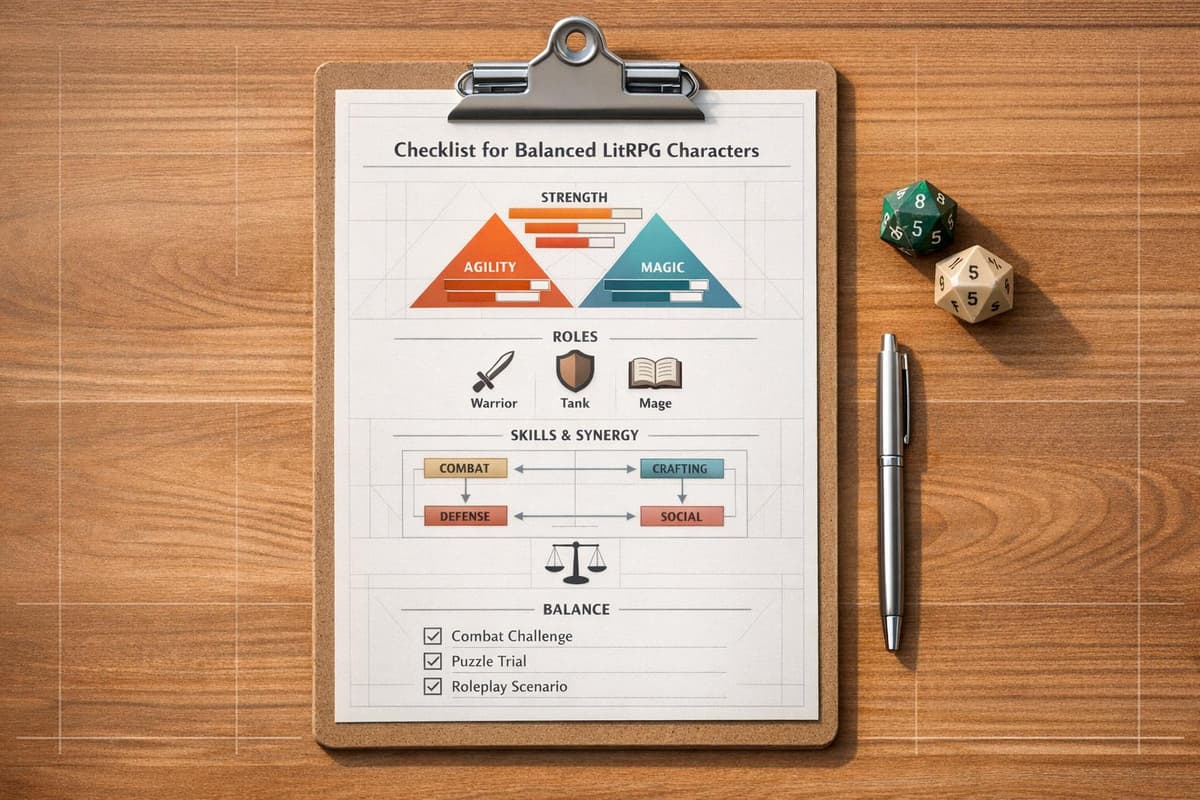
Checklist for Balanced LitRPG Characters
Creating balanced LitRPG characters means blending engaging storytelling with logical game mechanics. A strong character design avoids overpowered builds, ensures meaningful progression, and incorporates weaknesses to maintain tension. Here's a quick checklist to craft well-rounded characters:
- Define a Role: Start with a one-sentence role description (e.g., "Burst fire mage with AoE attacks").
- Distribute Stats Wisely: Use the "Rule of Three" to focus on three key stats that align with the character's role.
- Choose Synergistic Skills: Select abilities that complement each other for offense, defense, and utility.
- Add Weaknesses: Include 2–3 flaws that impact both gameplay and narrative (e.g., low stamina, fear of fire).
- Plan Trade-Offs in Progression: Attach costs or limitations to level-ups and align growth with story milestones.
- Test in Scenarios: Evaluate the character in combat, puzzles, and social situations to ensure balance.
This approach keeps progression engaging and ensures characters feel both powerful and grounded in their world. Stats and mechanics should support the narrative, not overshadow it.
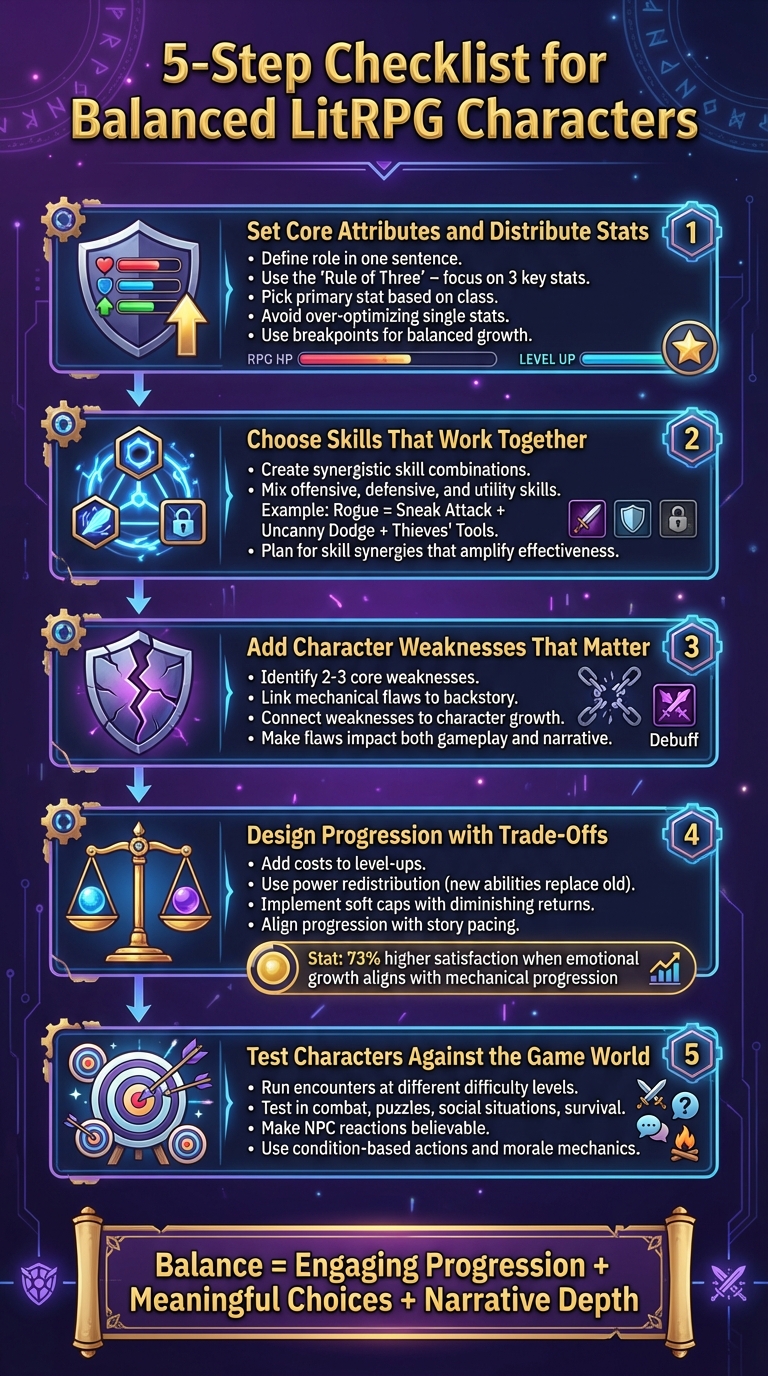
5-Step Checklist for Creating Balanced LitRPG Characters
4theWriters: How to Write LitRPG Without Losing the Plot
sbb-itb-2566684
Step 1: Set Core Attributes and Distribute Stats
Before assigning any stats, define your character's role in a single sentence, like "Burst fire mage with strong AoE" or "Tank protecting fragile allies". This helps avoid creating a character with stats that feel scattered or don’t align with their intended purpose.
Next, identify your character's core ability and focus on the three key stats that enhance it. For instance, a fire mage benefits from Power (Intelligence), Critical Chance, and Mana Efficiency. A rogue thrives on Dexterity for precision, some Strength for damage, and Constitution for survival when stealth fails. This approach, known as the Rule of Three, ensures a balanced distribution of stats rather than pouring everything into one area. These foundational choices pave the way for more refined attribute allocation in later steps.
Pick a Primary Stat Focus
Start by selecting the primary stat based on your character's class. For example, Barbarians rely on Strength, Wizards on Intelligence, and Rogues on Dexterity. To maintain balance, use standardized systems like Standard Array or Point Buy to avoid creating an overpowered character right from the start. Once the primary stats are set, use secondary stats to address weaknesses. For example, adding Wisdom to a Strength-heavy character can improve their Perception, helping them avoid ambushes.
For a more realistic feel, link secondary attributes to primary ones. For instance, Maximum HP could depend on both Constitution and the character's Level. This creates interconnected scaling - a logical progression where a Level 10 warrior with 16 Constitution has more HP than a Level 5 warrior with the same Constitution score.
Don't Over-Optimize Single Stats
Focusing too much on one stat can lead to diminishing returns. For example, a mage who pours everything into Intelligence might deal massive damage but risks being easily defeated without enough Vitality for survivability. As Runic Dice explains:
"Good optimization is about clarity and focus... Choices that don't feed that engine are distractions".
Instead, aim for specific breakpoints - thresholds where a stat activates a key mechanic, like reaching 40% critical hit chance to trigger a special ability. Once you hit that breakpoint, shift your attention to other stats to improve overall performance. Test your build in controlled scenarios to find these breakpoints and adjust accordingly. Sometimes, a small sacrifice in damage can result in significant gains in survivability, making your character more effective and enjoyable to play within both the game's mechanics and its narrative framework.
Step 2: Choose Skills That Work Together
After defining your character’s core attributes, the next step is picking skills that align with and enhance their role. Think of this process as creating a primary skill or combination that your character will rely on most often. As Runic Dice explains:
"Good optimization is about clarity and focus. You pick a core damage type or role... then make your choices work together toward that role. That's synergy: every stat, skill, and gear choice supports your goal."
For example, a Nova Knight (Paladin/Sorcerer) uses Charisma to fuel both melee bursts and spellcasting. By pairing Quickened Hold Person with Divine Smite, they can paralyze opponents and land guaranteed critical hits. This combination ensures every action works in harmony, resulting in high-impact turns that are both narratively engaging and mechanically effective.
Mix Offensive, Defensive, and Utility Skills
With your core attributes in place, aim for balance by selecting a mix of offensive (damage-dealing), defensive (survivability), and utility (problem-solving) skills. A character focused solely on damage might excel in combat but struggle with durability or versatility. A well-rounded approach ensures your character can handle various challenges, whether in battle, exploration, or social interactions.
Take a Rogue, for instance. They might prioritize Sneak Attack for offense while adding Uncanny Dodge for defense and proficiency with Thieves' Tools for utility. This setup allows them to excel in ambushes, disarm traps, and contribute during social encounters. If your character tends to burn through resources quickly, consider adding a defensive skill or two to improve their durability.
Plan for Skill Synergies
Strong builds don’t just stack powerful abilities - they combine them in ways that amplify their overall effectiveness. This might involve pairing crowd control with high-damage attacks or using environmental manipulation alongside forced movement. For instance, casting Grease to create a slippery surface and following up with a Shove action can knock enemies prone, disrupting their positioning and giving your allies an edge.
Another example is the Executioner build (Fighter/Rogue), which uses Action Surge to deliver multiple attacks that capitalize on Sneak Attack damage. This approach reinforces the character’s role and strengthens their overall impact. When planning synergies, think about how skills can complement each other in timing and resource use. Playtesting these combinations is key to ensuring they work as intended during gameplay.
Step 3: Add Character Weaknesses That Matter
Once you've polished your character's skills and synergies, it's time to focus on their weaknesses. A character without meaningful flaws can feel one-dimensional, lacking the tension and growth that make stories engaging. Flaws introduce challenges, create stakes, and pave the way for development. As Tal Valante Kilim puts it:
"A flaw is any imperfection, bad habit, or negative character trait that affects how a character behaves or makes decisions."
The goal is to craft weaknesses that actively influence gameplay and the narrative. Superficial traits like being "slightly messy" won't carry the same weight as deeper issues, such as trust problems stemming from betrayal or a debilitating fear of fire during combat.
Identify 2–3 Core Weaknesses
When designing your character, aim for 2–3 specific weaknesses tied to both their mechanics and backstory. On the mechanical side, think about vulnerabilities that challenge gameplay, like low resistance to certain damage types (e.g., fire or poison), a stamina bar that depletes quickly in prolonged battles, or reliance on abilities with long cooldowns that leave them exposed. These weaknesses create tactical hurdles, forcing strategic adjustments.
For psychological or behavioral flaws, consider how your character's past shapes their present. For instance, a character who was betrayed by a close friend might struggle with paranoia, making it hard to form alliances. Or, someone who survived a traumatic event could develop a phobia that impacts their decisions in key moments. The table below illustrates how backstory elements can translate into gameplay-relevant flaws:
| Backstory Origin | Resulting Weakness | Impact on Gameplay |
|---|---|---|
| Betrayal by a close friend | Distrust/Paranoia | Hesitant to form party alliances |
| Excessive praise as a child | Arrogance/Hubris | Ignoring NPC advice or tactical warnings |
| Childhood accident/Trauma | Fire phobia | Panic in fire-based encounters |
| Growing up in a broken home | Fear of commitment | Avoids long-term bonds or guild loyalty |
Just as strengths define a character's build, well-thought-out weaknesses add depth and complexity.
Connect Weaknesses to Character Growth
The best flaws aren't static - they're stepping stones for character growth. As Melissa Kremer explains:
"Quite often a character's flaw is rooted in something that the character fundamentally believes, but isn't actually true. This is the lie your character believes - a false belief that shapes how their flaw affects their actions and relationships."
Design your character's journey so their weaknesses push them toward self-discovery and change. For example, a lone wolf might be forced to accept help in a life-or-death situation, or someone with a fear of water could face a pivotal quest requiring them to dive into a submerged dungeon to save a friend. Growth should feel earned, with setbacks along the way. When your character finally overcomes their flaw, it should mark a major turning point, leaving a lasting impact on their story and relationships.
Step 4: Design Progression with Trade-Offs
Once you've established balanced stats and meaningful skills, character progression needs to incorporate trade-offs. Growth should come with challenges, ensuring that every power gain requires players to make thoughtful decisions. Dr. Sarah Chen from the Journal of Narrative Mathematics explains this perfectly:
"The ideal progression function balances the reader's psychological need for frequent rewards with the narrative requirement for meaningful challenge."
Rather than simply adding bigger numbers to a character sheet, design systems where advancement introduces new dilemmas to solve.
Add Costs to Level-Ups
When characters unlock powerful new abilities, attach limitations that force them to think strategically. For example, a devastating fire spell might drain their mana so quickly that they’re left vulnerable afterward. A defensive shield might reduce movement speed, making them an easy target for faster enemies. These kinds of trade-offs prevent characters from becoming overly powerful and one-dimensional.
Another effective approach is power redistribution - where new abilities replace older ones. For instance, a character might unlock an advanced sword technique that takes the place of their basic slash. This forces players to adapt their strategies instead of simply piling on new moves. It also helps control unchecked power growth, keeping the game balanced.
Soft caps with diminishing returns are another way to encourage diverse character builds. For example, increasing strength from 10 to 20 might double damage output, but going from 90 to 100 should only yield minor improvements. This naturally pushes characters toward horizontal growth, encouraging them to diversify their skills rather than maxing out a single stat.
By incorporating these trade-offs, you can align character growth with meaningful gameplay and narrative moments.
Align Progression with Story Pacing
Progression milestones should coincide with major narrative events, not random grinding. Unlocking a game-changing ability should feel like the result of overcoming a significant challenge or making a crucial decision.
Data suggests that readers report a 73% higher satisfaction rating when a character's emotional growth aligns closely with their mechanical progression. For example, if a character gains the power to destroy entire cities, they should also wrestle with the responsibilities that come with such strength. A disconnect between rapid stat growth and stagnant personality development can feel jarring to players.
The stepwise progression model works well in this context. It alternates periods of stability with significant advancement events. For instance, characters might master their current abilities until a major boss fight forces them to grow. This mirrors real-world learning and makes progression feel earned rather than automatic.
| Strategy | How It Works | Why It Matters |
|---|---|---|
| Environmental Scaling | The world adjusts to match character growth | Maintains tension despite power increases |
| Power Redistribution | New abilities replace older ones | Prevents infinite ability stacking |
| Soft Caps | Diminishing returns on stat investment | Encourages diverse character builds |
| Internal Conflicts | Power introduces new personal challenges | Links mechanics to emotional development |
Step 5: Test Characters Against the Game World
Once you've crafted balanced stats and trade-offs, the next step is to see how they perform in the game itself. Testing characters in real scenarios ensures that your design choices hold up under pressure. These tests should cover a variety of situations - combat, exploration, social interactions, and problem-solving. As Michael Matson aptly says:
"A well-built LitRPG world isn't just a sandbox - it's a simulation. One where choices matter, consequences unfold logically, and victory feels earned."
Start with simple baseline tests, like training dummies, to get a feel for basic mechanics. Then move on to more intense challenges, such as boss fights or large-scale battles, to see how the character handles stress. These scenarios should test resource management, adaptability, and overall survivability. For example, prolonged encounters can reveal whether a character runs out of resources too quickly or if they're unrealistically powerful. The goal is to create a balanced experience where success feels satisfying, not guaranteed.
Run Encounters at Different Difficulty Levels
To truly test a character's design, they need to face a range of challenges that highlight different aspects of their build. Here are a few examples:
- Escort missions: Test utility skills and the ability to protect others, rather than just dealing damage.
- Puzzle-solving quests: Evaluate intelligence and problem-solving stats instead of relying on brute strength.
- Survival trials: Push resource management and endurance to see how well they perform under extended pressure.
- Diplomatic engagements: Challenge charisma and persuasion skills to expose any gaps in social abilities.
For a high-damage striker, pit them against tanks with strong defenses, healers who can sustain their allies, and controllers who manipulate the battlefield with status effects. This forces them to adapt instead of relying on a single strategy. Additionally, introduce environmental challenges - like uneven terrain, poor lighting, or hazards - to see if their skills are versatile or only effective in ideal conditions.
Make NPC Reactions Believable
Testing isn't just about combat and mechanics. NPC behavior plays a huge role in making the game world feel alive. Design NPCs with realistic decision-making processes, such as condition-based actions. For instance, enemies might retreat when outnumbered or focus on a high-damage but fragile "glass cannon" character. Adding morale mechanics can make encounters more dynamic - low-level foes may flee or surrender when overwhelmed, while elite enemies stand their ground or regroup strategically.
NPCs should also react differently based on your character's class, reputation, or social standing. A mage visiting an academy might gain insider tips from fellow spellcasters, while a warrior might be ignored. Implementing loyalty systems further deepens these interactions - NPCs with low trust might withhold critical information or act less cooperatively. Over time, these relationships should evolve based on shared experiences and the player's choices. When NPCs feel like they have their own motivations and instincts, the world becomes immersive, and the challenges feel earned rather than scripted.
Conclusion
Using the checklist outlined earlier, creating balanced character design becomes a blend of storytelling and game mechanics. By thoughtfully distributing stats, selecting complementary skills, incorporating meaningful weaknesses, designing progression with trade-offs, and testing characters within the game world, you build a structure that keeps readers engaged from start to finish.
Balance allows strategic decisions - like prioritizing offense over defense - to maintain tension and stakes within the story. Game mechanics should enhance the narrative, not overwhelm it with excessive stat details. When stats, skills, and weaknesses are seamlessly integrated into the plot, readers can enjoy the thrill of progression while staying emotionally invested in the character's journey.
For examples of how skilled authors apply these principles, check out curated LitRPG collections like those at Sababa Books. Books like The Gilded Rebellion by Rebecca Vale and The Lifeline Protocol by Sera Kane showcase how to combine mechanical depth with captivating storytelling, offering a masterclass in balanced character development.
FAQs
How do I pick my character’s “Rule of Three” stats?
To select your character's "Rule of Three" stats, zero in on three key attributes that best represent their strengths and role in the story. Popular choices include Physical Power, Agility, Magic Power, Vitality, and Luck. Choose stats that complement your character's class and playstyle, but be careful not to pour too much into one area. Striking a balance will keep your character's progression engaging and dynamic.
How can I add flaws that matter without nerfing the character?
To give your character meaningful flaws without undermining their overall strength, consider traits like specific fears, unyielding beliefs, or quirky habits that spark internal conflict. These flaws should actively shape their decisions and interactions, creating tension and adding layers to their personality. Rather than making these flaws entirely negative, use them as catalysts for growth. This approach keeps your character relatable and dynamic, while still preserving their core strengths, enriching your story in the process.
What’s the best way to test if a build is actually balanced?
To determine if a build is well-balanced, you’ll need to assess how it performs in different situations - combat, problem-solving, and role-playing. Watch for areas where it might feel too overpowering or, conversely, underwhelming. Testing it within actual gameplay or story-driven scenarios can highlight its strengths and weaknesses, giving you the chance to make adjustments. The aim is to create a fair and engaging experience that stays true to the core elements of LitRPG and progression fantasy.