
Portal Fantasy vs Epic Fantasy: Which to Read First
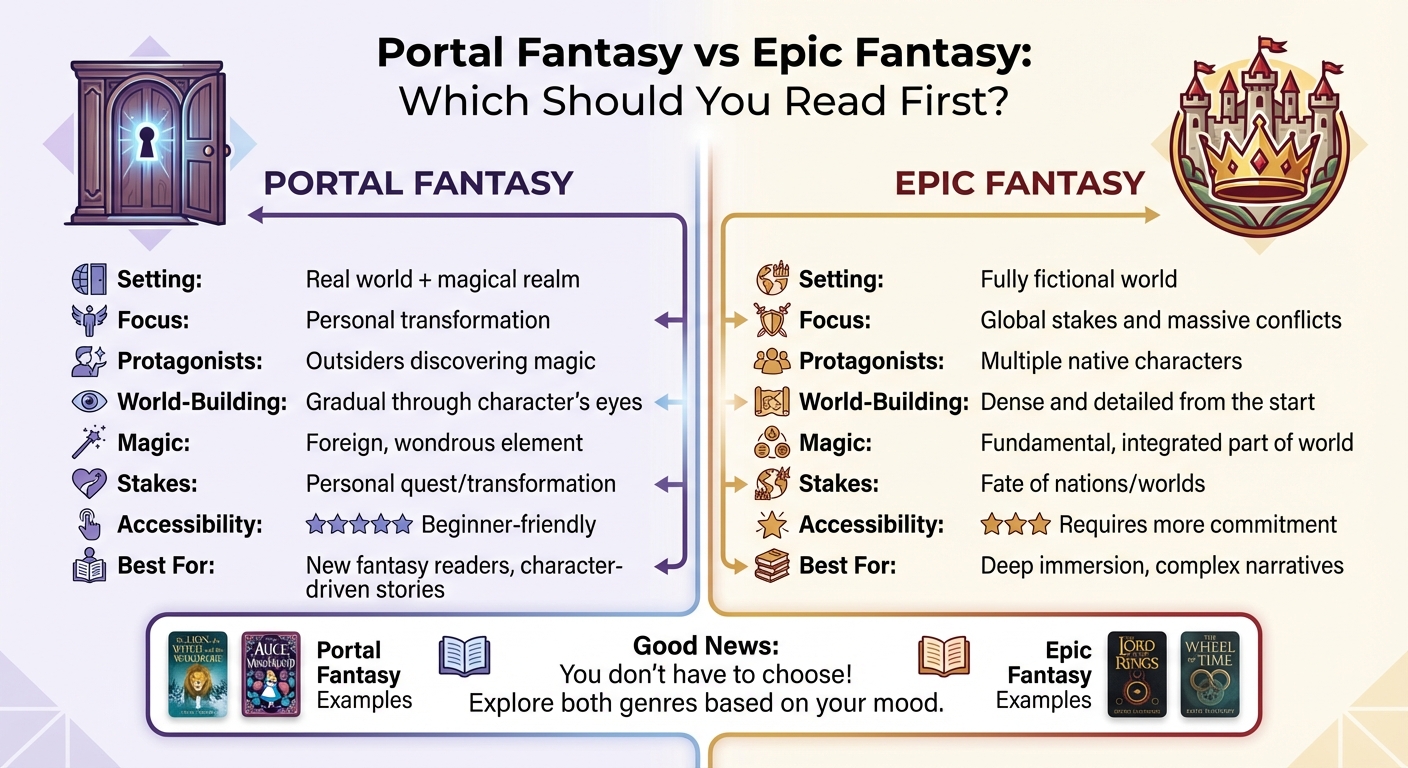
When choosing between Portal Fantasy and Epic Fantasy, it comes down to how you want to experience a story. Portal Fantasy introduces readers to magic through the eyes of a character transitioning from the real world into a magical one. Epic Fantasy, however, immerses you directly into a fully developed fictional universe with high stakes and complex narratives.
Key Differences:
- Portal Fantasy: Starts in the real world, often focuses on personal growth, and gradually introduces magic as the protagonist discovers it.
- Epic Fantasy: Set entirely in a fictional world, with larger stakes, multiple characters, and deeply developed lore.
Quick Comparison:
| Feature | Portal Fantasy | Epic Fantasy |
|---|---|---|
| Setting | Real world + magical realm | Fully fictional world |
| Focus | Personal transformation | Global stakes and massive conflicts |
| Protagonists | Outsiders discovering magic | Multiple, native characters |
| World-Building | Gradual through character’s eyes | Dense and detailed from the start |
| Accessibility | Beginner-friendly | Requires more commitment |
If you're new to fantasy, Portal Fantasy offers an easy introduction with relatable characters. For readers seeking a rich, immersive experience, Epic Fantasy delivers grand quests and complex plots. Both genres offer unique adventures, and you can enjoy them based on your mood or interests.
Portal Fantasy vs Epic Fantasy: Key Differences Comparison Chart
Key Features of Portal Fantasy
Magical Portals and Real-World Contrasts
At the heart of portal fantasy lies the concept of magical gateways - portals that bridge the ordinary and the extraordinary. These portals can appear in all sorts of shapes and forms: a wardrobe that opens into a snow-covered forest, a rabbit hole that plunges into Wonderland, or even a tornado that whisks Dorothy off to Oz. They create striking contrasts between the familiar and the fantastical, whether it's through differing physical laws, societal norms, or logic.
"The portal itself is the story's first 'terms and conditions' agreement with the reader." - AI-Owl
This sharp contrast fuels a sense of wonder and escapism. By starting in a world we recognize, readers are able to share in the protagonist's amazement when they step into the unknown. The nature of the portal also sets the stage for the story: accidental gateways often lead to chaos and self-discovery, while deliberate ones hint at quests for power or knowledge.
Personal Growth and Character Transformation
Portal fantasy isn't just about exploring new worlds - it's about the personal journeys of the characters who cross over. Often, these stories double as coming-of-age tales where protagonists break free from the limitations of their everyday lives and discover who they truly are.
"The 'weirdness' that makes the protagonist an outcast in the real world is precisely what makes them a hero in the new one." - AI-Owl
This transformation is a cornerstone of the genre. Characters who feel out of place in their own world often find purpose and strength in the magical realm. Think of Bastian Bux in The Neverending Story, who learns the power of his imagination, or Aza Rey in Magonia, who thrives in a sky kingdom despite battling chronic illness. These arcs of self-discovery and empowerment are what make portal fantasy so compelling.
Popular Portal Fantasy Books
Some of the most iconic works of portal fantasy have stood the test of time. C.S. Lewis' The Lion, the Witch and the Wardrobe is a classic example, with the Pevensie children stepping through a wardrobe to become Narnia's unlikely heroes. Lewis Carroll's Alice's Adventures in Wonderland uses a rabbit hole as its portal, marking one of the earliest examples of the genre. Meanwhile, L. Frank Baum's The Wonderful Wizard of Oz features a tornado as the accidental gateway that transports Dorothy to a world governed by its own unique set of rules.
For contemporary readers, Sababa Books' The Lifeline Protocol offers a modern twist on portal fantasy, reimagining how portals function and how characters evolve through their journeys. It’s a reminder that while the genre continues to grow and adapt, it still holds onto its core themes of discovery and transformation. Portal fantasy remains a gateway - not just to magical worlds, but to the timeless joy of storytelling.
sbb-itb-2566684
Key Features of Epic Fantasy
Detailed World-Building and Grand Quests
Epic fantasy draws readers into intricately crafted worlds brimming with unique cultures, political systems, and rules that feel as real as our own. These worlds often include rich histories, elaborate magic systems, and backstories that span centuries. The genre thrives on scope and scale, immersing readers in tales that revolve around events capable of reshaping entire nations or even entire races.
Take J.R.R. Tolkien's The Lord of the Rings, for example. Frodo's quest to destroy the One Ring isn't just a personal journey - it's a mission to save all of Middle-earth from plunging into darkness. The stakes in epic fantasy are colossal, and the conflicts ripple across every corner of the story's world.
"To be truly epic a story has to be world-changing. It has to deal with the fates of entire nations and races."
– Gav Thorpe, Author
To fully explore these grand narratives, epic fantasy novels often span over 100,000 words. This length allows for the development of sprawling plots and richly detailed settings. For fans of the genre, this depth isn’t a drawback - it’s part of the appeal. As Brandon Sanderson puts it, epic fantasy offers "a deep sense of immersion and scope".
But the genre isn’t just about vast worlds and monumental stakes. It’s also about the characters who inhabit these worlds and how their lives intertwine with the larger narrative.
Multiple Characters and Layered Storylines
Epic fantasy rarely focuses on just one protagonist. Instead, it employs multiple points of view, allowing readers to see how conflicts ripple through an entire world. George R.R. Martin's A Song of Ice and Fire is a prime example. The power struggles in Westeros unfold through the perspectives of dozens of characters, each with their own motivations, challenges, and intersecting storylines. The result is a narrative that feels as intricate and sweeping as a historical epic.
The characters in epic fantasy often embark on journeys of self-discovery, but their personal growth is tied to events that alter the course of history.
"Epic Fantasy is, at its heart, about meaning and significance. ... The principal characters' lives and actions acquire immense meaning and importance within the pattern of a series of hugely significant events. Their lives matter."
– Victoria Strauss, Author
This combination of personal stakes and world-altering events gives the genre its emotional weight and resonance.
Popular Epic Fantasy Books
These defining elements - grand quests, detailed world-building, and layered storytelling - are brought to life in some of the most iconic works in the genre. Tolkien's The Lord of the Rings remains the gold standard for epic fantasy, setting the bar for world-building and high-stakes storytelling. Robert Jordan’s The Wheel of Time series expanded on this foundation with its massive scope and intricate character arcs. Similarly, Tad Williams’ The Dragonbone Chair tells the story of a young hero on a quest to find ancient swords of power to save Osten Ard from an overwhelming threat.
For modern readers, Sababa Books’ The Gilded Rebellion shows how epic fantasy continues to evolve. While staying true to the genre’s roots - grand scale, high stakes, and immersive storytelling - it also introduces fresh elements that keep the genre relevant. These stories invite readers to lose themselves in worlds where individual actions can have far-reaching, even world-shaking, consequences.
The elements that define epic fantasy lay the groundwork for an intriguing comparison with portal fantasy, which will be explored in the next section.
Reviews / The Fantasy Subgenres: Crossworld/Portal, Comic, and Epic Fantasy / Reading Challenge
Portal Fantasy vs Epic Fantasy: Direct Comparison
Let’s break down the differences between portal fantasy and epic fantasy. Understanding these distinctions - and their occasional overlaps - can help you figure out which genre fits your current reading mood.
One of the most noticeable differences lies in the setting. Portal fantasy begins in our world and transitions into a magical one, creating a dual-world structure. In contrast, epic fantasy is rooted entirely in a fictional realm where magic is woven into the fabric of daily life. This distinction shapes how each story unfolds. Portal fantasy eases readers into the fantastical by starting in a familiar reality, while epic fantasy throws you straight into a richly imagined world.
This difference in setting also influences the narrative’s style and pacing. In portal fantasy, the protagonist’s role as an outsider drives a gradual exploration of the new world. As AI-Owl explains:
"The protagonist's 'fish out of water' status is the engine for natural, gradual exposition. Their first question - 'Where am I, and why is that badger talking?' - is our first question, too".
On the other hand, epic fantasy often immerses readers in a sprawling, intricate world right from the start. Its stories usually revolve around massive-scale conflicts, involving entire nations or even worlds. Claire Vandal, a contributor at Fully Booked, captures this well:
"epic fantasy is a sub-genre defined by its massive scope. In works of epic fantasy, there are usually so many characters you need a chart to keep them straight".
Portal fantasy tends to focus on personal growth, often portraying characters whose "outsider" qualities become their strengths. Meanwhile, epic fantasy operates on a grander scale, with multiple characters and complex plotlines that tackle global stakes.
Here’s a quick comparison to summarize the key differences:
Comparison Table: Main Differences
| Feature | Portal Fantasy | Epic Fantasy |
|---|---|---|
| Setting | Dual: Real world and a magical realm | Single: A completely fictional secondary world |
| World-Building | Gradual discovery; learned alongside the character | Dense and established; deep lore, history, and maps |
| Protagonists | Outsiders/Surrogates (often children or "weird kids") | Natives/Insiders (often multiple POVs and large casts) |
| Stakes | Personal transformation or specific quest | Global/Epic; fate of the world and massive conflicts |
| Magic | A foreign, wondrous, or intrusive element | A fundamental, integrated part of the world |
| Accessibility | High; beginner-friendly due to relatable protagonists | Lower; requires immersion into complex systems |
Portal fantasy is perfect for readers seeking a relatable gateway into magic, while epic fantasy offers a fully immersive experience for those ready to dive into intricate worlds.
Which Should You Read First?
The best choice really hinges on the kind of reading experience you’re looking for. Both portal fantasy and epic fantasy offer unique experiences, but they differ in their storytelling approach and the level of commitment they demand. Let’s take a closer look at how each genre caters to different reader preferences.
For Beginners and a Gentle Introduction
If you’re new to fantasy or just dipping your toes into the genre, portal fantasy is a fantastic place to start. This style of storytelling typically follows a relatable protagonist who begins their journey in the ordinary world before stepping into the extraordinary. It’s a gradual introduction to magic and fantastical elements, making it feel approachable rather than overwhelming.
Since the protagonist learns about the magical world alongside the reader, it’s easy to follow along. The focus often stays on a single character’s personal growth and adventure, which makes it particularly appealing for beginners. For a story that balances emotional depth with thrilling escapades, you might enjoy The Lifeline Protocol from Sababa Books.
For Deep Immersion and Complex Worlds
On the flip side, if you’re ready to dive headfirst into a richly detailed world filled with high stakes and intricate conflicts, epic fantasy might be your perfect match. These stories throw you into a fully developed universe where magic is a fundamental part of life and entire civilizations are at risk.
Epic fantasy is known for its sprawling scope. As Sara Letourneau puts it:
"Scope is what sets epic fantasy apart from other subgenres. The main focus is the plot, allowing the writer to show how the conflict impacts the story world at large".
These novels often run over 100,000 to 120,000 words and feature large casts with multiple perspectives. While they require a bigger time commitment, the payoff is a sweeping narrative where the characters’ actions ripple through kingdoms and cultures. For those ready to immerse themselves in layered storytelling, The Gilded Rebellion from Sababa Books delivers intricate world-building and a gripping, complex plot that epic fantasy enthusiasts will love.
Conclusion
Deciding between portal fantasy and epic fantasy comes down to the kind of adventure you're in the mood for. Portal fantasy provides a softer introduction, blending gradual world-building with a focus on personal growth - ideal for readers who enjoy character-driven stories. On the other hand, epic fantasy plunges you into a vast, high-stakes world filled with intricate plots and multiple viewpoints, perfect for those craving a deeper, more layered narrative.
If you're drawn to tales where personal transformation takes center stage, portal fantasy is a great choice. But if you're ready to immerse yourself in a sweeping saga where individual decisions can shape entire worlds, epic fantasy delivers that level of complexity and immersion. Both genres cater to different tastes, offering unique ways to experience imaginative storytelling.
And here's the best part: you don't have to pick just one. You can explore both genres as your interests evolve. Sababa Books makes it easy, with a curated selection that includes portal fantasy adventures like The Lifeline Protocol and epic fantasy series such as The Gilded Rebellion. Whether you're in the mood for a quick escape or a deep dive into a richly crafted universe, you'll find stories that perfectly match your reading journey.
FAQs
Why is portal fantasy often easier to start with than epic fantasy?
Portal fantasy tends to be a great starting point for newcomers because it begins in a familiar, real-world setting before easing into the magical and mysterious. This gradual shift helps readers adjust to the fantastical elements without feeling overwhelmed. The stories often emphasize themes like personal growth, adventure, and the discovery of magic, making them straightforward and enjoyable to follow.
On the flip side, epic fantasy is known for its sprawling worlds, large casts of characters, and intricate plots. While these stories can be deeply rewarding, they might feel intimidating for someone diving into fantasy for the first time. Starting with portal fantasy offers a gentler introduction to the genre, allowing readers to explore its core themes without immediately tackling the complexity of epic fantasy.
How is magic used differently in portal fantasy and epic fantasy?
Magic in portal fantasy often acts as a bridge, connecting the mundane world to a fantastical one. Unlike the intricate systems you might find in other genres, this magic leans more on mystery and wonder. Its primary role is to create that stark contrast between the ordinary and the extraordinary, serving as the mechanism that pulls characters - and readers - into a whole new universe.
In epic fantasy, magic takes on a much more integrated role within the world itself. It’s woven into the very fabric of the story, often governed by detailed rules, ancient lore, or specific systems. Magic here isn’t just a tool; it’s a driving force that shapes the plot, characters, and conflicts. You might encounter ancient prophecies, legendary artifacts, or the timeless struggle between good and evil. While portal fantasy uses magic to transport characters between worlds, epic fantasy makes it an essential part of the universe it creates.
What makes epic fantasy a great choice for an immersive reading experience?
Epic fantasy offers an unparalleled reading experience, pulling readers into vast, meticulously crafted worlds filled with layered plots and dynamic characters. These stories often weave together detailed histories, intricate societies, and immersive settings, making the fictional universe feel alive and tangible.
For those who love diving into complex narratives and exploring magical realms, this genre hits the mark. Its depth and intricacy provide not just an escape from reality but also ignite the imagination, delivering a deeply engaging and satisfying journey for readers craving a more involved and enriching tale.