
How Magic Evolves in Progression Fantasy
Progression fantasy focuses on characters growing stronger through structured systems, with magic playing a central role in their journey. Unlike traditional fantasy, this genre emphasizes measurable growth, like levels or ranks, as the core of the story. Evolving magic systems ensure the narrative stays engaging by linking power growth to effort, emotional development, and increasing challenges.
To design effective magic systems, follow these principles:
- Set clear rules and limits: Define what magic can and cannot do.
- Build scalability: Introduce stages or milestones that track growth.
- Tie magic to the world: Ensure magic impacts society, economy, and culture.
- Balance power with costs: Scale costs - physical, moral, or material - as abilities grow.
Examples like Lord of the Mysteries, The Stormlight Archive, and Shadow Slave show how evolving magic systems shape stories, making growth feel earned and meaningful. These systems rely on effort, emotional breakthroughs, and well-defined rules to keep readers invested.
10 UNDERRATED Magic System Trends We Need More Of
sbb-itb-2566684
Basic Principles for Designing Evolving Magic Systems
Creating a magic system that grows with your characters involves more than just flashy, powerful spells. The foundation relies on three key elements: a clear source (like internal energy, external forces, or divine intervention), costs (such as physical tolls, rare materials, or moral dilemmas), and limitations (what magic simply cannot do). These elements work together to create a system that feels both powerful and grounded.
As Brandon Sanderson points out, well-defined limitations encourage inventive problem-solving. When magic has boundaries, characters are forced to think outside the box to overcome obstacles. This makes victories feel earned rather than handed out through convenient plot twists. For instance, if magic in your world can't resurrect the dead or read minds, characters must find alternative, often more engaging, ways to tackle these challenges.
To avoid the problem of "power creep", establish a clear power ceiling early on. Instead of characters endlessly gaining strength, focus on refining their skill and precision. For example, a novice might throw a simple fireball, while a seasoned expert could manipulate heat on a molecular level or create invisible flames. This approach keeps growth meaningful without letting the system spiral out of control.
Magic should also be deeply intertwined with your world’s social, economic, and political systems. If magic has the power to heal injuries or instantly transport goods, it would drastically reshape medicine, trade, and other societal functions. Use a "Ripple Effect" analysis to think through how magic impacts areas like agriculture, law enforcement, and construction. If magic doesn’t replace traditional methods, establish clear reasons why. This integration ensures magic feels essential to the world rather than an afterthought.
The following sections break down these principles into actionable steps.
Set Clear Rules and Limits
Rules are the backbone of a magic system, building trust between the writer and the reader. When magic operates consistently, readers can follow the logic, anticipate outcomes, and understand the stakes. Magic that can do everything becomes dull, while magic without costs or rules eliminates tension. The trick is to define what magic cannot do - these boundaries push characters to solve problems creatively and prevent them from using magic as a shortcut.
To test your system, try the "Smart Enemy Test": imagine how a clever antagonist might exploit loopholes or break the rules. If they can easily bypass your system, it likely needs stronger constraints. Similarly, apply the "Mundane Solution Test": if a problem could be solved more effectively without magic, then your system isn’t well-integrated into the narrative.
Avoid the trap of "Protagonist Exception Syndrome", where the hero conveniently sidesteps the rules or costs that apply to everyone else. Unless there’s a strong, established reason within the story, your main character should face the same challenges as other magic users. This consistency keeps readers engaged and makes the protagonist’s triumphs feel earned.
A helpful tool is the "Spreadsheet Test": create a chart listing all abilities, their sources, costs, limitations, and power levels. This can help you catch contradictions early and maintain consistent scaling throughout the story.
Build in Scalability and Progression
A great magic system should grow in power and complexity without breaking the story. One way to achieve this is by establishing a hierarchy of stages or milestones—common in LitRPG and GameLit— - such as apprentice, journeyman, and master - that clearly track character growth. These levels help readers understand a character’s progress and set up future challenges.
Sanderson’s Third Law advises, "Expand what you already have before adding something new". Instead of introducing endless new abilities, focus on deepening the ones you’ve already established. A few well-developed powers are far more engaging than a long list of shallow ones. This also keeps your system from becoming overly complicated or confusing for readers.
Foreshadow advanced abilities early in the story. When a character reaches a new level of power, it should feel like a natural progression rather than a sudden, convenient leap. This avoids Deus Ex Machina moments that can undermine the story’s tension.
Show a gradual learning curve. Characters should experience setbacks and failures as they grow, making their eventual successes more satisfying. Readers connect more deeply with characters who struggle and evolve over time rather than those who achieve mastery overnight.
As characters become more powerful, the costs of using magic should scale accordingly. High-level spells might come with unique conditions - like only working under specific circumstances or against certain foes - to maintain balance. A spell that nearly kills a character early on shouldn’t be used casually later without showing significant growth or sacrifice.
Connect Magic to Story and World
To make magic feel integral to your story, it should be so deeply woven into the world that the plot couldn’t exist without it. If you can remove magic without fundamentally altering the story, it risks being little more than a decorative element. Instead, magic should shape character choices, drive conflicts, and influence the world’s culture.
Design your magic system to create conflict rather than solve it. For example, magic might come with steep sacrifices, corrupt the user over time, or force morally complex decisions. These costs create tension and push characters into difficult situations that reveal their values. Imagine a scenario where powerful magic drains years of life or compromises a character’s morality - this adds layers of intrigue and raises the stakes.
Magic also shapes social hierarchies. Hereditary magic could lead to caste systems, while rare magic might create an elite class or spark persecution of those with abilities. If magic is widespread, it could become a common skill, reshaping education and daily life. On the other hand, if it’s rare, you’ll need to justify its scarcity and consider how it affects those who wield it.
Think about how magic impacts the economy and politics of your world. If magic can heal, it would revolutionize medicine and warfare. If it enables teleportation, it would transform trade and travel. These ripple effects make your world feel authentic and lived-in, where magic has shaped society over centuries rather than existing in isolation. This deep integration ensures that your evolving magic system supports character development and enriches the story at every turn.
Common Magic Progression Mechanics
When creating evolving magic systems, three core progression mechanics often stand out: level-based magic, tiered advancement, and cultivation stages. Each offers unique ways to tie character growth to both narrative tension and world-building.
Level-Based Magic
Level-based systems rely on characters gaining experience points (XP) through activities like combat, quests, or training. These points translate into numeric level-ups, such as progressing from Level 1 to Level 99. This approach is a staple in LitRPG stories, where stat sheets often display traits like strength, intelligence, or mana capacity. The appeal lies in its clarity - each level-up delivers that satisfying "numbers go up" moment, which keeps readers engaged.
However, systems with excessively high level caps, like Level 999, can make individual level-ups feel less impactful unless they unlock unique skills or significant stat boosts. Andrew Rowe, author of Arcane Ascension, highlights a potential pitfall:
"Characters constantly beating higher-level opponents can be awesome to some people, but hugely off-putting to others, as it may make levels feel irrelevant".
To maintain tension, consider using a smaller level range (e.g., 1 to 20) and ensure that each level unlocks meaningful story changes. For instance, increased stats should visibly affect the character's abilities and interactions, rather than being abstract numbers in the background.
Tiered Advancement
Tiered systems replace numeric levels with named ranks or titles, such as Copper, Iron, Jade, or Gold. These ranks are achieved less frequently, making each advancement feel like a major event. Will Wight's Cradle series, which has garnered millions through crowdfunding by 2025, showcases how tiers can blend seamlessly with world-building and power hierarchies.
One challenge with tiers is the large power gap between ranks. For example, in Arcane Ascension, each rank can represent a 1.5x to 2x increase in power. This can make it tricky to justify lower-tier characters holding their own against higher-tier opponents, potentially sidelining key characters. To address this, consider using differentiated attribute scaling - allowing specific traits, like speed or defense, to grow at different rates. This lets lower-tier characters remain relevant by excelling in niche areas, such as agility or strategy.
Another way to keep things balanced is by introducing trials, rare resources, or revelations as prerequisites for advancement. These obstacles not only heighten tension but also make each new tier feel earned.
Cultivation Stages
Cultivation stages focus on inner growth, requiring characters to refine their body, mind, and spirit through meditation, training, and moments of enlightenment. Progression often hinges on overcoming "bottlenecks" - challenges that test a character's willpower and understanding. This system ties power growth directly to personal development, making advancements feel like transformative milestones rather than just grinding for XP.
The downside? Repetition. If the story leans too heavily on meditation or training montages, progression can feel monotonous. To keep readers engaged, mix up the sources of growth. Balance traditional techniques (like clan or sect teachings), physical training, and spiritual epiphanies to create variety. Sunny Sain, a writer on Royal Road, offers this advice:
"If progression beat equals character development beat, your pacing will be snappier. Gating progression behind character revelations and growth can be really satisfying".
How to Design Evolving Magic Systems
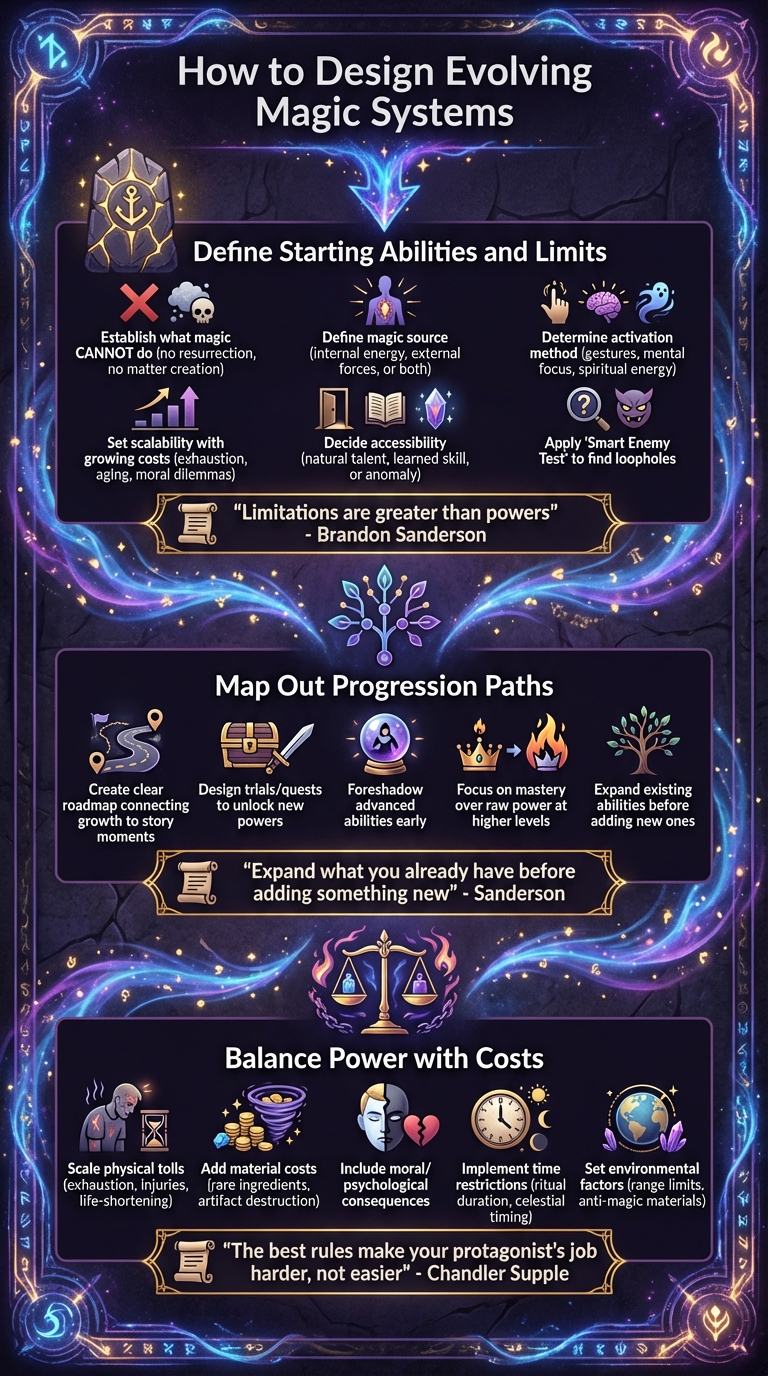
3-Step Framework for Designing Evolving Magic Systems in Progression Fantasy
Creating evolving magic systems can be a rewarding challenge. To keep things balanced and engaging, follow a three-part approach: define the starting point, map out how magic progresses, and ensure that every increase in power comes with a meaningful cost. This structure keeps the system grounded while allowing for growth and complexity.
Step 1: Define Starting Abilities and Limits
The first step is to establish what magic cannot do. As Brandon Sanderson, author of the Mistborn series, famously said:
"Limitations are greater than powers".
Clear boundaries - like forbidding resurrection or the creation of matter - prevent magic from becoming an easy solution to every problem. These limits not only shape the story but also help maintain tension.
Next, decide where magic comes from and how it works. Does it draw from internal energy, external forces, or both? Does it require gestures, mental focus, or spiritual energy to manifest? And what exactly can it do - heal, manipulate elements, or alter gravity? Rita Melkonian, founder of Quill&Steel, offers a critical reminder:
"If your magic could be removed without changing your story, it's not doing enough work".
Scalability is key. Introduce costs that grow with power use, such as physical exhaustion, aging, or even moral dilemmas. Consider who can wield magic: Is it a natural talent, a learned skill, or an unpredictable anomaly? Finally, establish an upper limit early on to keep abilities in check and avoid runaway power escalation. Use the "Smart Enemy Test" to identify potential loopholes - if an antagonist could exploit the system, tighten the rules.
With these foundations in place, you’re ready to chart the system’s growth.
Step 2: Map Out Progression Paths
Once the starting rules are set, plan how magic evolves. Develop a clear roadmap that connects growth to pivotal moments in the story or character development. As Sanderson advises:
"Expand what you already have before adding something new".
This means that even advanced users rely on the same core abilities as beginners but with greater mastery and creativity.
Progression should feel earned, not handed out. Design trials or quests that characters must complete to unlock new powers. Introduce hints about higher-level abilities early on, so their eventual appearance feels natural rather than abrupt. As characters grow stronger, shift the focus from raw power to skill and ingenuity. For example, a seasoned mage might manipulate fire with surgical precision rather than overwhelming force.
Once you’ve mapped out the evolution, balance each new ability with costs to maintain tension and stakes.
Step 3: Balance Power with Costs
As magic grows stronger, the associated costs should scale as well. These could include physical tolls like exhaustion or injuries, or even life-shortening consequences. Material costs - such as rare ingredients or the destruction of artifacts - add another layer of complexity, while moral and psychological consequences deepen the narrative. For instance, a character might wrestle with guilt after using magic that requires a human sacrifice.
Time restrictions also work well. Long ritual durations or specific timing (like a rare celestial event) can prevent magic from being an easy fix. Chandler Supple, co-founder of River, emphasizes this point:
"The best rules make your protagonist's job harder, not easier".
For example, a powerful spell might incapacitate the caster for days, making it a last-resort option. Environmental factors - like limited range, duration caps, or anti-magic materials - can also add strategic layers to the system.
Examples of Evolving Magic in Progression Fantasy Novels
Looking at how well-known authors develop magic systems can shed light on the principles behind evolving magic. These examples highlight how structured rules and meaningful costs shape character growth. Three standout novels - Lord of the Mysteries, The Stormlight Archive, and Shadow Slave - each showcase unique approaches to evolving magic, emphasizing that power is never handed out freely and always comes with a price.
Potion Consumption in Lord of the Mysteries
In Lord of the Mysteries, magic is organized into 22 "Pathways", each consisting of 10 "Sequences", ranging from Sequence 9 (the weakest) to Sequence 0 (godhood). Advancing along these Pathways requires characters to consume special potions. But drinking a potion isn’t enough - characters must also act in ways aligned with their Sequence’s principles to "digest" the potion and avoid losing control. For instance, a Seer must perform divinations to properly integrate the potion's effects. This "Acting Method" reinforces the idea that magical growth must be earned through effort and comes with risks.
As characters reach higher Sequences, the stakes rise. Advancement rituals become necessary to handle the escalating supernatural burden. At Sequence 3 and beyond, they need "anchors" - such as the faith or perception of others - to prevent their humanity from being overtaken by the godlike traits of high-level magic. The Lord of Mysteries Store encapsulates this struggle:
"The path of a Beyonder is one of constant tension - between power, responsibility, and the loss of self".
Surges and Oaths in The Stormlight Archive
In The Stormlight Archive, magic progression revolves around the Nahel bond, a partnership between a character and a sentient spren. Unlocking new abilities, called "Surges", requires characters to swear Ideals or Oaths that reflect genuine personal growth. The First Ideal is universal: "Life before death, strength before weakness, journey before destination." Subsequent Oaths are specific to each character's journey and their Order of Knights Radiant.
This system ensures that power is tied to internal transformation. Characters gain new abilities only by demonstrating moral and emotional growth. For example, mastering their two assigned Surges allows characters to unlock "Resonances" - unique passive abilities that result from the combination of their powers. Windrunners, for instance, gain the ability to attract more squires as they advance. However, this power comes with a cost: excessive use of Surges can lead to "savantism", a condition with lasting physical or spiritual consequences.
Skill Evolution in Shadow Slave

Shadow Slave leans into LitRPG-style progression, where character growth is tracked through clear game-like mechanics. The protagonist’s abilities evolve through status screens, stats, and skill notifications. This transparent system makes progression easy to follow, letting readers see exactly how a character grows stronger and what new capabilities they unlock. It also reinforces that progress comes from effort and strategy, not just passive accumulation of experience points.
From potion consumption to oath-sworn transformations to stat-based growth, these examples highlight how evolving magic systems bring depth and structure to progression fantasy. Each approach ensures that power is earned and that the journey toward it is as compelling as the destination.
Conclusion: Building Magic Systems That Grow with Characters
Creating a magic system that evolves alongside your characters requires balancing three key elements: clear sources (where the power originates), meaningful costs (what characters must sacrifice), and defined limitations (what magic cannot achieve). These principles anchor your system, ensuring it remains believable even as characters grow stronger. Without these boundaries, magic risks becoming a convenient tool rather than a meaningful part of the story.
As your characters develop, their relationship with magic should deepen. Early on, abilities might be raw and straightforward, but over time, they should become more nuanced. For example, a novice fire mage might only hurl fireballs, while a seasoned master could manipulate combustion at a molecular level or even freeze objects by removing heat. This progression mirrors character growth and keeps the magic engaging. Brandon Sanderson's advice is especially relevant here:
"An author's ability to solve conflict with magic is directly proportional to how well the reader understands said magic".
To avoid overwhelming your story with unchecked power, establish a clear power ceiling early on. Define an ultimate goal - like mastering a specific element - to keep the narrative focused and prevent endless escalation. As River Editor insightfully points out:
"The best rules make your protagonist's job harder, not easier".
Test your system’s integrity by applying the "Smart Enemy Test." Imagine an antagonist who exploits every loophole in your magic system. If they could unravel your story by combining abilities in unexpected ways, it’s time to tighten the rules. Introduce conditions for advanced abilities, such as requiring specific environments, elaborate rituals, or binding oaths. These constraints add strategy and ensure magic complements the story rather than overshadowing it.
Lastly, let your magic shape the world beyond battles. If magic can heal wounds or enable teleportation, consider how these abilities impact the economy, warfare, and daily life. A magic system that influences the world adds depth and makes your setting feel alive. As Rita Melkonian, Founder of Quill&Steel, aptly says:
"If your magic could be removed without changing your story, it's not doing enough work".
FAQs
How do I stop magic progression from breaking my story?
To keep magic progression from throwing your story off balance, it's crucial to establish clear rules and firm limits for your magic system. This approach prevents characters from becoming overpowered and ensures the story remains engaging and well-structured.
Start by defining how magic evolves in your world. Set growth boundaries that maintain consistency and introduce weaknesses or limitations. These restrictions help ground the magic system, making it feel more believable and aligned with the plot.
Consider strategies like:
- Limiting the extent of magical powers.
- Introducing a hierarchy within the magic system.
- Ensuring the magic integrates naturally into the story's world.
By keeping these elements in check, you can preserve tension and avoid letting magic overshadow the narrative.
What’s the best way to make power-ups feel earned, not random?
To make power-ups feel rewarding, establish a clear progression system with consistent rules, well-defined costs, and reasonable limitations. Emphasize effort, practice, and meaningful challenges to keep players engaged. A balanced progression curve - where greater rewards demand more effort - helps reinforce the sense of accomplishment. When growth is tied to hard work and smart decision-making, power-ups become satisfying milestones rather than random perks.
How should magic reshape a world’s economy and politics?
Magic in progression fantasy isn't just about spells and power; it reshapes entire economies and political landscapes. It can spark the birth of new industries, change how resources are distributed, and redefine societal roles. This can lead to periods of growth - or, on the flip side, deepen inequality.
On the political front, magic often becomes synonymous with power. Those who master it can wield significant influence, sometimes controlling governments or dominating factions. Disputes over magical resources or knowledge can ignite unrest, while societal structures may fracture, giving rise to stratification or even revolutions. Magic, in these worlds, isn't just a tool - it's woven into the very fabric of how societies function and evolve.