
New Fantasy Reader Checklist: 7 Things to Know
Diving into fantasy genres like LitRPG and progression fantasy can feel overwhelming, but understanding the basics makes the experience rewarding. Here's a quick guide to help you navigate these stories:
- Core Tropes: Recognize recurring elements like "The Chosen One" or "The Quest" to quickly connect with the story.
- Magic Systems: Learn the difference between structured (hard) and mysterious (soft) magic, and how they impact storytelling.
- Game Mechanics: LitRPG blends fantasy with video game elements like stats, levels, and skill trees.
- World-Building: Focus on maps, key locations, and active story areas to avoid getting lost in dense lore.
- Character Growth: Track steady, measurable progress in skills and abilities, often central to these genres.
- Genres Explained: LitRPG uses game-like interfaces, while progression fantasy emphasizes skill mastery without relying on stats.
- Complex Narratives: Manage multiple characters and viewpoints with tools like notes or relationship maps.
These tips will help you enjoy immersive and detailed fantasy worlds without feeling overwhelmed.
LitRPG vs Progression Fantasy: Key Differences Explained
LitRPG Explained: 5 Must-Know Elements For New Readers
sbb-itb-2566684
1. Know the Basic Fantasy Tropes
Fantasy thrives on tropes - recurring themes that help define characters and storylines. Think of them as storytelling shortcuts that make it easier to dive into unfamiliar worlds. Editor John I. highlights how these tropes quickly establish character roles, making it easier for readers to connect with the story.
Some of the most recognizable tropes include The Chosen One (a seemingly ordinary individual destined for greatness), The Dark Lord (a villain embodying pure evil), The Mentor (a wise guide who helps the hero prepare for their journey), and The Quest (a mission to achieve a specific goal, like destroying a dangerous artifact). These elements are staples of fantasy because readers have come to expect - and enjoy - seeing them in action.
Let’s explore how these tropes shape both heroic stories and game-inspired narratives.
1.1 Hero's Journey and Quest Stories
The Hero's Journey is the backbone of many fantasy tales, following a 12-step structure that begins in the ordinary world and ends with the hero returning home, transformed. The story typically kicks off with an event that disrupts the protagonist's normal life, such as a prophecy, an invasion, or a mysterious challenge. Once the "point of no return" is reached, the hero embarks on a quest, faces trials, gathers allies, and ultimately confronts the villain.
In progression fantasy, this classic arc gets a twist. Instead of focusing solely on abstract personal growth, these stories emphasize measurable advancement. Heroes climb through defined ranks - like Copper, Iron, or Jade - or level up through intense training and battles. Here, the narrative revolves around accumulating power in a clear, trackable way.
1.2 Game-Like Elements in LitRPG
LitRPG takes fantasy storytelling in a different direction by blending traditional tropes with video game mechanics. This genre introduces RPG stats like strength, intelligence, and damage points, which play a central role in the plot. The Hero's Journey becomes a literal game progression, where characters start in tutorial-like settings, fight bosses, and earn loot. Even the classic mentor figure is reimagined as an "Old Man Mentor" who explains skill trees and game rules.
What sets LitRPG apart is its focus on making progress tangible. The "Novice to Expert" trope is visualized through stat screens, skill upgrades, and level-ups. This approach has resonated with readers - so much so that by January 2020, Aleron Kong's The Land: Monsters reached the Wall Street Journal bestseller list for Fiction E-Books. By turning character development into something measurable, the genre delivers a sense of achievement with every victory.
Understanding these tropes lays the groundwork for diving deeper into magic systems, world-building, and character evolution.
2. Learn How Magic Systems and Game Mechanics Work
Understanding how magic operates in fantasy stories is a key step. Authors generally take two approaches: some craft detailed, logical rules for their magic systems, while others leave magic shrouded in mystery. LitRPG goes a step further, transforming magic into a structured game system with stats, levels, and progression.
Why does this matter? It helps you grasp the stakes and the options available to characters. As Brandon Sanderson famously said:
"An author's ability to solve conflict with magic is directly proportional to how well the reader understands said magic".
When the rules are unclear, victories can feel hollow - like the story is relying on shortcuts. Clear systems, on the other hand, set the foundation for engaging conflicts and satisfying resolutions.
2.1 Hard vs. Soft Magic Systems
Hard magic systems come with clear, defined rules. You know exactly what the magic can do, its costs, and its limits. Think of it like science - specific actions lead to predictable outcomes. A prime example is Brandon Sanderson's Mistborn series, where characters gain powers by "burning" specific metals.
Soft magic systems, in contrast, are more mysterious. The rules are vague or undefined, creating an air of wonder or danger. Gandalf’s abilities in The Lord of the Rings are a classic example - you’re never quite sure what he can or can’t do. Sanderson points out:
"The really good writers of soft magic systems very, very rarely use their magic to solve problems in their books. Magic creates problems, then people solve those problems on their own without much magic".
The choice between hard and soft magic systems shapes the story. Hard magic allows for logical problem-solving, while soft magic heightens tension and atmosphere without offering easy solutions. Often, the limitations of magic push characters to find creative solutions.
2.2 Game Mechanics in LitRPG
Once you understand magic systems, you can dive into how LitRPG transforms these rules into interactive game mechanics.
LitRPG takes the structure of hard magic and gives it a video game twist. Characters monitor stats like XP, strength, and intelligence in real time. These aren’t abstract ideas - they’re tangible numbers displayed on status screens.
The genre’s defining mechanics emerged in late 2013 during a brainstorming session between author Vasily Mahanenko and editors at Russian publisher EKSMO. Fans love the "Numbers Go Up" loop - the same addictive satisfaction that made World of Warcraft a global phenomenon with over 10 million players at its peak.
Knowing whether a story uses hard magic, soft magic, or game-like mechanics helps you focus on the right details. It also sets expectations for how challenges will be tackled and resolved as the hero faces their toughest moments.
3. Handle Complex World-Building
Diving into fantasy worlds can feel like stepping into uncharted territory. You're suddenly faced with unfamiliar kingdoms, strange customs, and names that seem impossible to pronounce. But here's the thing: you don’t have to memorize every single detail right away. Once you get a handle on the basics - like common tropes and mechanics - you can focus on how the world shapes the story. Most authors reveal their worlds gradually, and with a few simple tricks, you can stay grounded without getting lost in the lore.
Start with the map. If the book includes one, make it your best friend. Maps aren't just pretty illustrations - they show how territories connect and why conflicts arise. For example, natural barriers like mountains or rivers often explain why certain kingdoms stay isolated or why trade routes are so critical. While tools like Inkarnate or World Anvil can provide extra clarity, the map in the book is usually all you need.
Keep a quick-reference list. Jot down character names, places, and unfamiliar terms as you go. A phonetic glossary can also help with tricky naming conventions. You don’t need anything fancy - a notebook page or notes app will do. Focus on the "active worldbuilding area", meaning the part of the world where the story is currently unfolding. Trying to track the entire universe at once is a recipe for frustration.
Embrace a little confusion. Authors often use the "Iceberg Method", where only 10% of the world’s details are visible to readers while the rest stays in the author's notes. Trust that the story will reveal what you need when you need it. As Rita Melkonian, Founder of Quill&Steel, puts it:
"Reveal worldbuilding details through character actions, dialogue, and observations rather than narrative exposition".
Pay attention to cultural markers. Each society in a fantasy world has its own values, customs, and taboos. Some might prioritize honor, others wealth or magic. Look for these cues in dialogue, traditions, and conflicts - they often reveal how geography shapes survival and societal values. Spotting these patterns can help you distinguish between groups without needing to memorize extensive backstories.
3.1 Track Detailed Settings
Keeping track of locations doesn’t have to be overwhelming. Instead of cataloging every single place mentioned, focus on the ones tied to the current plot.
Use the book’s built-in tools. Many fantasy novels include glossaries, appendices, or character lists in the back. Bookmark these sections and refer to them whenever you hit an unfamiliar term. If you’re reading digitally, the search function can be a lifesaver - just type in the name of a location or character to find earlier mentions.
Set up a simple tracking system. Prefer taking notes? Keep them in one centralized spot. Whether it’s a notebook or a digital app, consistency is key. List locations alongside their role in the plot and any related characters. If you’re using digital tools, stick to consistent formatting so you can easily search for details later.
Don’t overdo it. Janet Forbes, CEO of World Anvil, has a warning for writers that applies just as much to readers:
"The setting should support the story. It's easy to let worldbuilding become a form of procrastination by endlessly building out elements that don't serve your story or game".
As a reader, this means you don’t need to know every historical detail or geographical feature - just enough to keep up with the narrative. If a location hasn’t come up in a while, it’s okay to let those details fade until they’re relevant again.
By focusing on the settings that matter, you’ll have a solid foundation for understanding the diverse societies and cultures that come next.
3.2 Understand Different Societies and Cultures
Fantasy worlds often feature a mix of societies with clashing values, customs, and power structures. Recognizing these differences not only makes the story more engaging but also helps you understand why characters behave the way they do.
Spot core values and hierarchies. Each society prioritizes something different. One kingdom might revere hereditary nobility, while another rewards magical ability or religious devotion. Pay attention to who holds power and why - it often explains political conflicts. Similarly, notice what behaviors are celebrated or condemned. Taboos, in particular, reveal what a society fears or rejects.
See how geography shapes culture. The environment plays a huge role in daily life. A society living in constant darkness might worship the moon, while island nations often develop rich maritime traditions. Everything from architecture to military strategies reflects environmental pressures. Once you understand the “what if” premise of a society - like “What if sunlight is deadly?” - its customs start to make sense.
Follow naming patterns and language. Authors often use names to hint at a character’s origin. Some cultures might name children after virtues or natural elements, while others include lineage markers. Speech patterns, slang, and the distinction between formal and informal language can also signal a character’s social class or region. These linguistic clues help you place characters within the world without needing lengthy explanations.
Pay attention to economies and resources. What a society trades often reveals its priorities and vulnerabilities. Whether it’s dragon scales, magical artifacts, or rare minerals, these resources shape economies and power dynamics. Understanding what’s scarce or valuable in each culture can explain alliances, rivalries, and underlying tensions. As one worldbuilding guide points out, the logistics of how a society feeds itself and maintains trade routes often determine its stability and ambitions.
4. Follow Character Development
Character growth is the heart of progression fantasy and LitRPG. Unlike traditional fantasy, where characters often gain power suddenly, these genres emphasize steady, measurable progress. Every skill mastered becomes a permanent part of the character's arsenal.
Growth unfolds in stages. Characters usually start by mastering basic skills through consistent effort. Over time, they build on that foundation, combining abilities in inventive ways. This journey isn’t always smooth - it’s marked by plateaus and moments of revelation that redefine how they understand their power.
A key aspect of this growth lies in distinguishing what a character wants (like defeating a rival or finding a magical artifact) from what they need (such as self-worth, safety, or validation). The most rewarding arcs happen when a character confronts and resolves this deeper need, often through a pivotal crisis that forces them to choose between clinging to old habits or embracing change. As developmental editor Fija Callaghan explains:
"The most interesting characters are always ones who transform in some way from beginning to end".
This emphasis on deliberate, step-by-step development creates a natural bridge between storytelling and game mechanics.
4.1 How Heroes Grow and Change
In these genres, protagonists earn their power through dedication and effort - not by sheer luck. They start from scratch and gradually build their strength through rigorous training and well-defined magic systems.
Pay attention to training arcs. Training arcs often involve meditation, physical conditioning, or studying core principles. These scenes aren’t just about skill-building; they reveal traits like determination, creativity, or even desperation. When characters hit a wall in their progress, how they respond - whether by seeking a mentor, experimenting with new methods, or pushing through setbacks - shapes their identity.
Notice structured skill progression. Growth in progression fantasy follows a clear path: establishing a foundation, developing new abilities, and eventually combining those skills in inventive ways. Unlike traditional fantasy, where old powers might fade into the background, progression fantasy ensures that every skill remains relevant. Neglecting these abilities can signal inconsistencies in the writing.
Look for earned breakthroughs. The genre term "progression fantasy" was coined in 2019 by authors Andrew Rowe and Will Wight to describe stories focused on intentional, measurable power increases. By 2025, the genre had gained mainstream appeal, with Will Wight's Cradle series raising millions through crowdfunding. When characters achieve a breakthrough - like advancing to a new rank - it should feel deserved, with readers witnessing the struggles, failures, and sacrifices along the way.
Recognize growth beyond combat. As characters gain power, brute strength alone often isn’t enough to solve every problem. Watch for moments that require negotiation, strategic thinking, or resisting the lure of power itself. These challenges highlight whether a character is becoming wiser and more resourceful - not just stronger.
As the hero evolves, the supporting cast and antagonists add depth to the story.
4.2 Villains and Supporting Characters
Well-crafted antagonists and supporting characters enrich the narrative. The best villains often see themselves as the heroes of their own stories, making their motivations more compelling.
Understand villain archetypes. Villains often fall into familiar categories like "Dark Lords" (symbols of pure evil) or "Fallen Heroes" (warnings about the dangers of unchecked power). Reluctant villains - those who act out of necessity or hesitation - tend to be more nuanced, reflecting ethical dilemmas that resonate with real-life struggles. Consider their backstories: What drives their choices? What are they afraid of? What do they desire?
Explore mentor dynamics. Mentors play a crucial role in guiding the protagonist’s growth. However, a good mentor doesn’t solve the hero’s problems for them. As fantasy editor Lesley Jones notes:
"The protagonist must be the one who takes action in the climax of the story. The lessons are proven true - and they can only do this without their mentor".
If a mentor is still stepping in to save the day by the story’s end, it’s a sign the hero hasn’t truly grown.
Notice character foils. Supporting characters who remain static can serve as mirrors, highlighting how much the protagonist has changed. A companion who clings to their old worldview underscores the hero’s transformation. Others may grow in contrasting ways, creating tension or offering alternative perspectives on the challenges faced.
5. Tell LitRPG and Progression Fantasy Apart
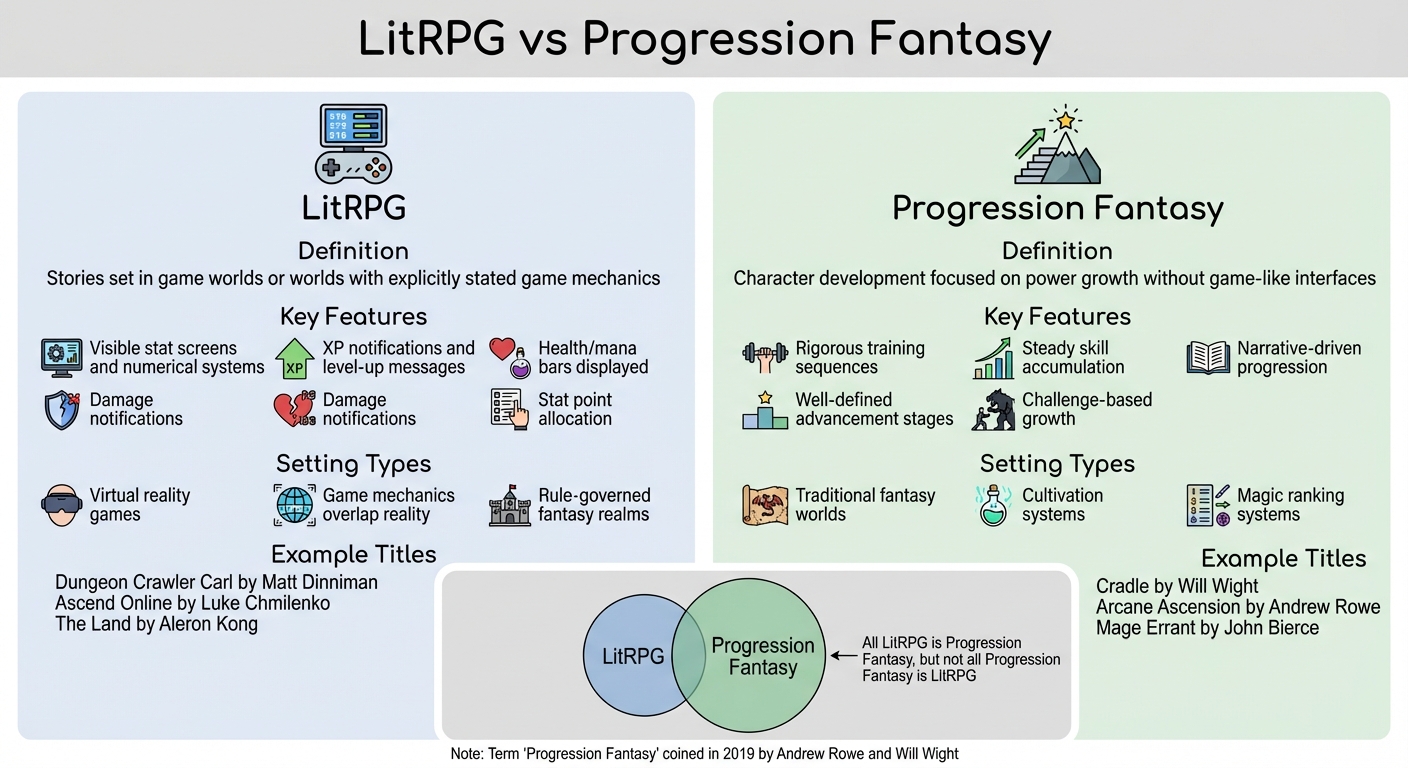
While both genres share a focus on character growth, they diverge in how that progress is presented. LitRPG is technically a subset of progression fantasy - every LitRPG involves character advancement, but not all progression fantasy stories incorporate game mechanics. Progression fantasy often highlights skill mastery and training over time, while LitRPG integrates game-like elements such as XP, status screens, and numerical stats.
Luke Chmilenko sums it up well:
"A LitRPG shall, involve a story or character, that exists in a game world or world with obviously stated game mechanics. Ie: damage notifications, status screens, stats, health/mana bars, etc."
The term "progression fantasy" emerged in 2019 to describe stories that focus on power growth without relying on video game-inspired interfaces. By 2025, both genres had grown from niche web serials into mainstream hits. For instance, in March 2025, Matt Dinniman's This Inevitable Ruin (Book 7 in the Dungeon Crawler Carl series) climbed to #2 on The New York Times Audio Fiction best-seller list.
Grasping these differences can help you better appreciate how each genre handles character development, whether through game-like mechanics or more traditional storytelling.
5.1 LitRPG: Game Worlds and Interfaces
LitRPG stories embed game mechanics directly into their narratives. Characters don’t just grow stronger - they level up, allocate stat points, and track their progress using visible, numerical systems. You’ll often see status screens detailing attributes like health, mana, and strength. Notifications like "You gained 500 XP" or "Level Up! You are now Level 12" are common. These elements are woven into settings that might include virtual reality games, worlds where game mechanics overlap with reality, or fantastical realms governed by explicit rules.
Some standout titles in the LitRPG genre include Dungeon Crawler Carl by Matt Dinniman, Ascend Online by Luke Chmilenko, and The Land by Aleron Kong.
5.2 Progression Fantasy: Gradual Power Growth
Progression fantasy, on the other hand, focuses on character development without relying on game-like interfaces. Growth is portrayed through rigorous training, steady skill accumulation, and the overcoming of challenges. Characters often advance through well-defined stages that mark significant changes in their abilities. As Jay Cartere explains:
"LitRPGs have a stat/game element shown to the reader... Progression fantasies can include many different kinds of progression, not limited to game-like systems or stats."
This subgenre leans heavily on narrative and character-driven storytelling, emphasizing how protagonists evolve and tackle obstacles. If you prefer stories without constant numeric updates, progression fantasy might be more up your alley. Notable works include Cradle by Will Wight, Arcane Ascension by Andrew Rowe, and Mage Errant by John Bierce.
6. Manage Dense Stories and Multiple Viewpoints
Fantasy novels often come with a hefty dose of complexity - think sprawling casts, elaborate lore, and shifting perspectives. It’s normal to feel a bit lost at first. As Corrie from Realm of Reads puts it:
"When you start a new fantasy book, accept that there will be terms, places, and people you may not understand right away, and take comfort that explanations will come the longer you read."
Instead of trying to grasp every detail upfront, focus on the big picture: the main conflict and how characters relate to one another. Tools like Notion can be a lifesaver for organizing characters, locations, and events. Prefer pen and paper? A trusty notebook works just as well. These strategies, paired with earlier tips on tracking world-building, can help you navigate even the most intricate narratives.
6.1 Track Lore and Plot Details
Dense fantasy plots often weave together countless names, places, and events. To keep up, jot down the essentials - key characters, major events, and significant locations. For epic sagas that span thousands of pages, maintaining a timeline of historical events can be a game-changer, especially when characters reference ancient wars or political shifts .
Internal maps are another great resource - use them to follow character movements and untangle plot developments. If the book includes a glossary or pronunciation guide, bookmark it for easy reference. And for stories with tricky or similar-sounding names, creating your own phonetic guide can help keep things straight.
6.2 Follow Multiple Character Perspectives
When a story shifts between viewpoints, it offers fresh angles on the same events, enriching your understanding of the plot. To keep track, try building a relationship map - a visual tool that outlines how characters are connected. As NY Book Editors explains:
"A relationship map can help you see clear relationships between characters. Alternatively, you can develop a map that shows the characters or objects and their magical abilities."
Mapping relationships not only clarifies connections but also highlights how dynamics change over time. Pay attention to each character’s driving force - whether it’s revenge, survival, or a thirst for power. These motivations can act as guideposts, helping you follow their journey. Many fantasy stories also draw from the Hero’s Journey framework, which can serve as a familiar structure for tracking character growth.
Conclusion
These seven points offer a straightforward approach to navigating the world of fantasy storytelling. Whether you're following the Hero's Journey, unraveling hard magic systems, or juggling multiple character perspectives, these tips can help you make sense of even the most intricate plots.
To get started, consider titles from Sababa Books like The Gilded Rebellion by Rebecca Vale or The Lifeline Protocol by Sera Kane. Begin by identifying the subgenre - whether it leans toward high fantasy or blends with sci-fi elements. Observe how magic or technology operates within the story's framework, sticking to consistent internal rules rather than acting as a convenient fix for the plot. This aligns with the structured approach outlined in the checklist. Jot down a simple list of key characters and locations while tracking how protagonists evolve or "level up" throughout their journey.
FAQs
What’s the difference between LitRPG and progression fantasy?
Both LitRPG and progression fantasy focus on character development and growth, but they take very different approaches to show that journey.
LitRPG weaves explicit game-like mechanics into its storytelling. Think levels, stats, skills, and even notifications like health bars or damage logs. Characters operate in a world with defined systems and rules, progressing through what feels like a structured gameplay experience. Reading a LitRPG story often feels like watching someone play through a video game, complete with all the mechanics you'd expect.
Progression fantasy, however, takes a more narrative-driven approach. It focuses on character growth and power development without relying on game-like elements. Instead of stats and level-ups, the emphasis is on training, overcoming obstacles, and evolving through personal effort and challenges. The story centers on the journey of growth rather than the mechanics behind it.
To sum it up: LitRPG immerses you in a game-like world, while progression fantasy tells a story of personal development within a more traditional fantasy framework.
What’s the difference between hard and soft magic systems in fantasy storytelling?
Hard and soft magic systems play a big part in shaping the direction and feel of fantasy stories. Hard magic systems are built on clear, defined rules and limitations. This means the mechanics of magic are predictable and make logical sense, allowing readers to grasp how magic operates. With this structure, tension arises naturally as characters must navigate these boundaries to solve problems or face challenges.
On the other hand, soft magic systems thrive on mystery and uncertainty. They don’t rely on strict rules, instead leaning into the wonder and unpredictability of magic. This adds a sense of awe and mystery to the story but keeps the inner workings of magic more ambiguous. While hard magic creates structured, rule-based narratives, soft magic explores the unknown, offering freedom in storytelling - but it demands careful execution to avoid feeling inconsistent or random.
The choice between these systems shapes the tone, themes, and overall complexity of a fantasy tale, giving authors the tools to build worlds and stories that align with their creative vision.
How can I keep track of complex world-building and multiple character perspectives in fantasy stories?
Tackling the challenge of intricate world-building and juggling multiple character perspectives can feel like a massive undertaking. But with the right strategies, it becomes much more manageable.
Start by building a comprehensive reference guide for your world. This should include key details about geography, societies, and historical events. Having this resource ensures consistency and prevents contradictions, which helps your world feel more believable and immersive.
When dealing with multiple perspectives, focus on creating unique narrative voices for each character. This distinction makes it easier for readers to follow along and connect with different viewpoints. Structuring your story into clear sections or chapters dedicated to specific characters or regions can also make the narrative more organized and easier to navigate.
Lastly, let your world-building emerge naturally through character interactions and dialogue. Instead of overwhelming readers with an info dump, reveal details gradually. This approach keeps the story engaging while making the complexity of your world feel approachable.