
Ultimate Guide to Magic Resource Management in Fiction
Magic resource management is the backbone of well-structured fictional worlds. It sets the rules for how magic works, what it costs, and its limitations. Without these boundaries, magic risks becoming a convenient fix, draining tension from the story. This guide dives into key systems like mana and stamina, explaining how they shape narratives, create challenges, and add depth to characters and worlds.
Key Takeaways:
- Magic Costs and Limits: Every spell should come with a price - be it energy, materials, or consequences.
- Mana Systems: Function like a rechargeable battery; focus on strategic spell use and regeneration methods (time-based, potion-based, or environmental). These mechanics are foundational to LitRPG and GameLit novels, where resource management is often explicitly tracked through stats.
- Stamina Systems: Tie magic to physical endurance, balancing spellcasting with survival in combat.
- Hybrid Models: Combine resources (e.g., mana + stamina) for added complexity, often linking magic to health, sanity, or economic systems.
- Progression: Magic systems should grow with characters, increasing energy reserves, efficiency, and complexity.
- World Impact: Magic should influence economy, politics, and society, creating stakes and driving conflict.
Whether you're building a hard or soft magic system, remember: clear rules and meaningful costs make magic feel impactful and believable.
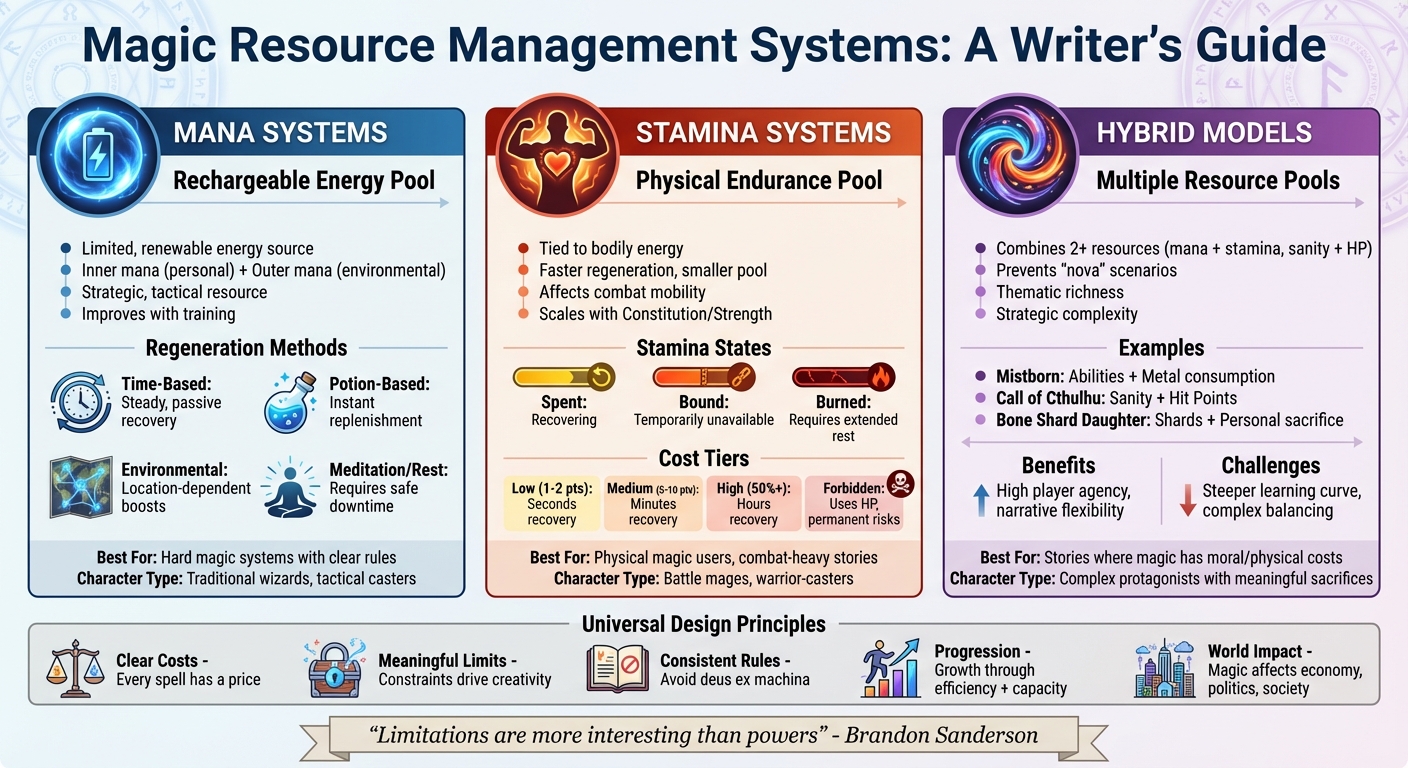
Magic Resource Management Systems Comparison: Mana vs Stamina vs Hybrid Models
Creating Cost-Based Magic Systems: A Worldbuilding How To
sbb-itb-2566684
Mana Systems: How They Work
Mana functions as a limited, renewable energy source that characters use to cast spells or perform supernatural feats. Think of it like a rechargeable battery with a maximum capacity that depletes as it’s used and gradually refills over time. This setup encourages strategic thinking, as characters must manage their energy carefully instead of relying on endless magical solutions.
Most systems distinguish between inner and outer mana. Inner mana refers to a character’s personal reserves, while outer mana is ambient energy found in the environment. Some systems require users to harmonize these two sources, while others involve refining raw outer mana for personal use. This refinement often reflects a character’s skill level - beginners struggle with unstable energy, while experienced users convert and store it efficiently.
As characters grow stronger, their mana capacity and efficiency improve. Training or leveling up often increases maximum reserves. Tools like wands, staffs, or crystals serve as magical focuses, helping channel energy, extend spell range, or improve accuracy. Skilled casters also learn to reduce the mana cost of spells, making them increasingly potent as they advance.
Core Features of Mana Systems
A key aspect of mana systems is their structured, measurable mechanics. In hard magic systems, the cost of each spell is clearly defined, and the consequences of running out of mana are explicit. This transparency makes magic feel like a tactical resource, akin to ammunition in combat. Characters must weigh decisions carefully - should they unleash a powerful spell now or conserve energy for future challenges?
Mana use often comes with specific requirements. For example, casting might involve channeling energy or preparing spells, and when mana reserves are empty or distant from environmental sources, magic becomes impossible. Some systems add physical or verbal components, like hand gestures or spoken incantations, which can be disrupted if the caster is restrained or silenced. These limitations add suspense - a bound wizard is helpless, and a silenced mage must improvise.
Beyond simple depletion, many systems impose additional costs for overuse. Excessive casting might lead to exhaustion, physical harm, or impaired decision-making. This adds weight to every spell, ensuring magic isn't treated as an easy, risk-free solution.
Mana Regeneration Methods Compared
Different methods of mana regeneration create unique gameplay dynamics and storytelling opportunities. Time-based regeneration offers steady, passive recovery but can leave characters exposed during prolonged battles, forcing them to retreat or stall for time. Potion-based recovery allows for instant replenishment, enabling dramatic bursts of power, but ties magic to resources and preparation. A lack of potions or a spike in their cost can create tense scenarios.
Environmental regeneration - through ley lines, mana storms, or celestial events - provides massive boosts in specific areas but makes magic dependent on location. This can drive territorial disputes, as controlling a ley line becomes as crucial as holding a fortress. For example, in Dungeons & Dragons 1st Edition, psionic recovery varied by activity, with characters regaining 0 points per hour during strenuous exertion but up to 24 points per hour while resting. Similarly, Final Fantasy XIV's Black Mages use an "Umbral Ice" stance to regenerate 32% to 62% of their total MP every 3 seconds, balancing their high-cost offensive spells.
| Regeneration Method | Pros | Cons | Narrative Impact |
|---|---|---|---|
| Time-Based | Consistent, requires no external items. | Slow; leaves characters vulnerable during prolonged fights. | Builds tension; forces retreats or tactical delays. |
| Potion/Consumable | Instant recovery; enables bursts of power. | Limited by inventory and cost; risks overuse effects. | Links magic to economy; demands careful preparation. |
| Environmental | Grants significant boosts in key zones. | Location-specific; unpredictable or hazardous (e.g., mana storms). | Encourages territorial conflict; makes certain areas strategically critical. |
| Meditation/Rest | Promotes downtime and introspection. | Requires a safe, uninterrupted setting. | Allows for character bonding and reflective moments. |
Each regeneration method brings its own challenges and opportunities, shaping the gameplay and the story in meaningful ways. Next, we’ll dive into stamina-based systems to see how they compare to mana-based resource management.
Stamina-Based Resources: Physical Magic and Combat
Stamina introduces a fascinating twist to magic systems by tying spellcasting directly to physical endurance. Unlike mana, which is an abstract and renewable resource, stamina reflects the caster's bodily energy. This means that when stamina runs out, the caster isn't just out of magical juice - they're physically drained, unable to run, dodge, or even hold their own in combat. It adds a layer of vulnerability, forcing players to carefully balance their spells against their physical survival.
This system also reshapes the traditional image of spellcasters. Instead of the fragile, bookish wizards often seen in mana-based systems, stamina-based casters tend to be stronger and more physically resilient. Their magical potential often scales with attributes like Constitution or Strength, making them capable of transitioning between melee combat and spellcasting. This versatility creates dynamic fighters who don't just rely on magic but can handle themselves in close quarters. Unlike mana's steady replenishment, stamina introduces an immediate tradeoff: every spell comes at the cost of physical energy, demanding strategic thinking.
How Stamina Systems Work
Stamina operates on a quick burst-and-recovery cycle. It regenerates faster than mana but has a smaller pool, limiting how long a caster can sustain their magic. This creates a tactical rhythm where players alternate between bursts of magic and moments of recovery. In drawn-out battles, this rapid regeneration can give stamina-based mages an edge over traditional mana users.
Some systems add depth by categorizing stamina into states like "Spent" (recovering), "Bound" (temporarily unavailable), and "Burned" (requiring extended rest or special items). These distinctions force players to think ahead. For example, binding stamina to maintain a defensive spell like Stone Skin might limit their offensive options but provide crucial protection. On the other hand, burning stamina for a powerful ultimate ability could leave them vulnerable for the rest of the encounter.
The physical toll of stamina depletion is not just theoretical; it shows up in gameplay. Characters might move slower, breathe heavily, or even collapse when they push too far. Some systems allow players to exceed their stamina limits by taking on "Fatigue" or "Strain", which temporarily reduces stats like Strength or Speed. This creates high-stakes decisions, where casting one last desperate spell might turn the tide of battle but leave the caster defenseless afterward.
Balancing Stamina Costs Across Spell Tiers
Balancing stamina costs is crucial to maintaining fairness and challenge. Low-tier spells should use only a small amount of stamina and recover almost instantly, allowing frequent use without major drawbacks. Mid-tier spells, however, should have more noticeable costs, leading to temporary fatigue and requiring short recovery periods. High-tier abilities, like ultimate spells, often consume over half of the stamina pool, with recovery taking hours or requiring rest.
| Spell Tier | Stamina Cost | Recovery Rate | Overuse Penalties |
|---|---|---|---|
| Low (Cantrips) | Minimal (1-2 pts) | Rapid (Seconds) | Slight fatigue; no impact on movement. |
| Medium (Combat) | Moderate (5-10 pts) | Steady (Minutes) | Slower movement; heavy breathing. |
| High (Nova/Elite) | Massive (50%+ pool) | Slow (Hours/Rest) | Physical collapse; unconsciousness; "Burn." |
| Forbidden/Over-limit | Lethal (Burned/HP) | Permanent injury/death | Risks like "Godscorch" or permanent depowering. |
To prevent spell spamming, most systems set a minimum stamina cost (often 1 point), even for reduced-cost spells. When applying bonuses, percentage reductions should always be calculated before flat deductions for consistency. Forbidden or over-limit abilities that use hit points instead of stamina should carry risks that match their power, such as permanent consequences like "Godscorch" or severe physical damage.
Hybrid Resource Models: Combining Multiple Resources
Hybrid resource models bring together multiple resource pools - like mana and stamina, or sanity and hit points - to create magic systems with both strategic complexity and storytelling depth. These systems force characters to juggle tradeoffs between different energy reserves. For example, a wizard might have enough mana to unleash a devastating fireball but lack the physical stamina to evade an enemy's counterattack.
One of the key strengths of hybrid models is their ability to curb "nova" scenarios, where a character might otherwise burn through an entire resource pool in one overwhelming burst. By introducing dual costs - such as requiring both mana and hit points for a spell - authors naturally limit a character's ability to dominate encounters. Horror games like Call of Cthulhu illustrate this principle well, where casting spells costs both Sanity and Hit Points, reinforcing the psychological and physical toll of magic.
These systems also lend themselves to thematic richness. By blending different magical traditions or mechanics, authors can create systems that feel deeply tied to the world. For instance, Brandon Sanderson's Mistborn series combines internal abilities with the external consumption of metals, while Andrea Stewart's The Bone Shard Daughter uses bone shards alongside personal sacrifice, embedding the theme of loss into the magic itself. These tradeoffs introduce both benefits and challenges that shape the narrative and gameplay.
Benefits and Challenges of Hybrid Models
Using multiple resources adds layers of tactical and narrative depth. Characters can decide which resource to spend depending on the situation - perhaps using mana to escape danger quickly or sacrificing stamina to strengthen a defensive barrier while conserving magic for later. This interplay makes magic feel less like a simple, all-powerful tool and more like a strategic choice.
However, hybrid systems demand careful planning. They come with a steeper learning curve and require precise balancing. Combining systems - like ritual magic with elemental spellcasting - requires clear rules to avoid confusion. As Obsidian Tavern puts it:
"When combining systems, focus on limitations before possibilities. Each addition to your magic system should create new restrictions along with new powers."
Without this clarity, hybrid models can overwhelm readers or disrupt a story's internal logic.
Hybrid vs. Single-Resource Systems
To better understand their impact, let’s compare hybrid models with single-resource systems:
| Feature | Single-Resource Systems | Hybrid Resource Models |
|---|---|---|
| Player Agency | Straightforward; manage one resource pool | High; balance multiple, sometimes conflicting resources |
| Narrative Flexibility | Lower; often tied to predictable rest cycles | Higher; integrates magic with diverse elements like health or the environment |
| Design Complexity | Easier to balance and pace | More challenging; requires fine-tuning to maintain coherence |
| Onboarding | Simpler for readers and players | More difficult; involves understanding multiple mechanics |
| Narrative Tension | Comes from depleting a single resource | Stems from the moral and physical costs of using magic |
The choice between these systems depends heavily on the needs of your story. Single-resource systems work well for straightforward narratives, where magic serves as a functional tool. On the other hand, hybrid systems are ideal when magic itself is central to the story - when every spell reflects a character's inner struggles, sacrifices, or moral dilemmas. These dynamic systems, while demanding to design, can make magic feel meaningful, with lasting consequences that resonate through the narrative.
Balancing and Limitations in Magic Resource Systems
When magic has no limits, it drains the story of suspense. If characters can solve every problem with endless power, the stakes vanish, and readers disengage. That’s why restrictions are so crucial - they create space for tension, creativity, and character growth. Brandon Sanderson's Laws of Magic provide a solid foundation for crafting resource systems that feel impactful yet constrained.
Using Sanderson's Laws for Resource Design
Sanderson's First Law emphasizes that readers need to understand how magic works for it to resolve conflicts effectively. In resource management, this means clearly defining the rules for how resources are used or replenished before they come into play. If readers grasp the mechanics, the resolution feels earned.
The Second Law states: “Limitations are more interesting than powers.” A character’s struggles within these limitations often drive the most compelling moments. For instance, a fire mage might face challenges casting spells in rain, require recovery time after each use, or risk personal harm. These constraints push characters to think outside the box and find creative solutions.
Sanderson's Third Law suggests: “Expand what you already have before adding something new.” Instead of introducing a brand-new power to overcome a locked door, show how a character can adapt their existing abilities - like using a stamina-draining spell to superheat and bend metal. This keeps the system cohesive and avoids unnecessary clutter.
For resource systems, the cost of magic should scale with its power. A simple spell like lighting a candle might require minimal effort, while a building-leveling spell could drain the caster’s energy, impair their focus, or consume rare materials. Some systems use exponential scaling, where doubling a spell’s power demands far more than double the resources. This approach ensures that stronger magic comes with steep trade-offs.
To add depth, establish 3–5 constraints for your system. These could include time limits, environmental factors, or even moral dilemmas. For example, a shadow mage might struggle to operate in a brightly lit room, creating a unique challenge compared to simply running out of magic reserves. Such varied limitations open up opportunities for dramatic tension.
But even with well-balanced systems, there are common pitfalls to avoid.
Common Pitfalls and How to Avoid Them
Even carefully designed systems can stumble if their limitations are ignored. Here’s a breakdown of common missteps and how to address them:
| Common Pitfall | Description | Recommended Solution |
|---|---|---|
| Infinite Regeneration | Resources recover too quickly, allowing characters to overuse powerful spells. | Introduce resource caps, environmental recharge conditions (e.g., sunlight), or penalties like exhaustion. |
| Deus Ex Machina | Magic resolves major conflicts without prior explanation or setup. | Clearly establish the mechanics and limits of magic well before the climax. |
| Convenient Power Manifestation | Characters suddenly develop new abilities to escape danger, undermining earlier challenges. | Stick to existing powers and rules, finding creative ways to solve problems rather than adding surprises. |
| Ignoring Established Costs | Magic’s toll on characters is skipped, reducing believability. | Show the aftermath of major magical feats, whether physical exhaustion or mental strain. |
| Overpowered Utility | Abilities like instant teleportation remove travel-related challenges. | Add restrictions, such as requiring a physical anchor, line of sight, or preparation time. |
One of the trickiest pitfalls is instant mastery. If a protagonist learns a complex spell in hours instead of years, it undercuts the entire progression system. A realistic learning curve, complete with setbacks and failures, makes magical growth feel earned and satisfying.
Hard magic systems - those with clear, defined rules - work best for logical problem-solving. On the other hand, soft magic, which is more mysterious, excels at building atmosphere or portraying overwhelming forces. However, soft magic should rarely resolve key plot conflicts, as it risks frustrating readers if its use feels arbitrary or unfair. Mixing these approaches can work, but only if the boundaries are clear.
Progression Systems and Integration
A magic resource system that stays the same over time can feel lifeless and uninspiring. Characters should grow stronger as the story progresses, but that growth needs to follow a clear structure. The best progression systems often take a tiered approach - like moving from apprentice to journeyman to master - where each level unlocks new abilities but still comes with meaningful trade-offs. This kind of progression doesn’t just increase stats; it adds depth by broadening the range of actions available. Let’s dive into how resource systems evolve alongside a character’s growth.
Scaling Resources with Character Growth
Expanding resource capacity is a simple yet effective way to show progression. For instance, a beginner mage might have a small mana pool, while an experienced archmage commands a much larger reserve. But capacity isn’t the only factor - efficiency plays a big role too. Casting spells with fewer resources becomes just as important as having a larger pool to draw from. This balance ensures that growth feels strategic, not just like a numbers game.
Take Brandon Sanderson’s Mistborn series, for example. Allomancers gain power by ingesting and "burning" specific metals. As the protagonist, Vin, grows stronger, she doesn’t just gain access to more metals; she also learns to use them with greater precision and creativity. This progression adds layers to the system, making resource management an integral part of the narrative. Running out of metals or relying on rare ones controlled by the nobility creates tension that drives both character development and plot. The system stays engaging by introducing new elements - like previously unknown metals - without breaking existing rules.
Instant mastery, however, should be avoided. Watching characters earn their skills through challenges and setbacks feels far more satisfying than seeing them achieve perfection overnight. For example, mastering a complex spell over time, with failures along the way, makes eventual success feel earned. Foreshadowing advanced abilities subtly before they’re fully realized can also make their later use in pivotal moments feel natural rather than forced.
Connecting Magic Resources to Story and Economy
Building on the idea of resource scaling, tying magic systems to the story and economy adds another layer of depth. Magic resources should influence the world around them. In genres like LitRPG and progression fantasy, treating magic as a limited commodity creates natural tension. Imagine a scenario where a mana potion costs $50 in in-game currency, but the character only has $120. Do they buy multiple potions or invest in other upgrades? These kinds of trade-offs make resource management feel meaningful.
Magical resources can also drive entire economies. For example, if healing spells require rare crystals mined from dangerous dungeons, industries will naturally form around adventurers, miners, and traders. Similarly, when high-quality resources are hoarded by the elite while commoners are left with weaker alternatives, it can create class struggles and social divides. In the VRMMO Eternal Dominion, the game’s economy became so massive that it accounted for about 20% of the world’s real-life economy.
Character progression can be tightly linked to economic systems. A blacksmith who learns to enchant weapons might charge higher prices to fund advanced magical training, while an alchemist who invents a groundbreaking potion could disrupt the market, leading to new opportunities - and conflicts. These connections make magic feel like a natural part of the world. As characters grow stronger, their influence should ripple outward. For instance, if teleportation becomes common, it could revolutionize trade routes, and widespread healing magic might change the nature of warfare. This ensures that as resource systems evolve, they continue to shape both the story and the world’s economy in meaningful ways.
Conclusion: Designing Balanced Magic Systems
Crafting a balanced magic system hinges on its limitations rather than its possibilities. The real power of a magic system lies in its costs - whether it's physical exhaustion, rare resources, or moral consequences. These boundaries give every spell a purpose and weight within the narrative.
Consistency is key. As Brandon Sanderson wisely put it:
An author's ability to solve conflict with magic is directly proportional to how well the reader understands said magic.
When the rules of magic are inconsistent or characters gain sudden, unexplained power boosts, it disrupts immersion and lowers the stakes. To avoid this, authors often document every ability, rule, and limitation in a "Magic Bible" to ensure consistency throughout the story.
Great magic systems often create more challenges than they resolve. To ensure a system works within the story, practical tests can be applied. For example, the Smart Enemy Test evaluates whether an antagonist with knowledge of the system could exploit its loopholes to derail the plot. If they can, the system's rules need tightening. Similarly, the Economics Test asks how magic would realistically impact areas like trade or resource creation. If magic could, say, easily produce gold or teleport goods, the story must clearly define why these uses aren't widespread.
Magic should influence every aspect of the world - economy, politics, warfare, and daily life. As characters grow stronger, their development should focus on creativity and precision rather than sheer power. For instance, a character who learns to manipulate heat at a molecular level is far more compelling than one who simply hurls larger fireballs. Foreshadowing abilities early on ensures that when they're used later, they feel like a natural progression rather than a convenient plot device.
Ultimately, the most effective rules make life harder for the protagonist, not easier. If magic becomes a tool for solving every problem, it risks turning the story into wish fulfillment rather than a meaningful narrative.
FAQs
How do I choose between mana, stamina, or a hybrid system?
When choosing between mana, stamina, or a hybrid system, think about how each aligns with your worldbuilding and gameplay objectives.
- Mana symbolizes magical energy, emphasizing resource management and setting boundaries on spellcasting.
- Stamina represents physical effort, making it a great fit for magic tied to physical strain or martial arts.
- Hybrid systems combine both, adding layers of flexibility and depth to your mechanics.
Your choice should reflect how magic functions within your story or game design.
How can I stop magic from fixing every problem in my story?
To keep magic from becoming an easy fix for every problem, it's essential to set clear rules, costs, and boundaries for its use. A well-thought-out system with real consequences ensures magic feels like a natural part of the story while preserving tension and stakes.
You might opt for hard magic with clearly defined rules, which offers better control and predictability. Alternatively, soft magic - with its mysterious and undefined nature - provides more flexibility. Whichever approach you choose, the key is to ensure magic has consequences and isn't used randomly to resolve conflicts.
How do I make magic resources affect the economy and politics?
To seamlessly blend magic into a fictional economy, it’s crucial to establish clear rules about how magic interacts with resources. For instance, does magic create gold or manipulate commodities? If so, there should be limitations, costs, or conditions tied to its use. This helps maintain balance and prevents the economy from spiraling into chaos.
Magic can also reshape political landscapes. By granting certain groups control over valuable resources, it can shift power dynamics and create new hierarchies. Governments might respond by regulating magic through laws, taxes, or restrictions. This opens the door for intrigue, as different factions vie for control, influencing societal structure and power struggles.