
How to Write Villain Motivations
Villains drive the tension in Progression Fantasy and LitRPG stories. Without a clear reason for their actions, they feel hollow and weaken the narrative. A strong villain isn’t just evil - they have a purpose, emotions, and beliefs that make their actions feel real. Here’s how to craft motivations that resonate:
- Base motivations on relatable emotions: Fear, love, ambition, or grief make villains more human.
- Give them a personal logic: They should see their actions as justified, even if others don’t.
- Tie goals to the story’s world: Their ambitions should reflect the game mechanics or themes of your story.
- Show complexity: Add internal conflicts, vulnerabilities, or moments of doubt to make them layered.
- Challenge the hero’s journey: Their motivations should directly clash with or mirror the hero’s, creating moral tension.
Writing Villains #3 - Motivation
sbb-itb-2566684
Core Principles of Believable Villain Motivations
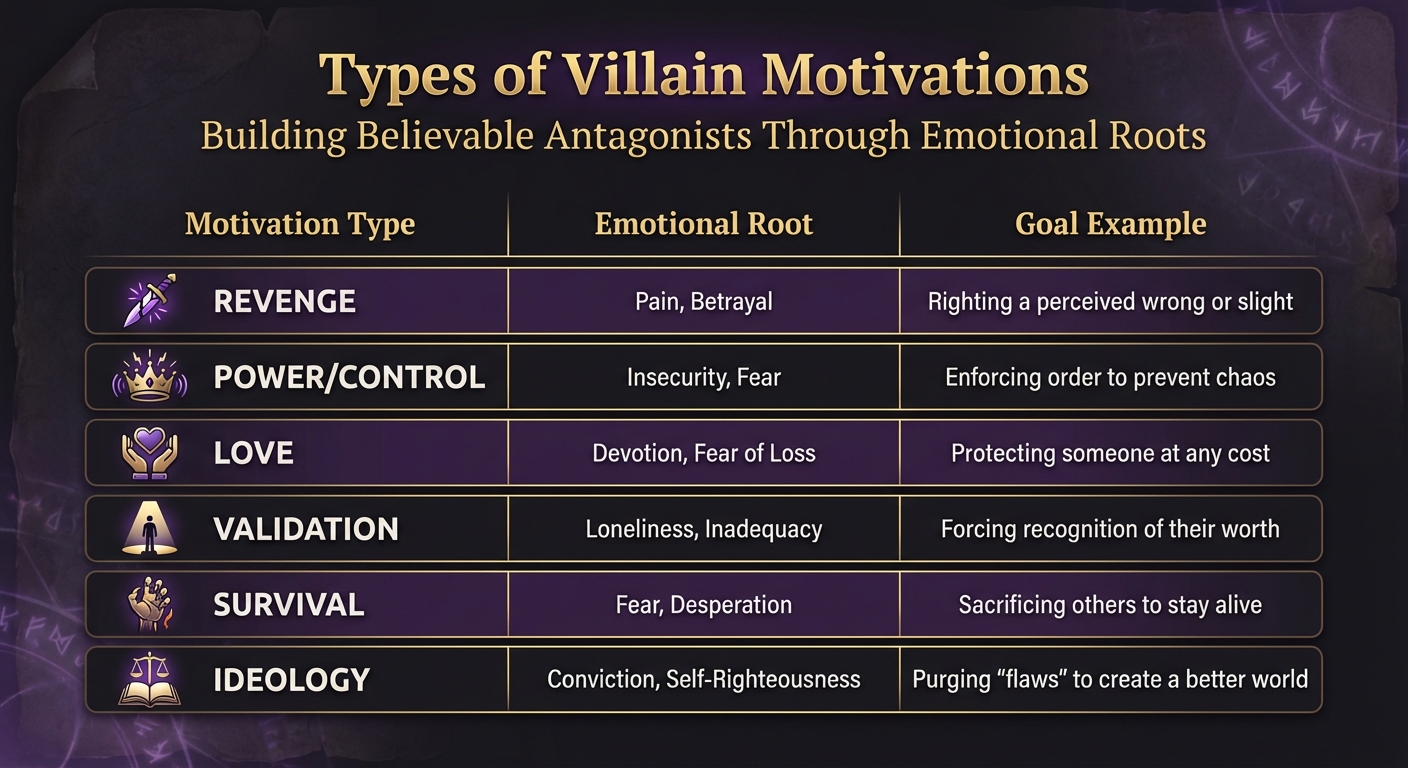
6 Types of Villain Motivations with Emotional Roots and Goals
Crafting a villain that feels authentic starts with nailing down a few key principles. These elements help shape antagonists that stick with readers long after the story ends.
Root Their Motivations in Relatable Emotions
Villains aren’t just faceless forces of evil - they’re characters with emotions, desires, and their own internal logic. The best villains draw their drive from emotions we all recognize: fear, love, ambition, grief, or the need to prove themselves.
"Villains are characters, not just inanimate forces of evil, but beings with their own thoughts, feelings, and desires." - Rose Atkinson-Carter, Character Development Writer
What makes this work? Ground their motivations in a personal wound or sacrifice. It’s that cost - whether tragic or self-inflicted - that makes their actions relatable. Ask yourself, “If I were in their shoes, would I do the same?” If the answer feels plausible, you’ve tapped into something real.
Adding small vulnerabilities can also make them feel more layered. When their emotional roots are clear, their choices - no matter how extreme - start to make sense.
| Motivation Type | Emotional Root | Goal Example |
|---|---|---|
| Revenge | Pain, Betrayal | Righting a perceived wrong or slight |
| Power/Control | Insecurity, Fear | Enforcing order to prevent chaos |
| Love | Devotion, Fear of Loss | Protecting someone at any cost |
| Validation | Loneliness, Inadequacy | Forcing recognition of their worth |
| Survival | Fear, Desperation | Sacrificing others to stay alive |
| Ideology | Conviction, Self-Righteousness | Purging "flaws" to create a better world |
Provide Logical Justifications for Their Actions
A villain’s actions should come from their beliefs, not just convenience. They’re not evil for the sake of being evil - they act because they’re convinced their way is right. Even if their reasoning feels twisted to others, it makes sense to them.
"A villain works when their belief drives their behavior. Give them a specific goal, a reason that feels true to them, a method that hurts people, and enough wins to scare your hero." - Rita Melkonian, Founder, Quill&Steel
This perspective of "necessary evil" is what makes them dangerous. Whether they’re seeking harmony through drastic measures or advancing science through unethical experiments, their actions feel justified in their own eyes. To build this, consider what they’re trying to protect or achieve and why they believe a moral path won’t work.
Show their internal logic through their decisions - how they treat allies, handle setbacks, or decide which lines they’re willing to cross. This personal code not only explains their choices but also highlights how they challenge your hero as a dark reflection.
Ensure Motivations Reflect the Story's Themes and Game Mechanics
A villain’s actions should also fit the world they inhabit. Their ambitions need to align with the story’s themes and the rules of its universe. For example, in a game-based narrative, their goals might revolve around exploiting mechanics - hoarding resources, abusing glitches, or breaking level caps.
"The best villains aren't just obstacles - they are mirrors, rivals, warnings, or dark reflections of what the heroes could become." - Paul Bellow, Founder, LitRPG Reads
When a villain’s goals directly clash with the hero’s journey - like competing for a rare class or controlling a vital resource - it raises the stakes. It’s not just about power; it’s about what that power means in the context of your story. Use your villain to expose flaws in the system, like leveling up recklessly or bending rules to achieve their vision. By tying their motivations to specific mechanics - like cooldowns, permadeath, or resource limitations - you make them an integral part of the world, not just a generic threat.
Types of Villain Motivations in LitRPG and Progression Fantasy
Understanding the why behind your villain's actions is key to crafting antagonists that feel real and impactful. In LitRPG and progression fantasy, villains with compelling motivations not only challenge the hero but also add depth to the story. Below are four types of motivations that can shape memorable villains and drive your narrative forward.
Survival and Self-Preservation
Not all villains crave power for its own sake. Some are simply fighting to survive. In worlds governed by harsh game mechanics, survival can become a desperate struggle. A villain might need to consume souls, drain lifeforce, or even sacrifice others to escape a curse or stave off extinction. Sometimes, their actions are the only way to protect their community from being wiped out.
"What if the villain needs destruction to live themselves? They might need to consume souls, the lifeforce of the land, or the sunlight from the sky." - Aron Christensen, Author and Storyteller
When survival is at stake, villains make extreme choices. A high-level antagonist might even seek out the hero to end their eternal boredom or curse. This kind of motivation ties directly into the stakes of the game's rules, making the villain a reflection of the world’s brutal mechanics.
Revenge and Personal Vendettas
Revenge is a powerful motivator, especially for villains nursing old wounds. Whether it’s betrayal, humiliation, or loss, these antagonists are shaped by unresolved pain. In progression fantasy, their vendetta often intertwines with the hero’s journey. Perhaps they were once an ally who took a different path after a pivotal moment, or maybe they’re a victim of collateral damage from the hero’s past actions.
What makes these villains compelling is that their quest for retribution can feel justified from their perspective. If the hero’s actions inadvertently caused harm, the villain’s rage becomes more understandable. This complexity creates tension, allowing readers to see the story from both sides.
Ambition and the Pursuit of Power
Ambition-driven villains mirror the hero's own struggle for growth and empowerment, which is central to LitRPG and progression fantasy. These antagonists often have a backstory rooted in vulnerability - maybe they were humiliated, oppressed, or powerless in the past. Their hunger for power becomes a way to shield themselves from ever feeling weak again.
In LitRPG settings, this ambition often aligns with game mechanics. A villain might control a trade guild, hoarding essential crafting materials to manipulate players. Or they could focus on breaking level caps, monopolizing legendary artifacts, or building empires to maintain dominance. Their relentless drive for power naturally clashes with the hero’s goals, especially when both are after the same resources.
Ideological or Philosophical Beliefs
Some of the most dangerous villains are those who believe they’re doing the right thing. They aren’t motivated by personal gain but by a vision of a better world - whether that means imposing order, eradicating corruption, or achieving world peace. Their methods may be ruthless, but their goals can sound noble, even reasonable.
"Having an antagonist with a specific ideology that informs their actions can also create a compelling dynamic with the protagonist, as it may force the hero to question their own ideology." - Rose Atkinson-Carter
Ideological villains force the hero to confront difficult questions. For example, a villain might argue that the leveling system is inherently oppressive and must be destroyed, even if it causes widespread chaos. Or they might believe that sacrificing freedom is necessary for stability. These antagonists act as a dark mirror to the hero’s values, showing what the hero might become if they took their own beliefs too far. This clash of ideals adds moral complexity to the story, making the stakes feel even higher.
Steps to Develop Villain Motivations
Step 1: Define the Villain's Core Beliefs and Goals
Start by identifying your villain’s fundamental beliefs - the principles that shape how they see the world. Jot down three to five statements that define their worldview. For example, they might believe, "Only absolute control prevents chaos," or "Peace always demands sacrifice." These beliefs should feel deeply personal to the villain, even if they’re warped or extreme.
Next, dig into why the villain clings to these beliefs so fiercely. What emotion drives their actions? Is it grief, a desire to protect someone, or a response to a perceived injustice? Trace this drive back to a key moment in their past - trauma, betrayal, or a life-altering loss. This pivotal event becomes the emotional anchor for all their decisions.
"The goal isn't to make readers agree with your villain. It's to make readers understand how the villain agrees with themselves." - Inkshift
Your villain’s perspective should feel clear and relatable, even if their actions are monstrous. If their goals and stakes don’t make sense when viewed from their point of view, refine their beliefs until they do.
Step 2: Connect Motivations to the LitRPG/Progression Framework
Once you’ve nailed down your villain’s core beliefs, tie those motivations into the LitRPG or progression fantasy mechanics of your story. In these genres, power isn’t just a concept - it’s measured in levels, stats, resources, and artifacts. Your villain’s objectives should be tightly linked to these systems.
For example, their backstory might justify controlling a trade guild that monopolizes rare crafting materials, forcing players into conflict to advance. Or perhaps they’re competing with the hero for a legendary artifact, using the game’s mechanics to dominate and maintain their edge.
To create a compelling dynamic, align the villain’s growth with the hero’s journey. As the hero levels up and gains allies, the villain should evolve too - perhaps transitioning from a manipulative schemer to an outright tyrant. A well-developed villain doesn’t just react; they anticipate the hero’s moves, use their superior resources, and secure small victories to keep the stakes high.
You can also use the world’s lore - prophecies, ancient rules, or succession struggles - to justify the villain’s actions. This adds weight to their motivations and creates moral dilemmas for the hero. For instance, the hero might face a choice between advancing their progression or doing what’s morally right.
Step 3: Introduce Internal Conflicts and Complexities
A strong villain isn’t just driven by external goals - they’re also shaped by internal struggles. Layer in conflicting motivations to avoid creating a flat, one-note character. For example, a villain might pursue wealth out of greed but also seek revenge for a personal loss. Or they might have noble ideals, like wanting to end suffering, but take a destructive path to achieve them.
Show glimpses of their humanity to make them more complex. Maybe they’re kind to animals but ruthless toward people. Or they preach mercy yet punish failure with brutal consequences. Highlight the personal cost of their choices - broken relationships, lost trust, or inner turmoil - to show how they slowly become the villain they are.
"A villain works when their belief drives their behavior. Give them a specific goal, a reason that feels true to them, a method that hurts people, and enough wins to scare your hero." - Rita Melkonian, Writer, Worldbuilder & Founder, Quill&Steel
Flaws make villains relatable and human. Mirror some of the hero’s weaknesses, like arrogance or unchecked ambition, to create an emotional connection. Allow moments of doubt or tenderness - perhaps toward a loyal ally - to make them feel more real and unpredictable.
Step 4: Align Villain Motivations with the Hero's Journey
Finally, make sure your villain’s goals intersect with or directly challenge the hero’s journey. Their beliefs should act as a dark reflection of the hero’s, sharing similar fears or questions but offering destructive answers.
This overlap can create moral tension. For instance, if the villain believes the leveling system is oppressive and must be destroyed, the hero might agree with the critique but reject the violent approach. Such dilemmas force the protagonist to confront their own values and question their sense of justice.
As the hero grows stronger, the villain’s motivations should shift too. They might escalate their plans, adapt their tactics, or double down on their beliefs. This evolving dynamic keeps the conflict engaging and pushes both characters to grow in response to each other.
Enhancing Story Impact with Villain Motivations
Crafting a villain with compelling motivations can elevate your story, especially when their desires contrast sharply with the hero’s, unfold gradually, and connect deeply to the world they inhabit. Let’s explore how to make these elements work together.
Contrast Villain and Hero Motivations
Some of the most gripping conflicts come from villains who reflect the hero’s journey but take a darker route. Imagine them as two sides of the same coin - perhaps they’ve endured similar hardships or share a common goal, but their responses couldn’t be more different. This contrast adds layers of complexity to the narrative, far beyond simple clashes of power.
"The best villains aren't just obstacles - they are mirrors, rivals, warnings, or dark reflections of what the heroes could become." - Ken Chan, LitRPG Author
For instance, you could give both the hero and villain a shared trauma but show how they process it differently. One might channel their pain into healing, while the other uses it as a justification for destruction. Alternatively, they might fight for the same goal but employ opposing methods - like striving to save a dying race, where the villain adopts an “ends justify the means” approach, clashing with the hero’s moral boundaries. This dynamic forces the protagonist to defend their values and grapple with their own vulnerabilities.
| Contrast Type | Hero's Approach | Villain's Approach | Narrative Impact |
|---|---|---|---|
| The Dark Mirror | Chooses growth and morality despite past trauma | Succumbs to trauma, justifying corruption | Challenges the hero to face their own potential for darkness |
| The Foil | Values principles and restraint over quick results | Prioritizes efficiency, ignoring moral costs | Highlights the hero's integrity and sacrifices |
| Shared Goal | Works toward change through cooperation and sacrifice | Seeks change through control or force | Creates ethical dilemmas where the hero questions their stance |
This interplay between hero and villain lays the groundwork for a deeper connection with the audience as the villain’s motivations unfold.
Reveal Motivations Gradually for Greater Reader Investment
Don’t wait until the villain’s final moments to explain their motives. Instead, weave hints and subtle details throughout the story. A glimpse of vulnerability or a small act of kindness can make the antagonist more relatable and intriguing.
"Do not save the motivations of your antagonist until the very end... 'I'm doing all this stuff and I can't tell you why!' gets old." - Mary Kole, Founder, Kidlit.com
Sprinkle these moments early and build on them over time. Maybe the villain shows a flicker of self-doubt or expresses genuine affection for someone. These brief insights add emotional depth, ensuring that by the climax, the audience fully understands their complexity without needing a long-winded explanation.
This gradual revelation not only enriches the villain but also ties their motivations seamlessly into the world they inhabit.
Connect Motivations to the World-Building
A villain’s goals should feel inseparable from the setting. Their ambitions might stem from the world’s history, political dynamics, or even its magical systems. For example, they could be driven by a desire to resurrect a fallen empire or exploit ancient traditions to gain power.
The key is grounding even the most fantastical motivations in human emotions. As Aron Christensen, Author and Storyteller, explains: "I will become the most powerful sorcerer in the world so that no one can hurt me again". This longing for safety through power is universally relatable, even when wrapped in a fantastical narrative. By anchoring their desires in such emotions, your villain’s actions will feel natural and emotionally charged, making their journey all the more compelling.
Conclusion
Crafting believable villain motivations hinges on giving them real conviction rather than relying on convenience. A strong antagonist should see themselves as the hero of their own story, driven by goals and emotional stakes that align with their worldview.
"A villain works when their belief drives their behavior. Give them a specific goal, a reason that feels true to them, a method that hurts people, and enough wins to scare your hero" - Rita Melkonian, Founder, Quill&Steel.
The best villains grow alongside the hero and the world they inhabit. Their humanity shines through in moments of vulnerability - whether it's a personal code of honor, genuine love for someone, or even a fleeting moment of doubt. These contradictions make them unforgettable and challenge readers to wrestle with moral gray areas.
To avoid tired clichés like "power" or "revenge", dig deeper into their motives. Define what they want and why they believe traditional methods won’t work. Tie their backstory to either the protagonist’s journey or the world’s lore, ensuring their role feels purposeful and connected rather than arbitrary.
FAQs
How do I make a villain feel justified without excusing them?
To give a villain a sense of justification without condoning their actions, delve into their perspective, ambitions, and core beliefs. Show how their reasoning aligns with what they see as "right" and the personal stakes driving their behavior. Root their motivations in practical constraints - like societal rules or personal struggles - to make them understandable, even if their choices are harmful. This way, their actions make sense within their own framework, while still being clearly wrong.
How can I tie a villain’s goals to LitRPG stats, levels, and loot?
To tie a villain’s goals to LitRPG stats, levels, and loot, link their motivations directly to in-game progression mechanics. For instance, a villain might obsess over acquiring rare loot, reaching higher levels, or maxing out specific stats to fulfill their desire for domination, revenge, or even redemption. By making their pursuit of power hinge on particular artifacts or abilities, their development feels more natural and directly connected to their personal ambitions. This approach adds layers to their character and makes their journey feel more engaging.
How do I reveal a villain’s motives early without spoiling twists?
To introduce a villain's motives early without ruining future twists, focus on making their goals relatable and intriguing while keeping some details hidden. One way to achieve this is by placing the villain close to the hero, perhaps under a disguise or false pretense. This allows you to explore their character naturally. By giving them realistic, personal objectives and carefully withholding critical information, you can build suspense and maintain the element of surprise for later revelations.