Ultimate Guide to Hybrid Stat Systems in LitRPG
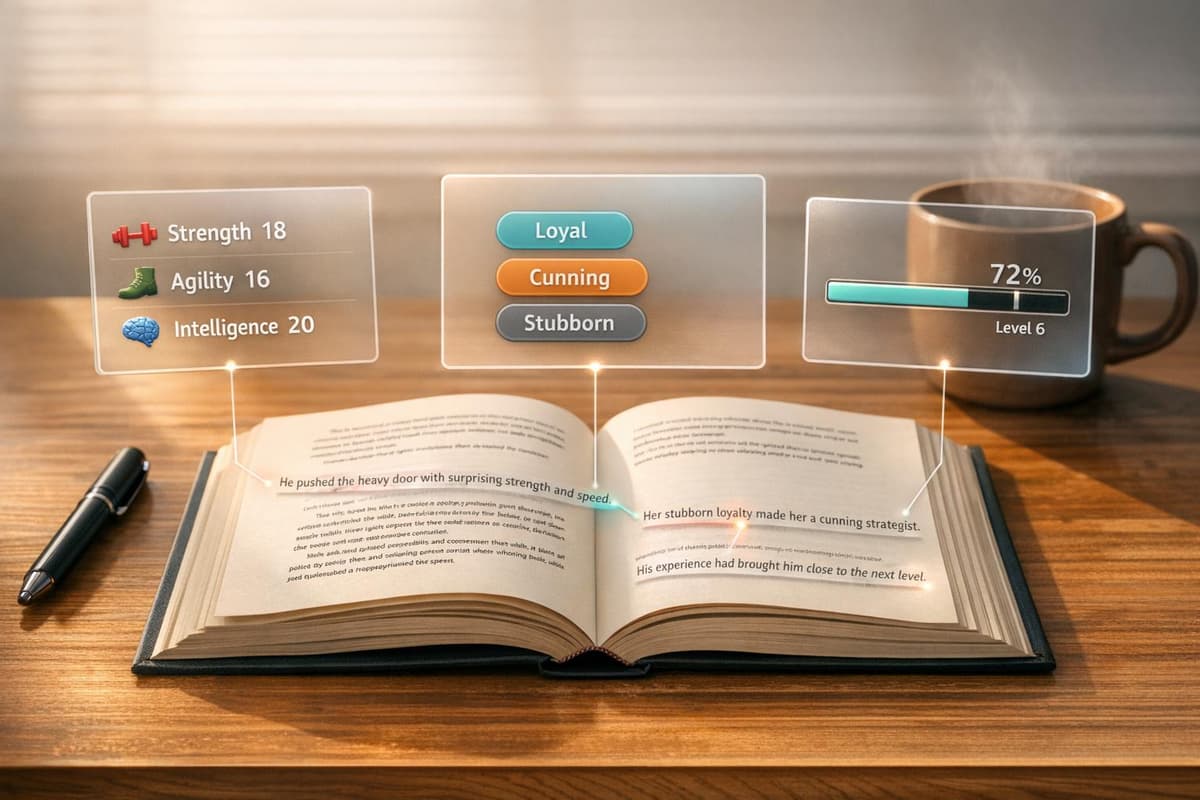
Hybrid stat systems in LitRPG combine numerical stats (like Strength or Intelligence) with story-driven elements (like traits or perks). This approach balances mechanics with narrative, making character progression feel engaging and tied to the story. Unlike pure numerical systems, hybrid systems avoid overwhelming readers with data while still offering measurable growth.
Key Takeaways:
- What They Are: Mix of stats and story-based traits for immersive progression.
- Why They Work: Avoids "spreadsheet fatigue" by linking growth to character arcs.
- Examples: The Wandering Inn and Awaken Online use minimal stats to enhance storytelling.
- Design Tips: Keep systems simple, tie growth to meaningful moments, and ensure consistency.
Hybrid systems make stats part of the narrative, creating a smoother, more engaging reading experience.
Core Design Principles of Hybrid Stat Systems
Balancing Numerical and Narrative Elements
The backbone of a functional hybrid system lies in keeping things simple. As LitRPG author and narrative designer Edwin McRae aptly puts it:
"Simplicity = Accessibility. Simplicity = Sanity. Simplicity = Sustainability."
A streamlined system works best when it focuses on just a few key stats - like Body, Mind, and Spirit - that can branch into secondary mechanics. For example, you might tie Health Points to both a physical attribute and character level (HP = Body × Level). This creates a system that's interconnected yet easy to follow. By doing this, you avoid overwhelming readers with too many numbers while keeping the story engaging.
The stats should always support the narrative, not overshadow it. As LitRPG Reads explains:
"Stats should be tools - servants to the narrative, not its overlords. Every mechanic should earn its keep by deepening immersion, tension, and investment."
A well-balanced design also ensures that the system evolves naturally alongside the story.
Scalability and Progression
A good hybrid system grows with your characters without becoming overly complicated. The trick is to establish clear formulas early on - like "Primary Stat = Level × 2.5" - and stick to them consistently. This ensures that character growth and gear upgrades remain balanced within the broader context of progression fantasy over the course of a multi-book series. It also prevents jarring power jumps, where a character goes from "struggling novice" to "unstoppable god" in just a few chapters, which can disrupt the narrative flow.
Interconnected scaling is another key element. When secondary stats automatically adjust based on primary attributes and levels, it eliminates the need for constant manual updates. Adding some randomness - like unexpected stat boosts or loot drops - can make the system feel more dynamic and less predictable, much like an actual game.
The most engaging systems tie progression to narrative milestones. Level-ups should feel earned, tied to moments of real challenge or emotional growth rather than repetitive grinding. As LitRPG author and publisher Paul Bellow notes:
"The best level-ups are hard-won. Defeating a boss is more than swinging a sword - it's overcoming trauma, mastering fear, or cementing bonds with allies."
For example, when a character unlocks new abilities by studying forbidden knowledge or training under a master, their mechanical growth aligns naturally with their personal journey.
Player Agency and Integration
Scalable growth is important, but so is giving characters meaningful choices. Strategic limitations - like cooldown timers, resource caps, or limited skill slots - force characters to think tactically rather than relying purely on brute strength. When a character has to decide whether to invest skill points in "Empathy" or "Brute Force", it reflects a shift in their values and drives their development.
These mechanics show how in-game decisions can shape both the character's stats and their story arc:
| Mechanic Type | Narrative Role | Example Application |
|---|---|---|
| Mana Pool | Resource Management | A mage runs out of mana at a critical moment, requiring quick thinking. |
| Skill Points | Training Obstacle | A character must choose between two vital skills, altering their future path. |
| Cooldowns | Conflict Limiter | A powerful attack is unavailable during a boss fight, heightening tension. |
| Item Durability | Drama Driver | A weapon breaks mid-battle, forcing the character to improvise. |
To blend mechanics with the story, integrate system messages into the character's inner thoughts. Describe the physical sensations - like a surge of strength, a deepening mana reserve, or the weight of a new skill settling into their body. This approach makes the mechanics feel like a natural part of the narrative.
sbb-itb-2566684
Common Types of Hybrid Stat Systems
Numerical Stats with Skill Trees
This system combines straightforward numerical stats like Intelligence or Strength with branching skill trees to create a rich sense of progression. For example, a fire spell might deal base damage enhanced by 80% of your Intelligence stat. Players allocate skill points to unlock new abilities or enhance existing ones, forcing strategic decisions about which paths to pursue. This approach shapes not only the character’s abilities but also their narrative arc, as each choice reflects a deeper specialization.
The appeal lies in its transparency - players can see the math and optimize their builds accordingly. To keep things balanced and avoid runaway stat inflation, developers often use exponential growth or tiered systems, where each additional stat point becomes more impactful at higher levels.
Another variation blends core stats with class-specific perks, creating a hybrid system that ties attributes directly to a character’s role.
Attribute and Class Hybrids
In this model, core stats function as bundles that provide multiple benefits, with bonuses tailored to the character’s class. For example, Strength might boost both Health and Attack Power, but its exact impact depends on the character’s role. A Warrior could gain additional Critical Rating from Strength, while an Assassin might see increased Attack Power from Dexterity.
| Stat Bundle | Derived Benefits | Class-Specific Bonus Example |
|---|---|---|
| Strength | Health, Attack Power | Warriors gain Critical Rating |
| Dexterity | Dodge Rating, Critical Rating | Assassins gain Attack Power |
| Intelligence | Spell Power, Mana | Mages gain increased Mana pool |
| Constitution | Health, Resilience | Tanks gain increased damage mitigation |
Class evolutions, unlocked at significant level milestones (e.g., every 50–100 levels), provide major boosts to power. This ensures progression feels rewarding without overwhelming players with constant minor upgrades.
For those seeking something less numbers-driven, personality-based progression systems offer a more narrative-driven alternative.
Dynamic Personality-Driven Systems
These systems tie progression to character decisions, emotional arcs, or non-combat elements like "Nature Attunement" or "Karma" [6, 17]. Instead of grinding for stats, characters grow by making moral or relational choices. For example, pacifying spirits might earn "Veneration", while angering them could incur "Burden", a debuff. Major actions that reshape the world or challenge its established rules often lead to meaningful advancements.
Books like Dungeon Crawler Carl by Matt Dinniman and Heretical Fishing by Haylock Jobson explore systems with their own personalities. In Dungeon Crawler Carl, a "Macro AI" evolves from a simple antagonist into a complex, nuanced character. In Heretical Fishing, persistent error messages hint at a catastrophic event that has disrupted the world’s logic. These elements add emotional depth and turn mechanical updates into moments of narrative significance. However, there’s always a risk that a system’s personality could overshadow the protagonist if it becomes too dominant.
Hard VS Soft LitRPG Systems
How to Implement Hybrid Stat Systems in Storytelling
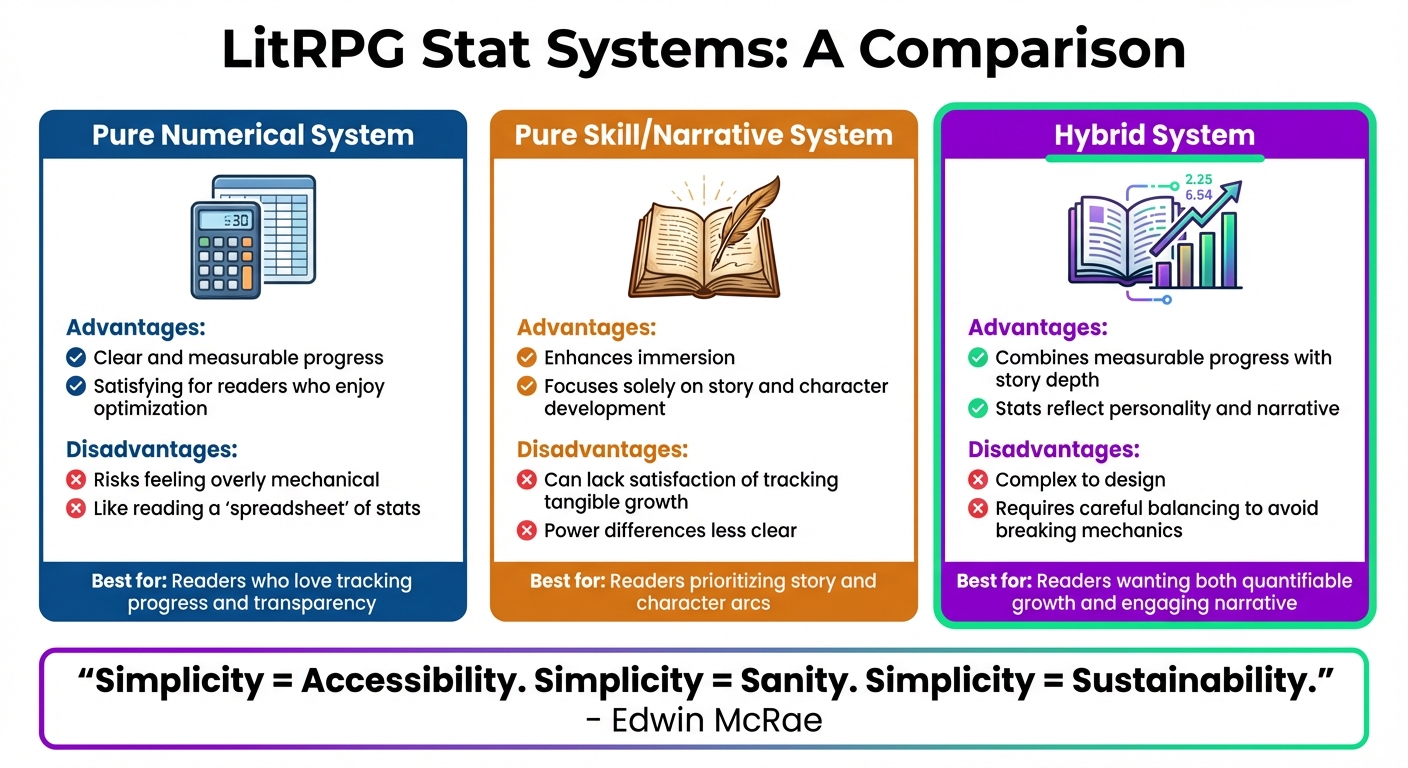
Comparison of LitRPG Stat System Types: Pure Numerical vs Pure Narrative vs Hybrid
Revealing Stats Through Character Sheets
Stats can be revealed strategically during pivotal story moments - like an intense boss fight, a character's personal breakthrough, or a significant plot twist. By showing only the relevant stats (e.g., revealing a character's Intelligence when they unlock a new fire spell), you avoid overwhelming readers with unnecessary details, keeping them immersed in the narrative.
Use formatting tools like italics, brackets, or text boxes to distinguish system updates from the story. This approach also works to highlight internal monologues. For instance, a confident character might think, "Finally hit Level 15 - time to show these bandits what real power looks like," while a more nervous one might worry, "My Health just dropped to 40%. I can’t take another hit." You can further integrate stats into the story by reflecting numerical changes in physical actions - like a Strength boost allowing someone to break handcuffs. This creates a sense of "implicit progression", where stat increases feel like natural character growth rather than arbitrary numbers.
These techniques help stats align with the story, making progression feel meaningful and tied to character milestones.
Narrative-Driven Stat Progression
Building on selective stat reveals, you can tie level-ups to emotional or story-driven moments. For example, a character might gain new abilities after conquering a personal fear, overcoming a traumatic event, or making a selfless decision. This makes their growth feel earned and emotionally resonant.
To deepen this connection, link skill unlocks to your world’s lore. A character acquiring a new ability could study ancient texts, train under a master, or rediscover lost techniques. This not only grounds progression in the story but also avoids the jarring feel of game-like mechanics suddenly appearing. Well-thought-out systems can even influence the world itself - for example, societies where skill levels determine social status, or legal rights tied to attributes like Charisma.
For characters reaching power levels that outgrow standard numerical scales, consider using ranks (e.g., S, SS, SSS) to keep progression understandable. And always apply the "Skip Test": if readers choose to ignore stat updates, the story should still flow seamlessly.
Pros and Cons of Hybrid Systems vs. Pure Systems
Here’s a quick look at how different systems compare, especially in the context of stat reveals and progression:
| System Type | Advantages | Disadvantages |
|---|---|---|
| Pure Numerical | Offers clear and measurable progress, satisfying readers who enjoy optimization. | Risks feeling overly mechanical, like reading a "spreadsheet" of stats. |
| Pure Skill/Narrative | Enhances immersion by focusing solely on story and character development. | Can lack the satisfaction of tracking tangible growth or power differences. |
| Hybrid System | Combines measurable progress with story depth, letting stats reflect personality. | Complex to design and requires careful balancing to avoid breaking mechanics. |
Pure numerical systems are great for readers who love tracking progress and enjoy transparency in character growth. However, they can bog down the story with excessive details, making it feel dry or overly technical.
On the other hand, pure skill or narrative systems excel at immersing readers in the story and character arcs but may leave them wanting the satisfaction of seeing quantifiable growth. Hybrid systems aim to bridge this gap, offering the clarity of numbers while ensuring the narrative stays engaging. The key is consistency - once you set rules for things like mana costs or cooldowns, they must remain reliable throughout the story. As Edwin McRae wisely notes:
"Simplicity = Accessibility. Simplicity = Sanity. Simplicity = Sustainability."
Best Practices for Authors Designing Hybrid Stat Systems
Avoiding Common Pitfalls
Don't let your story become a data dump. Including full stat sheets in every chapter or overloading readers with dense system explanations can grind your narrative to a halt—a common challenge when balancing Progression Fantasy vs LitRPG mechanics. Keep your systems straightforward and easy to follow to maintain the flow of your story.
Another common misstep is inconsistent power scaling. If your protagonist suddenly leaps from Level 10 to Level 25 without any logical progression or narrative cost, it can break the reader's trust. Similarly, introducing "mystery mechanics" - new rules or systems that appear out of nowhere - can feel like you're inventing solutions on the fly. Proper foreshadowing is key to avoiding this trap and keeping your world believable.
Equally problematic is failing to connect stats to the narrative. Simply mentioning a "+2 Strength" isn’t enough to engage readers. Instead, show what that stat boost means in the story: maybe it allows the character to break free from handcuffs or move a massive obstacle. Numbers alone don't create emotional stakes - descriptive, immersive storytelling does.
Once you’ve sidestepped these pitfalls, the next step is weaving your hybrid stats naturally into your story.
Organic Integration of Hybrid Stats
The best hybrid stat systems feel like a natural part of the story rather than a distraction. Think of stats as tools to support your narrative, not as the main focus. Ursula Le Guin's "shave the brick" technique is a great approach: instead of dumping loads of stats at once, sprinkle bits of system logic throughout your story. For example, reveal only the stats relevant to a specific scene - like a partial stat sheet during a high-stakes boss battle - rather than overwhelming readers with unnecessary details during quieter moments.
Tie every stat change to an emotional moment. A level-up should reflect more than just numbers; it should show how the character is growing emotionally or mentally. If your mage runs out of mana during a pivotal fight, it’s not just a mechanical limitation - it’s an opportunity to create tension and force creative problem-solving. You can also format system messages in the protagonist's voice, using italics or brackets, to keep the immersion intact without cluttering the page.
Keeping Systems Accessible to Readers
Simplicity and consistency are your best allies when designing stat systems that readers can easily follow. Keep the number of core stats manageable. For instance, instead of tracking separate values for strength, agility, and dexterity, you could combine them into a single "Body" stat, representing overall physical capability. This mirrors how physical traits often overlap in real-world scenarios, like athletics.
Behind the scenes, tools like Excel or Google Sheets can help you manage complex calculations and maintain consistent power scaling without bogging down your prose. For digital formats, use tables instead of images for stat blocks. Tables not only work better with screen readers but also avoid extra delivery fees on platforms like Amazon KDP.
Once you've established rules for things like mana costs, cooldowns, or stamina limits, stick to them. Consistency builds trust with your readers and prevents frustration caused by arbitrary changes to the system.
Conclusion
Hybrid stat systems shine by blending simplicity with depth. To keep readers engaged without overwhelming them, focus on straightforward core mechanics - three to five primary attributes often hit the sweet spot. As Edwin McRae wisely states:
"Simplicity = Accessibility, Simplicity = Sanity, Simplicity = Sustainability".
This approach forms the backbone of effective system design.
The real magic of hybrid systems lies in tying stats to narrative moments. Every level-up, skill unlock, or stat boost should echo a character's journey - whether it's conquering fear, making a tough choice, or achieving victory. Research shows that when emotional growth aligns with mechanical progression (within a 15% variance), reader satisfaction jumps by 73%. Numbers alone don’t create stakes; it’s the story behind them that resonates.
Consistency is another cornerstone. Sticking to established rules - like mana costs, cooldowns, or armor scaling - not only builds trust but also ensures a smooth narrative. Tools like spreadsheets can help maintain balance and avoid "hyper-scaling", where stats lose meaning at higher levels. Readers are quick to spot inconsistencies in the rules.
Stats should complement your story, not overshadow it. Share system details at impactful moments - after a major battle, during a character’s breakthrough, or when the stakes are at their peak. Weave mechanics seamlessly into your world so they feel integral to the universe rather than tacked on.
When hybrid stat systems stay accessible, connect to emotional beats, and follow consistent rules, they elevate LitRPG and GameLit novels. This balance appeals to both the number-focused readers and those drawn to compelling narratives.
FAQs
How do I pick the right number of core stats?
Choosing how many core stats to include in a LitRPG system boils down to finding the sweet spot between simplicity and functionality. A good starting point for many authors is a small set of three to five stats - common examples include Body, Mind, and Spirit. Each stat should serve a clear purpose, adding depth to the gameplay or story without bogging down readers with excessive complexity. Keeping things straightforward makes the system easier to grasp and ensures the narrative remains front and center.
How can I prevent broken power scaling over a series?
To prevent power scaling from spiraling out of control in LitRPG stories, it's crucial to create a progression system that's both balanced and well-defined. Start by setting clear limits and milestones for character growth. Using growth curves - such as logarithmic or exponential functions - can help keep development feeling realistic and challenging over time.
Take inspiration from successful LitRPG series. Study how they handle progression and adapt those insights to fit your story. Regularly fine-tune your system to ensure it stays balanced as the narrative evolves. This approach keeps character growth satisfying while preserving the consistency of your story's internal logic.
When should I show stats without killing pacing?
When using stats, make sure they add to the story rather than bogging it down. Most readers appreciate quick, skimmable details over an overload of numbers. Introduce stats naturally - connect them to character growth or plot points to keep things flowing. Steer clear of lengthy info-dumps or overly technical asides that might feel like interruptions. Instead, strike a balance that keeps fans informed without losing the narrative’s momentum.