
Role Synergy in LitRPG: Tank, Healer, DPS Explained
In LitRPG and GameLit stories, teamwork is everything. The "Holy Trinity" of roles - Tank, Healer, and DPS - forms the backbone of any successful group. Each role has a distinct job:
- Tank: Absorbs damage and keeps enemies focused on them for the team's safety.
- Healer: Keeps the group alive by restoring health and removing harmful effects.
- DPS (Damage Per Second): Deals high damage to eliminate enemies quickly.
These roles don't just make battles more dynamic - they shape the narrative, character growth, and group dynamics. Tanks provide stability, Healers ensure survival, and DPS characters bring the offensive power. Together, they create tension and strategy in both combat and storytelling.
The key to success lies in synergy: Tanks control the battlefield, Healers manage resources wisely, and DPS players optimize their damage output. When these roles work in harmony, they ensure not just survival but victory in even the toughest encounters.
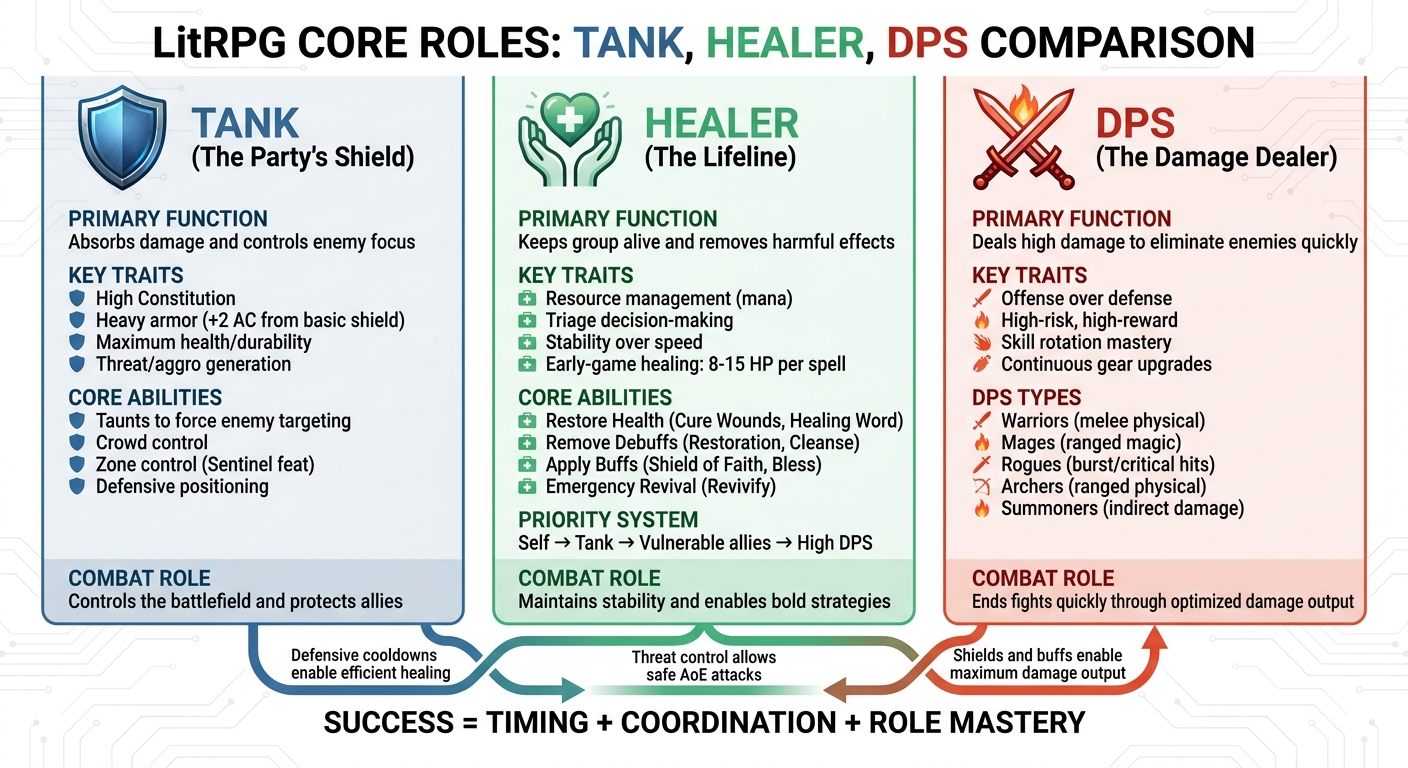
Tank, Healer, and DPS Roles in LitRPG: Key Traits and Responsibilities
Why Do So Many Games Have Tanks, Healers and DPS?
sbb-itb-2566684
The Tank: The Party's Shield
The Tank takes the brunt of the action, standing firm on the front lines to protect the rest of the party. As The Nilbog aptly describes it:
The Tank is big, the Tank is tough. The Tank doesn't hit very hard, but he's in the enemy's face, making sure the focus is on him alone.
This role isn't about flashy damage or quick takedowns. Instead, it's all about endurance. While damage dealers might fold after a single heavy hit, a Tank is built to withstand relentless punishment.
Key Traits of a Tank
Tanks are all about durability. They maximize their health and rely on heavy armor to act as an impenetrable barrier. In D&D-inspired LitRPG systems, a basic shield adds a +2 bonus to Armor Class (AC), but Tanks often stack additional defensive gear like a Cloak of Protection or a Ring of Protection to push their defenses even further.
At the core of any Tank's build is Constitution, which boosts their hit points and helps maintain concentration on defensive spells during combat. Racial bonuses also play a big role: Hill Dwarves gain an extra +1 HP per level, while Warforged characters enjoy built-in immunities to certain conditions. Beyond raw stats, Tanks also rely on abilities that generate "threat" or "aggro" - mechanics that force enemies to target them instead of their more fragile teammates.
With these tools, Tanks don't just survive; they actively control the battlefield, keeping enemies where they want them.
Tanks in Action: Controlling the Battlefield
Tanks excel at shaping the flow of combat. By predicting enemy movements and using taunts, they create a frontline that keeps foes in check. LitRPG author Isaac Hanson captures this perfectly:
The essence of tanking lies in predicting the flow of battle and positioning yourself effectively.
A Tank's arsenal includes taunts and other abilities that force enemies to focus on them. By establishing "zones of control", they make it nearly impossible for foes to bypass the frontline and target vulnerable allies. Feats like Sentinel are a game-changer here, as they stop enemies in their tracks by reducing their speed to zero when hit.
But it doesn't stop there. Tanks are also responsible for crowd control. When swarmed by multiple foes, a Tank must juggle their attention - stunning one enemy, intercepting another, and disrupting formations to maintain order on the battlefield. Success often depends on teamwork, especially with Healers, to time defensive maneuvers and keep the party standing strong.
In short, Tanks don't just endure - they control the chaos, ensuring their party can fight another day.
The Healer: The Lifeline of the Party
While Tanks endure the brunt of attacks, Healers are the ones who keep everyone standing. Positioned behind the frontline, they monitor the group's health and incoming threats. But their job isn’t just about topping off health bars - it’s about creating stability. As BoostRoom explains:
Your first goal is stability. Your second goal is speed.
Experienced Healers stay calm under pressure, focusing on who is at risk of dying soon rather than simply targeting the lowest health bar. This triage approach sets apart effective Healers. Their priorities are clear: protect their own survival first (a fallen Healer can lead to disaster), then focus on the Tank, followed by those taking unavoidable damage, and finally handle harmful debuffs like paralysis or damage-over-time effects.
Healers also play a vital psychological role. As LitRPG Reads notes:
A well-timed heal doesn't just save hit points; it boosts morale, allowing your team to take calculated risks.
This morale boost empowers the party to take on challenges with greater confidence, enabling bolder strategies and smoother coordination between Tanks and DPS.
Key Abilities of a Healer
Healers rely on a versatile set of abilities to keep their team alive and in fighting shape:
- Restore Health – Spells such as Cure Wounds, Healing Word, and Mass Heal repair damage and restore hit points.
- Remove Debuffs – Abilities like Restoration, Esuna, and Cleanse clear harmful effects such as poison, paralysis, or lingering damage-over-time.
- Apply Buffs – Spells like Shield of Faith, Aid, and Bless strengthen defenses, grant temporary hit points, or boost stats to reduce incoming damage.
- Emergency Revival – Skills like Revivify and Raise bring fallen allies back into the fight, though using them often signals that something went wrong earlier.
Mastering these tools means knowing when to use them. For instance, early-game healing (levels 1–3) often restores 8–15 HP per spell—a staple of Progression Fantasy vs LitRPG mechanics—which aligns with the average monster damage of 5–10 HP per hit. This balance requires Healers to carefully match their spells with the party’s needs. Preventive actions, like applying buffs or shields, are often more efficient than reactive healing after damage has been taken. These measures reduce spikes in damage, keeping the group stable and avoiding unnecessary panic.
Resource Management for Healers
The true test of a Healer lies in how well they manage their resources - namely, mana and cooldowns - during long battles. Overhealing, or casting powerful spells on targets that don’t need them, can quickly drain resources. As BoostRoom points out:
If you're forced into repeated hard-cast heals, something is off. Either the tank isn't mitigating, the pull is too big... or you're not using your kit efficiently.
A savvy Healer uses recovery tools proactively. Abilities like Lucid Dreaming or mana potions should be used when mana drops to around 70–80%, rather than waiting until it’s dangerously low. This approach helps avoid a critical "Out of Mana" moment that could jeopardize the fight.
Off-global cooldown (oGCD) abilities are another key part of a Healer’s toolkit. These instant spells can be used between primary casts, allowing Healers to heal while still contributing damage or buffs. And when the party is stable, adding damage can be a strategic choice. As BoostRoom explains:
Healing prevents deaths. Damage prevents future damage by ending the fight sooner.
Quicker fights require less healing overall, preserving resources for tougher encounters. By balancing stability and speed, expert Healers not only keep their party alive but also enhance the group’s overall effectiveness, ensuring both defense and offense remain in sync.
The DPS: The Party's Damage Dealer
Tanks take the hits, Healers keep everyone alive, and DPS? They’re the ones who bring the pain. As The Nilbog explains:
DPS stands for Damage Per Second, and thusly their role is to hit hard and fast.
This role prioritizes offense over defense, focusing purely on dealing damage. As All The Tropes puts it:
They focus on offensive power over all else, particularly defense.
It’s a high-risk, high-reward approach. DPS characters need to strike a careful balance - pushing their damage output to end battles quickly without drawing too much attention from enemies. Overextending can lead to their downfall, while underperforming can leave their team vulnerable.
Types of DPS Roles
DPS characters come in a variety of flavors, each with its own style. Here’s a breakdown of the most common types:
- Warriors (or Fighters): These are close-range powerhouses who rely on physical strength and weapon mastery to deal consistent damage in melee combat.
- Mages (Wizards/Sorcerers): Masters of the arcane, Mages unleash devastating spells from a distance, often reshaping the battlefield with their sheer magical force.
- Rogues (Thieves/Assassins): Stealthy and precise, Rogues excel at burst damage, using critical hits to deliver devastating blows in short bursts rather than prolonged battles.
- Archers (Rangers): Experts in ranged combat, Archers pick off enemies from afar, keeping themselves out of immediate danger.
- Summoners and Necromancers: These roles take a more indirect approach, summoning creatures or undead minions to do the fighting while they remain at a safe distance.
Each archetype offers a unique combat style. Melee DPS must balance their offensive power with enough resilience to survive on the frontlines, while ranged and magic-based roles rely on positioning and distance to stay out of harm’s way. Understanding these differences helps define how each type contributes to overall team dynamics.
Maximizing Damage Output
To excel as a DPS, it’s all about optimizing skills, gear, and positioning. Success starts with mastering skill rotations - specific sequences of abilities designed to maximize damage over time. Specializing through skill trees, like focusing on elemental magic for a Mage, allows for more targeted power growth.
Gear also plays a critical role. Continuously upgrading equipment to enhance key stats - like strength for melee fighters or mana for spellcasters - ensures your damage output keeps pace with tougher challenges. Positioning is equally important. Melee DPS must stay close enough to deal damage but avoid pulling enemy attention away from the Tank. Meanwhile, ranged DPS should use distance and cover to stay safe while maintaining consistent damage output.
Team coordination is crucial too. Timing damage bursts with the Tank’s crowd control abilities ensures that DPS can hit hard without putting themselves in danger. With the right strategy, DPS players can dominate the battlefield while keeping their team in the fight.
Building Synergy: How Tank, Healer, and DPS Work Together
Effective teamwork in any party hinges on timing and cooperation. True synergy happens when every role performs its duties at the right moment. As BoostRoom puts it:
Party synergy is the difference between 'we cleared' and 'we farmed it cleanly three times in a row'.
Tank-Healer Synergy
The connection between the tank and healer is the foundation of a strong team. A tank’s job is to make life easier for the healer - keeping pulls manageable and using defensive cooldowns proactively. This gives healers the chance to pre-cast shields or apply mitigation during known danger points. When tanks manage their defenses well and DPS avoid unnecessary hits, healers can conserve their resources and even pitch in offensively.
Tank-DPS Synergy
Tanks play a crucial role in setting up DPS for success. By controlling enemy positioning and maintaining threat, tanks allow DPS to fully utilize Area of Effect (AoE) attacks, turning prolonged battles into quicker victories. Tanks also isolate dangerous enemies, giving melee DPS the opportunity to attack safely from behind. DPS players, on the other hand, need to give tanks a brief window - 1 to 2 seconds - at the start of an encounter to secure aggro. Jumping in too early can disrupt the tank’s control and shift enemy focus. Coordinated DPS efforts also involve targeting enemies that complicate the tank’s job, like those with silencing or interrupting abilities, before focusing on high-damage AoE attacks. This teamwork creates a controlled battlefield, allowing healers to focus on their role more effectively.
Healer-DPS Synergy
Healers act as a safety net, providing shields and reactive healing that let DPS push their damage to the edge. Keeping top-performing DPS alive not only speeds up encounters but also reduces the overall damage the party takes. Healers follow a strict priority system: they focus on themselves first to prevent a total wipe, then the tank to maintain stability, followed by players targeted by lethal mechanics, and finally high-output DPS. In addition to healing, effective healers enhance team performance by applying buffs that amplify DPS output, creating a dynamic and efficient combat environment.
Role Synergy in Action: Examples from LitRPG Stories
The dynamic teamwork of Tanks, Healers, and DPS isn't just a cornerstone of gameplay - it’s vividly brought to life in LitRPG novels.
Party Dynamics in LitRPG Novels
LitRPG stories excel at showcasing how characters master the tank-healer-DPS triad to tackle overwhelming challenges. In The Gilded Rebellion by Rebecca Vale (published by Sababa Books), Nyra Amaris shifts fluidly between tanking as a Dire Wolf and dealing ranged damage as a Stellar Phoenix, demonstrating versatility in role adaptation. On the other hand, Sera Kane’s The Lifeline Protocol takes a different approach, with Myra Steele leveraging Quantum Transformation Technology instead of magic to navigate a post-apocalyptic world. These stories emphasize how a dependable healer enables bold tactical decisions, keeping the team afloat during critical moments.
Such examples naturally set the stage for gripping battle sequences where every role’s contribution is vital.
Lessons from Epic LitRPG Battles
Epic battle scenes in LitRPG novels vividly highlight the importance of precise role coordination. These moments often contrast preventive tactics like buffs, barriers, and strategic positioning with reactive measures. Every action - main, bonus, and reaction - is carefully utilized to maintain combat momentum in high-stakes scenarios. Writers often use strategic positioning to heighten drama; for instance, a healer being forced out of range or a tank losing control of enemy threat can instantly escalate the tension. The stakes become even clearer when the numbers tell the story: a healer’s recovery of 40–60 HP barely outpaces enemy damage of 35–50 HP in mid-level encounters, making every decision count.
As LitRPG Reads puts it:
When players know there's a reliable healer in the group, their confidence soars, leading to bolder moves and more dynamic combat strategies.
Conclusion: Mastering Role Synergy in LitRPG
Mastering the Tank, Healer, and DPS triad is about more than just gameplay mechanics - it’s a cornerstone of compelling LitRPG storytelling. As Progression Fantasy aptly puts it:
Character classes are linchpins that elevate plot, character development, and themes.
Understanding how a tank’s aggro management, a healer’s resource allocation, and a DPS’s damage output work together doesn’t just make battles more engaging - it deepens the entire narrative.
The balance between these roles reflects real-world teamwork challenges. When one role falters or overshadows the others, the entire party risks failure. This delicate balance creates tension, forces tactical decisions, and fuels character growth, making the story feel alive with stakes and consequences. The interplay of these roles doesn’t just shape the strategy - it drives the drama.
The Holy Trinity framework provides a clear structure for overcoming even the most daunting challenges. For example, the precise coordination required to balance mid-level damage (35–50 HP) with healing (40–60 HP) highlights how critical synergy is to survival.
For a closer look at these dynamics, check out Sababa Books’ The Gilded Rebellion by Rebecca Vale or The Lifeline Protocol by Sera Kane. These stories showcase characters who embody these roles, adapt to ever-changing battlefield conditions, and prove that mastering synergy can mean the difference between triumph and a total party wipe.
FAQs
What is aggro, and how do Tanks keep it?
Aggro is all about how much attention or threat a character creates to draw enemy focus. Tanks are masters at managing aggro. They use specific abilities to grab the enemy's attention and position themselves carefully to shield their teammates. This way, enemies stay locked on the tank, keeping the more fragile team members out of harm's way.
When should a Healer buff instead of heal?
A healer's main focus should shift to buffing when the team requires a short-term boost in stats, such as increased attack power or defense. These buffs can be game-changing, especially during high-stakes moments where improving the team's overall performance takes priority over immediate healing.
How can DPS maximize damage without pulling threat?
To deal the most damage as a DPS without drawing unwanted attention, you need to balance high output with smart threat management. Work closely with the tank to ensure they hold aggro, avoid using abilities that generate too much threat, and time your attacks strategically. Positioning is key - staying behind or keeping a safe distance from enemies not only reduces your risk but also allows you to maintain steady and effective damage.