
Evolving Quests: Lessons From Game Design
Game design principles can transform LitRPG and progression fantasy writing by creating dynamic, choice-driven narratives. The secret lies in using evolving quest systems - where decisions impact the story and world - to engage readers more deeply. Here's what you need to know:
- Evolving Quests: These systems track player actions and create lasting consequences, from small dialogue changes to major world shifts.
- Core Structure: The best quests follow a pattern: Hook, Decision, Complication, Payoff, and Epilogue.
- Impactful Choices: Readers want protagonists whose decisions visibly affect the world, unlocking new paths or altering NPC behavior.
- Dynamic Rewards: Balance mechanical progression (stats, abilities) with emotional growth to keep readers invested.
- Game Examples: Games like The Witcher 3 and Guild Wars 2 excel at blending adaptive objectives with immersive storytelling.
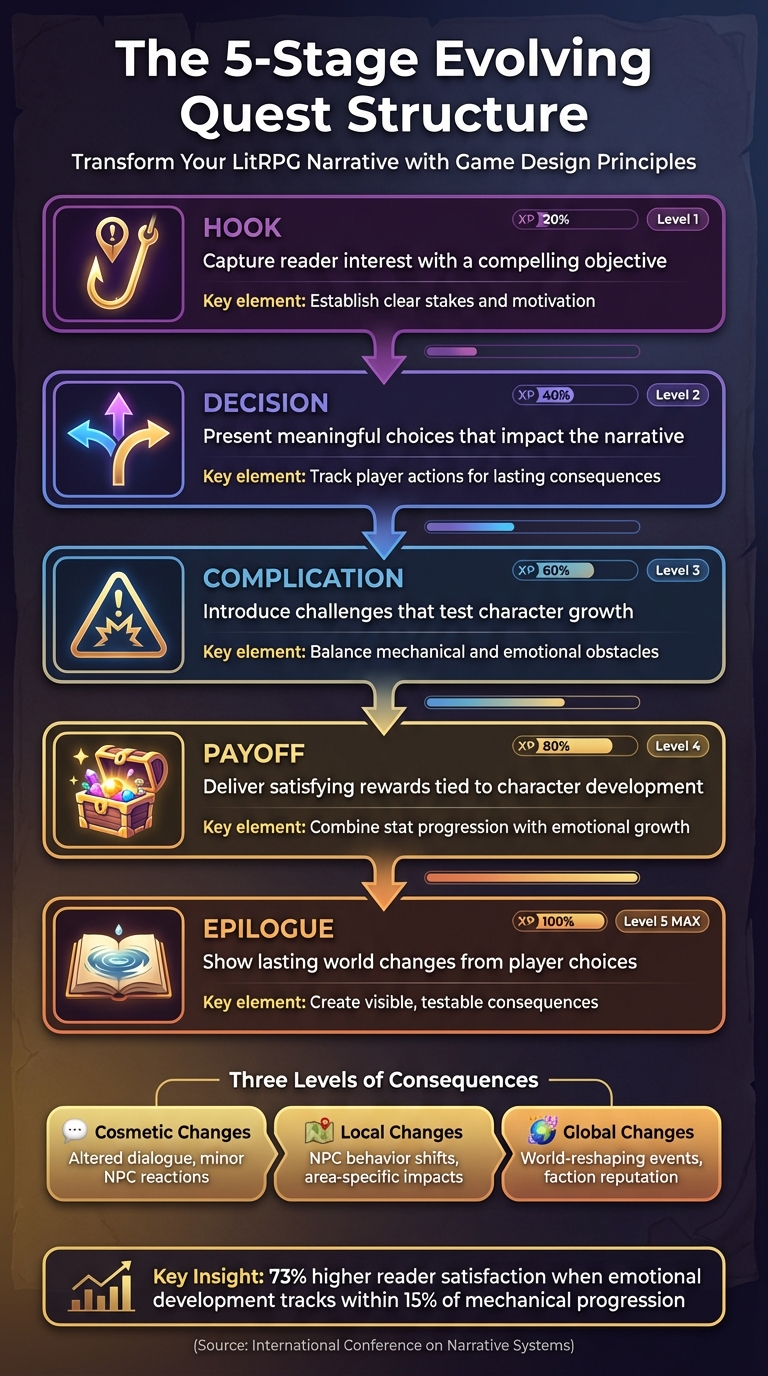
5-Stage Evolving Quest Structure for LitRPG Writers
Quest Design Primer - An Introduction to Quest Design
sbb-itb-2566684
Basic Principles of Evolving Quests in Game Design
Evolving quests succeed because they allow the game world to respond meaningfully to your actions. Instead of resetting NPCs or environments, these systems track both global elements (like faction reputation) and local ones (such as helping a merchant). This creates a world that reacts dynamically, where your choices have lasting consequences. Take Guild Wars 2, for example: its event chains progress through multiple stages depending on whether players succeed or fail collectively. The difficulty adjusts based on player participation, and the resulting changes linger in the game zone.
What sets dynamic quests apart from static ones is their consequence-driven storytelling. Designers typically group these consequences into three levels: cosmetic changes (like altered dialogue), local changes (such as an NPC behaving differently), and global changes (which reshape the entire game world). The most engaging systems make these consequences both visible and immediate. As PulseGeek highlights, "Use branching only where consequence is visible and testable in flow". If players can’t see how their choices impact the world, the branching feels meaningless. This approach also helps distinguish between optional and core progression paths in LitRPG and GameLit.
Modern quest design often separates progression into two main types. Side-quest progression provides optional upgrades that enhance your character’s power, giving you more flexibility in tackling challenges. On the other hand, campaign progression introduces abilities that transform gameplay itself. Josh Bycer, game design expert and author, explains this distinction:
"Upgrades introduced through the game should change how the game plays from that point on, not act as keys to get around certain obstacles".
The most rewarding systems don’t just boost stats by a small percentage - they unlock entirely new mechanics, offering fresh strategies and gameplay opportunities.
Dynamic events also play a critical role in storytelling by balancing structure and unpredictability. For instance, The Elder Scrolls Online features "Harrowstorm" events that appear randomly across zones, altering familiar areas and spawning unique enemies. These events tie into the larger narrative while still feeling unscripted. Such systems rely on an event-driven architecture, where specific triggers and probabilities set off world events that can cascade into others. This creates emergent storytelling, where the world evolves independently of the player’s direct actions.
Examples of Evolving Quest Mechanics in Popular Games
These examples highlight how evolving quest systems captivate players while enriching dynamic storytelling in LitRPG and progression fantasy genres.
Branching Quest Lines in MMORPGs
When World of Warcraft launched in 2004, it redefined how MMORPGs approached questing. Initially, the game's quest design offered a limited number of tasks. However, feedback during the alpha phase led to the introduction of expansive, story-driven quest chains. This shift allowed players to level up entirely through quests without needing to repeat content. Jeff Kaplan, one of the game's developers, later noted:
"We realized at that moment, that was defining in WoW's questing history. There's a new paradigm here. What previous games have done is not going to be accessible if we want to broaden our reach."
This decision not only made the game more approachable for casual players but also set a new benchmark for MMORPGs. Building on this foundation, many open-world RPGs have since refined quest mechanics to create deeper, more personalized narratives based on player choices.
Adaptive Objectives in Open-World RPGs
Taking dynamic questing to the next level, The Witcher 3 showcases how adaptive objectives can heighten narrative immersion. For example, the "Battle of Kaer Morhen" mission adjusts to player-driven decisions, with custom scripts creating effects like falling meteors that alter the environment.
CD Projekt RED also ensured that every monster contract in The Witcher 3 had a well-crafted beginning, middle, and end, steering clear of repetitive fetch quests. This attention to detail extended to the Blood & Wine expansion, which featured 14,000 lines of spoken dialogue - more than double the 6,000 lines in the earlier Hearts of Stone expansion - underscoring the studio's focus on delivering rich, handcrafted narratives rather than relying on procedural generation.
Applying Game Design Lessons to LitRPG and Progression Fantasy
The best MMORPGs and open-world RPGs didn’t land on engaging quest systems by accident - they fine-tuned them over years of player feedback and iteration. Similarly, LitRPG and progression fantasy authors can draw on these lessons to craft stories where character growth feels earned and keeps readers hooked. The secret? Balancing mechanical progression (stats, levels, abilities) with meaningful challenges, then weaving that balance into the narrative.
Scaling Quest Rewards and Challenges
Early victories should come quickly; later ones, through hard-fought effort. Research shows that the most satisfying progression curves follow a modified logarithmic function, where the sense of accomplishment grows alongside the effort required. Sarah Chen from the Journal of Narrative Mathematics puts it this way:
"The ideal progression function balances the reader's psychological need for frequent rewards with the narrative requirement for meaningful challenge."
This means your protagonist should experience rapid growth early on, but each subsequent milestone should demand more effort. Merely boosting stats isn’t enough to keep readers engaged. Environmental scaling, where the world evolves to match the character’s growth, can counteract the issue of "power creep." By introducing contextual challenges, characters are forced to use strategy rather than brute force.
To keep progression fresh, combine vertical growth (stat increases) with horizontal growth (new abilities or skills). Introducing "soft caps" - where stats face diminishing returns - can also ensure balance, preventing one attribute from overshadowing the story. This mirrors game design, where players’ actions influence the world and reshape challenges.
When done right, these scaling systems naturally intertwine with the protagonist’s emotional journey, adding depth to their growth.
Linking Quests to Character Development
Balanced rewards are only part of the equation. The best LitRPG stories tie mechanical progression to emotional growth. A study presented at the International Conference on Narrative Systems found that readers rated stories 73% more satisfying when a character’s emotional development mirrored their mechanical advancement. Researcher Emily Takahashi explains:
"Our data indicates a 73% higher reader satisfaction rating for characters whose emotional development tracks within 15% of their mechanical progression rate."
For example, when your protagonist unlocks a powerful new ability, it should mark more than just a stat boost - it should represent a turning point in their personal journey. Maybe they overcome a fear, make a tough moral decision, or sacrifice something important. Quest rewards should change how the character interacts with the world, enriching both their personal arc and the broader plot.
Each quest should have a clear arc that advances both the story and the character. Borrowing from game design, consider adding "breath beats" - moments of calm after intense sequences - to let readers absorb the weight of the character’s growth. For instance, after a climactic battle where your protagonist gains several levels, include a reflective moment where they confront the emotional toll of their victory. This approach mirrors the immersive storytelling seen in works from Sababa Books, where mechanical systems and emotional depth come together to create unforgettable progression fantasy.
Strategies for Designing Dynamic Quests in Progression Fantasy
Creating Personalized Quests Through Character Choices
The best quests feel like they grow organically from your character's journey. By tying quests to your protagonist's history and decisions, you can create a narrative that feels alive and deeply personal. Game designer Jacob Laurits Besenbacher Kjeldsen sums it up well:
"The task is not to design great quests, the task is to enable the users to create great quests".
One way to achieve this is through "quest seeds" - small narrative threads that blossom later in the story. For instance, if your protagonist shows kindness to a beggar early on, that same beggar might return 50 chapters later with a unique quest or vital information. This "Delayed Impact" approach reinforces the idea that choices have lasting consequences. Similarly, "Side Stubs" - optional objectives embedded in larger quests - can add depth. Imagine your character leading a prison break: they could choose to help others escape, potentially gaining allies but increasing the immediate danger. These techniques ensure that quests feel like natural extensions of the protagonist's decisions and values.
Character classes can also influence quest design. For example, a mage might encounter puzzles steeped in arcane lore, while a warrior faces more combat-driven challenges. This doesn't mean locking quests behind rigid rules but rather tailoring the world to reflect the character's growth and identity. When quests feel specific and meaningful, readers are more likely to feel immersed in the story.
Once you’ve personalized the quests, the next challenge is balancing their complexity with reader engagement.
Balancing Complexity and Reader Engagement
Dynamic quests can make a world feel alive, but too much complexity can overwhelm readers. The trick is finding the right balance between predictability and chaos. Raiden Studio emphasizes this point:
"A dynamic quest system can be the difference between a world that feels static and one that truly lives and breathes around the player".
To see how evolving quests enhance storytelling, let’s compare them to traditional linear structures:
| Feature | Linear Quest Structure | Evolving Quest Structure |
|---|---|---|
| Definition | Fixed task list | Adaptive, goal-oriented quests |
| Reader Agency | Limited; follows a set path | High; choices shape outcomes and future options |
| Complexity | Simple to design and follow | Complex; requires tracking variables and branching events |
| Immersion | Can feel static, like a "theme park" | Engages readers with a responsive, living world |
| Narrative Role | Often a backdrop for action | A tool for character development and role-play |
To keep complexity manageable, use modular quest templates and reputation systems. These allow NPCs to offer quests that feel relevant to the protagonist without bogging down the narrative. The goal is to create a world that feels dynamic and reactive, while still being easy for readers to follow.
Conclusion: Building Evolving Quests for Better LitRPG Stories
Evolving quests go beyond being just a clever game design feature - they're a powerful storytelling tool that can redefine LitRPG and progression fantasy narratives. By drawing inspiration from interactive game design, authors can craft worlds that feel alive and reactive, rather than static and predictable. When characters make decisions that genuinely influence the story, readers feel more connected, creating an engagement level that traditional linear narratives often struggle to achieve. Interestingly, statistics reveal that LitRPG readers are 42% more likely to finish a series and show 37% higher audiobook engagement. These numbers highlight how evolving quests enhance narrative involvement, a trend recognized by leading voices in the genre.
The evolution of LitRPG into what Dr. Victoria Liang refers to as "second-wave LitRPG" shows how the genre has matured. She explains, "What distinguishes second-wave LitRPG is... a more sophisticated integration of progression mechanics with thematic development. The numbers serve the story rather than dominating it". This shift allows authors to tie measurable progress to emotional and thematic growth, giving readers the dual satisfaction of seeing characters level up while also experiencing meaningful personal development. A great example is Marcus Chen's Leveled Land, which won the World Fantasy Award in 2025. The book uses game mechanics as "narrative scaffolding" to explore deeper themes, proving that blending dynamic quests with storytelling can achieve both critical acclaim and reader loyalty.
The trick lies in finding the right balance. Dynamic quests should amplify the story without overshadowing it. Rewards should align with narrative milestones, and the world should respond to the protagonist's actions in ways that feel authentic. A reactive world - where even small decisions leave a mark - creates a more immersive experience than one filled with overly complex systems that fail to influence the plot. As Dr. Elena Vasquez puts it, "The rise of LitRPG suggests... an evolution in how stories can be structured - one that reflects our increasingly quantified and systems-oriented world". Every choice, from crafting adaptive reward systems to planting personalized quest seeds, contributes to a vibrant, responsive world.
For writers ready to dive into these techniques, platforms like Sababa Books offer excellent examples. Titles such as The Gilded Rebellion and The Lifeline Protocol illustrate how evolving quests can drive both character arcs and reader engagement, proving that game-inspired mechanics can seamlessly enhance storytelling.
FAQs
How do I track consequences without confusing readers?
To keep your readers engaged and avoid confusion, make sure your story has clear cause-and-effect relationships. Every result should logically stem from a previous action, creating a sense of natural flow. Include decisions that matter - ones with visible and impactful outcomes - so readers can easily see how choices shape the narrative. By sticking to consistent patterns and logical progressions, you’ll show how actions drive consequences, making the story both clearer and more immersive.
What’s the simplest way to turn a quest into real character growth?
The most straightforward way to turn a quest into genuine character development is by linking the character's motives directly to the quest. When a character fulfills a motive, they earn 2 growth points, while simply engaging with a motive grants 1 point. This system promotes meaningful interactions and ensures characters evolve as they work toward their objectives.
How do I balance stats, rewards, and stakes to avoid power creep?
To keep power growth in check, tie stat increases to meaningful milestones. This approach ensures that progression feels earned rather than excessive. Introduce stakes and risks to make rewards more satisfying without bloating power levels. Instead of focusing solely on stat boosts, prioritize rewards that bring variety or enrich the narrative. Restrict overpowered items and make sure challenges grow alongside player strength to preserve balance and keep the experience engaging.