
Min-Maxing vs. Balanced Builds in LitRPG
Min-maxing and balanced builds are two core approaches to character development in LitRPG stories, each shaping the narrative and gameplay in unique ways, often within the broader context of progression fantasy.
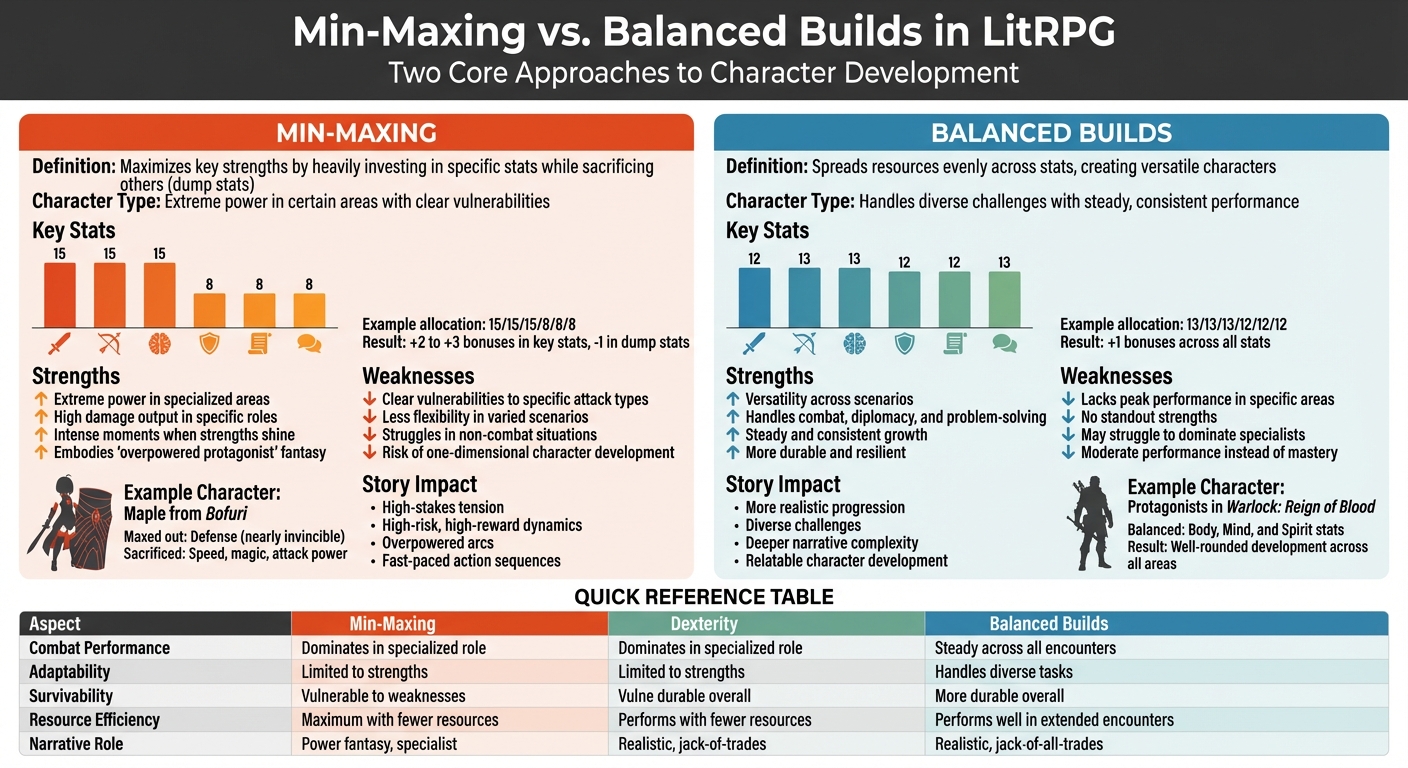
- Min-maxing focuses on maximizing a character's key strengths by heavily investing in specific stats, often sacrificing others (dump stats). This creates characters with extreme power in certain areas but clear vulnerabilities. For example, a "glass cannon" might deal massive damage but have low survivability.
- Balanced builds spread resources evenly across stats, creating versatile characters capable of handling diverse challenges. While they lack the peak performance of min-maxed characters, they offer steady performance across combat, problem-solving, and social interactions.
Key Differences:
-
Min-maxing:
- Pros: High power in specialized areas, intense moments when strengths shine.
- Cons: Glaring weaknesses, less flexibility in varied scenarios.
- Example: Maple from Bofuri maxes out defense, becoming nearly invincible but slow.
-
Balanced builds:
- Pros: Handles a variety of challenges, steady and consistent growth.
- Cons: Lacks standout strengths, may struggle to dominate in specific areas.
- Example: Characters in Warlock: Reign of Blood balance stats like Body, Mind, and Spirit, allowing for well-rounded development.
Quick Comparison:
| Aspect | Min-Maxing | Balanced Builds |
|---|---|---|
| Strengths | Extreme power in one area | Versatility across scenarios |
| Weaknesses | Clear vulnerabilities | Lack of peak performance |
| Story Impact | High-stakes tension, overpowered arcs | More realistic, steady progression |
| Example | Maple in Bofuri | Protagonists in Warlock: Reign of Blood |
Both approaches offer unique storytelling opportunities: min-maxing creates high-risk, high-reward dynamics, while balanced builds provide steady progression and diverse challenges. LitRPG authors use these strategies to shape character journeys and keep readers engaged.
Min-Maxing vs Balanced Builds in LitRPG: Complete Comparison Guide
Min-Maxing in LitRPG
What Is Min-Maxing?
Min-maxing is all about pushing a character's most important stats to their limits while sacrificing everything else. Instead of spreading points evenly across attributes like Strength, Intelligence, Charisma, and Vitality, a min-maxer funnels nearly all their resources into one or two key stats. The less important attributes - often called "dump stats" - are intentionally left weak.
Robert Fisher, referencing the 2nd edition AD&D Dungeon Masters Guide, puts it like this:
Min/maxing occurs when a player calculates all the odds and numerical advantages and disadvantages of a particular weapon. The player's decision isn't based on his imagination... It is driven by game mechanics to secure the highest modifier.
This approach treats character creation like solving a math problem. In some RPG systems, a balanced stat allocation like 13/13/13/12/12/12 might only give small bonuses (+1), while a min-maxed setup like 15/15/15/8/8/8 trades minor penalties (-1) in dump stats for bigger bonuses (+2 or +3) in key stats. The result? A character with hyper-focused strengths but glaring weaknesses.
Pros and Cons of Min-Maxing
Min-maxing creates characters who dominate in specific areas but often falter elsewhere. Here's a breakdown of the upsides and downsides:
| Aspect | Benefit | Drawback |
|---|---|---|
| Combat Performance | Excels in damage output and survivability within specialized roles | Highly vulnerable to attacks that exploit their weak stats |
| Narrative Role | Embodies the "overpowered protagonist" fantasy | Risks becoming a flat, one-dimensional character with limited depth |
| Story Pacing | Can bypass challenges through mastery of mechanics | Forces authors to adjust difficulty, which can sideline non-optimized allies |
| Flexibility | Maximizes efficiency with fewer resources | Struggles in non-combat situations like negotiations or problem-solving |
Min-Maxed Characters in LitRPG Novels
LitRPG novels often showcase the dramatic impact of min-maxing on characters and storytelling. In Bofuri: I Don't Want to Get Hurt, so I'll Max Out My Defense, the protagonist Maple invests every point into Vitality. This choice makes her nearly indestructible, but her movement speed is laughably slow, and she lacks both magic and attack power. Meanwhile, her allies Mai and Yui go for "glass cannon" builds, pouring everything into Strength. They can obliterate enemies in one hit but are incredibly fragile.
In Saintess Summons Skeletons, Sofia uses specialized gear to boost her Mana by 77%, ignoring other stats entirely. Similarly, in Min Maxing My TRPG Build In Another World, Erich tailors his growth to fit a Magic Knight build, aligning with his divine mission. These examples show how min-maxing isn’t just about stats - it’s a deliberate narrative tool that shapes how characters tackle challenges and interact with their worlds. Balanced builds, however, offer a different route for character development.
sbb-itb-2566684
Balanced Builds in LitRPG
What Is a Balanced Build?
Balanced builds take a middle-ground approach, offering flexibility rather than focusing on extreme strengths or weaknesses. Instead of pouring all points into one or two stats, these characters spread their skills across various areas, functioning like a multi-tool. The emphasis here is on versatility: balanced characters are equipped to handle combat, negotiations, puzzles, and exploration with steady proficiency. By avoiding the extremes of min-maxing, they maintain a consistent skill set, making them adaptable to a wide range of challenges.
LitRPG author Edwin McRae supports this concept by advocating for simplified stat systems like Body, Mind, and Spirit. He draws inspiration from multi-sport athlete Jeff Wilson, who demonstrates how physical traits like strength, speed, and agility often go hand-in-hand. This interconnected approach not only simplifies gameplay mechanics but also mirrors real-world dynamics, making it an appealing framework for both authors and readers.
Pros and Cons of Balanced Builds
Balanced builds come with their own set of trade-offs. While they prioritize flexibility and resilience, they often sacrifice peak performance in specific areas. Here’s a breakdown of their advantages and limitations:
| Aspect | Benefit | Drawback |
|---|---|---|
| Adaptability | Can handle diverse tasks, from combat to diplomacy and problem-solving. | Lacks the overwhelming power of highly specialized characters. |
| Survivability | More durable and less prone to failure from a single mistake. | Rarely excels in any one area, offering moderate performance instead of mastery. |
| Narrative Depth | Creates realistic challenges, avoiding overly simplistic "Easy Mode" scenarios. | May struggle to shine in moments where specialists dominate. |
| Resource Management | Performs well in extended encounters with hybrid sustain. | Managing multiple roles during critical moments can be overwhelming. |
As Gustavo Tondello puts it:
The game of life is designed for a balanced build, and that starts with balanced goals.
This idea resonates strongly in LitRPG storytelling, where balanced characters often lead to richer, more relatable narratives.
Balanced Characters in LitRPG Novels
Balanced characters frequently take center stage in LitRPG novels, offering a refreshing alternative to the hyper-specialized LitRPG archetype. These characters succeed not by excelling in one area but by maintaining moderate proficiency across a variety of challenges. In Edwin McRae's Warlock: Reign of Blood, for instance, the simplified Body/Mind/Spirit system ensures that stats like Health Points are tied to both the Body stat and the character’s level (HP = Body × Level). This approach not only boosts survivability but also mimics how real-world athletes develop multiple traits simultaneously.
Many authors also structure their narratives around the "Four Pillars of Balance" - Combat, Exploration, Roleplay, and Problem-Solving. A balanced character might not deliver devastating blows like a min-maxed striker, but they can decode ancient riddles, negotiate with NPCs, survive harsh terrain, and hold their own in battle. As LitRPG Reads describes it:
a well-oiled machine, all gears turning seamlessly as they cruise through the storyline with finesse.
This approach makes these characters feel more like real individuals navigating a dangerous and unpredictable world, rather than just stat-heavy constructs. The versatility of balanced builds not only shapes character development but also adds depth to the pacing and challenges of LitRPG stories. For those new to the genre, our guide to LitRPG and GameLit offers a deeper look at these mechanics.
How Build Choices Affect the Story
Character Development and Story Depth
Choosing between specialized power and a more balanced approach does more than shape a character’s abilities - it directly influences the story itself. Build choices are about more than just stats; they reveal the character’s personality, priorities, and even flaws. As LitRPG Reads explains, character sheets often reflect "a protagonist's dreams, limitations, ambitions, and even internal contradictions". For example, a character who maxes out damage while neglecting defense presents a high-risk, high-reward archetype. This kind of build introduces inherent vulnerabilities, creating opportunities for the narrative to challenge the character when brute strength alone isn’t enough.
Edwin McRae, author of Warlock: Reign of Blood, illustrates this concept through his Body/Mind/Spirit system. In his framework, Health Points (HP) are directly tied to both the Body stat and character level (HP = Body × Level). This connection ensures that physical growth is not just a mechanical progression but a narrative driver as well. As the protagonist faces increasingly dangerous foes, their survival depends on both their stats and their ability to adapt, weaving character development into the story’s core challenges.
Balanced builds, on the other hand, open up entirely different storytelling possibilities. The Jack-of-All-Trades archetype often symbolizes versatility but can also reflect a character’s initial indecision. These characters tend to evolve by specializing over time, often in response to specific challenges. When a character invests in traits like empathy instead of raw power, it signals a shift in their values and priorities. Even the numbers on the character sheet take on symbolic meaning, representing personal growth and evolving perspectives. This dynamic interplay between stats and story deepens the reader’s connection to the character and their journey.
Reader Connection and Story Pacing
Readers are drawn to protagonists who earn their achievements through struggle. Min-maxed builds, where characters focus heavily on specific strengths while leaving glaring weaknesses, create immediate narrative tension. These characters are always one misstep away from disaster, keeping readers engaged as they anticipate how the character will handle scenarios that exploit their weaknesses. For instance, a warrior with maxed-out strength but little intelligence facing a mental puzzle - or a delicate social situation - creates high stakes because of their imbalance.
Balanced builds, by contrast, often feel more relatable. They mirror the kind of interconnected growth seen in real-world development, like athletes who train across multiple disciplines. This approach resonates with readers who value a more human-like progression. However, balanced characters can sometimes slow the pacing of a story if their steady competence reduces the stakes. To counter this, LitRPG stories often lean into the underdog trope, where characters succeed despite starting with weaker classes or races. Kit Falbo’s The Crafting of Chess is a great example. The protagonist relies on non-combat skills and deep system knowledge to overcome challenges, offering a refreshing twist on traditional heroics.
Pacing also depends on how characters handle encounters. Min-maxed builds often create "snowball effects" by focusing on control strategies like forced movement or resource denial, allowing them to enter major battles fully prepared. While this can speed up the narrative, it risks removing tension if the character becomes too dominant, leading to predictable outcomes. The balance between fast-paced action and meaningful stakes is a key factor in keeping readers invested.
Build Strategies in Sababa Books Titles
Sababa Books’ LitRPG titles showcase how different build strategies can shape both plot and character development. In The Lifeline Protocol by Sera Kane and The Gilded Rebellion by Rebecca Vale, the protagonists’ mechanical decisions directly influence their journeys. These stories explore the tension between specialization and versatility, showing how characters navigate the consequences of their choices while facing increasingly complex challenges.
One recurring strategy in progression fantasy is the "Perfect Build", which focuses on Defense, Recovery, and Strength. This approach ensures that characters remain effective even in tough situations, like when mana reserves are depleted. It also allows for calculated risks - sometimes called "calculated insanity" - to acquire skills that fill gaps in their abilities. Every new skill becomes a deliberate choice, reflecting both mechanical growth and personal development.
Conclusion
Key Points
From the comparisons above, it’s clear that min-maxing and balanced builds offer two very different paths for character development in LitRPG stories. Min-maxed characters excel in specific areas but carry the risk of being undone by a single glaring weakness. As gamification expert Gustavo Tondello puts it:
A single high score doesn't make you a winner. It just makes you a specialist.
On the other hand, balanced builds focus on developing all stats more evenly, creating characters who are versatile and adaptable. These characters can handle combat, exploration, roleplay, and puzzles, making them well-suited for a variety of challenges, from diplomacy to intricate problem-solving. While they may lack the raw power of min-maxed builds, their ability to adapt and endure gives them a different kind of strength. Tondello sums it up well:
The ultimate victory lies in building a life that's not just successful in one area, but resilient, joyful, and fulfilling in all of them.
The choice of build also shapes the narrative. Min-maxed characters often create high-stakes tension, starting out as fragile specialists who need team support but can dominate later in the story once their strengths are fully unleashed. Balanced characters, however, offer more depth, seamlessly navigating diverse plot elements beyond combat, such as diplomacy and strategy. These decisions don’t just influence stats - they guide the entire narrative, determining whether the story leans toward intense, action-driven power fantasies or richly layered, challenge-filled adventures.
Discover LitRPG Novels at Sababa Books
If you’re intrigued by how these strategies play out in storytelling, check out the LitRPG novels at Sababa Books. Their curated collection includes titles like The Lifeline Protocol by Sera Kane and The Gilded Rebellion by Rebecca Vale, which showcase both min-maxed specialists and balanced protagonists. Whether you’re drawn to the high-stakes risks of min-maxing or the steady adaptability of balanced builds, these novels bring these concepts to life in gripping, action-packed adventures.
The Best Isekai You Will Ever Read - Min/Maxing my TRPG Build in Another World
FAQs
When should a LitRPG character min-max instead of going balanced?
When creating a LitRPG character, min-maxing is the way to go if your focus is on squeezing out maximum efficiency in combat, exploration, or honing specific skills. This strategy involves prioritizing certain stats or abilities to excel in areas like dealing damage or surviving tough encounters, often sacrificing roleplay or narrative depth in the process.
On the other hand, a balanced build is ideal for players who value roleplay and character development. It avoids the pitfalls of overly specialized characters that might disrupt the flow of the story, offering a more well-rounded and immersive experience.
How do authors keep min-maxed protagonists from feeling overpowered?
Authors keep min-maxed protagonists from becoming overpowered by carefully balancing their abilities within the story's framework. They often introduce limitations, such as finite resources or challenging environments, to prevent the character from effortlessly dominating every situation. Another tactic is emphasizing the need for strategic decision-making, ensuring even highly optimized characters must adapt and think on their feet. These methods help maintain suspense, encourage character development, and ensure the protagonist remains engaging and relatable despite their strength.
Can a balanced build still feel exciting in combat-heavy LitRPG?
Balanced builds can bring a sense of thrill to combat-heavy LitRPGs, especially when the mechanics and character progression are well-designed. Unlike min-maxed builds that hone in on specific strengths, balanced builds provide versatility, allowing characters to adapt to a variety of situations. This flexibility can make combat feel more dynamic and less predictable. When systems reward strategic thinking and skillful execution, battles stay engaging and impactful, even without the sheer power that comes with min-maxed setups.