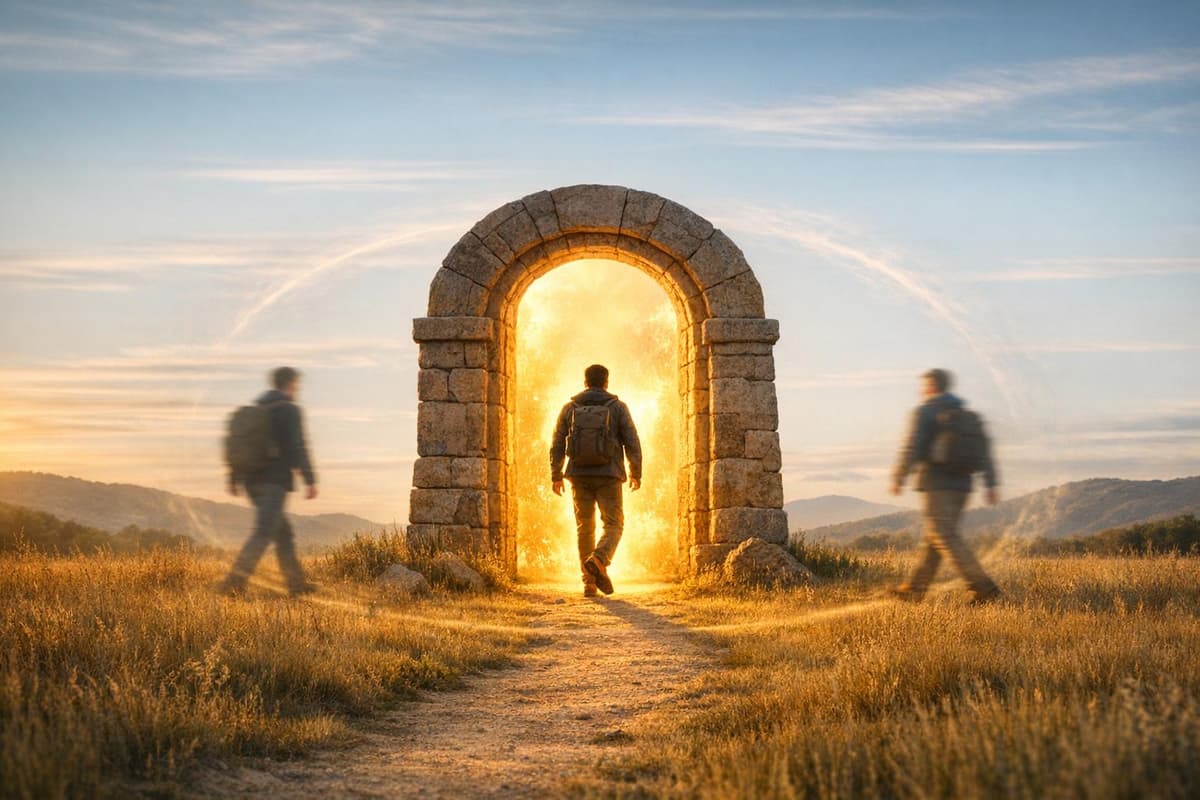
How Hero's Journey Shapes Portal Fantasy
The Hero's Journey is a storytelling framework that maps a character's transformation through three acts: Departure, Initiation, and Return. Portal fantasy - a genre where characters enter magical worlds through gateways like wardrobes or mirrors - fits seamlessly into this structure. Key moments, such as crossing into the magical world, facing trials, and returning home changed, align perfectly with the Hero's Journey stages.
Portal fantasy thrives on the contrast between portal fantasy vs epic fantasy settings, offering a space for growth and self-discovery. Classic examples like The Chronicles of Narnia and The Wizard of Oz, as well as modern takes like The Wayward Children series, use this framework to create engaging narratives that resonate with universal themes of courage, transformation, and personal growth.
Here’s why this pairing works:
- Crossing the Threshold: The portal symbolizes stepping into the unknown, a key moment in the Hero's Journey.
- Trials and Allies: The magical world tests the hero while offering allies and lessons.
- Return with the Elixir: The protagonist comes back stronger, bringing wisdom or change to their original world.
This structure has shaped countless portal fantasy stories, from Tolkien to modern LitRPG titles, showing its enduring appeal in storytelling.
How to Use The Hero's Journey to Help Your Story
sbb-itb-2566684
What Is the Hero's Journey Framework?
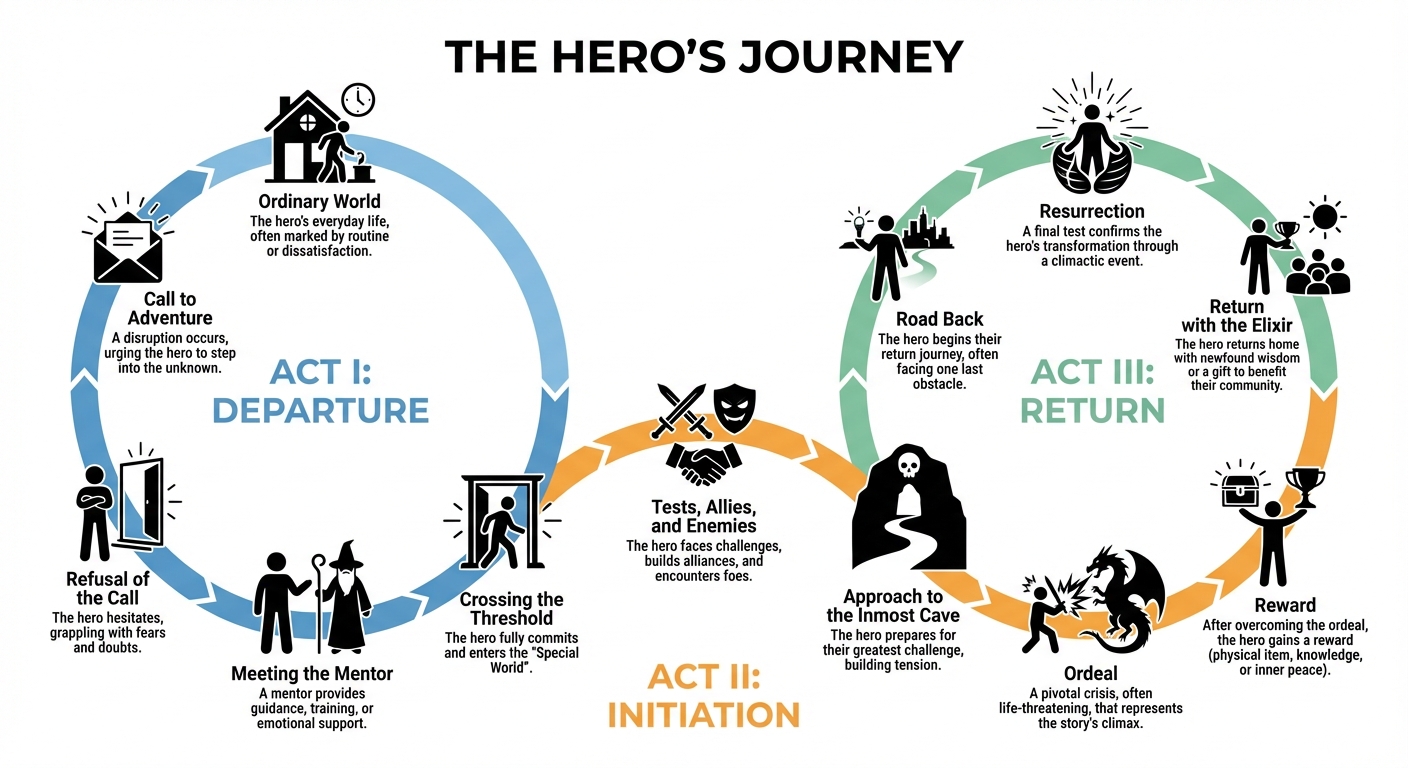
The 12 Stages of the Hero's Journey in Portal Fantasy
The Hero's Journey is a storytelling framework that captures the essence of progression fantasy and character transformation. Joseph Campbell introduced this concept in his 1949 book, The Hero with a Thousand Faces, identifying 17 stages that he referred to as the "monomyth." The term highlights how this structure appears consistently in myths, legends, and religious stories across different cultures and eras.
Christopher Vogler later condensed Campbell’s ideas into a more manageable 12-stage framework in his book, The Writer’s Journey: Mythic Structure for Writers. This version has become a go-to tool for modern storytellers, especially in film and fantasy fiction. A notable example is George Lucas, who drew heavily on Campbell's work for Star Wars. Reflecting on this, Lucas remarked:
"It was very eerie because in reading The Hero with a Thousand Faces I began to realize that my first draft of Star Wars was following classical motifs".
The framework divides the narrative into three major acts: Departure (leaving behind the familiar), Initiation (navigating trials in an unknown world), and Return (coming back transformed). This structure resonates deeply because it mirrors the psychological process of growth, something Carl Jung described as "individuation".
The 12 Stages of the Hero's Journey
The Hero's Journey unfolds through 12 key stages, each marking a step in the protagonist's transformation:
- Ordinary World: The hero's everyday life, often marked by routine or dissatisfaction.
- Call to Adventure: A disruption occurs, urging the hero to step into the unknown.
- Refusal of the Call: The hero hesitates, grappling with fears and doubts.
- Meeting the Mentor: A mentor provides guidance, training, or emotional support.
- Crossing the Threshold: The hero fully commits and enters the "Special World", a moment often vividly depicted in portal fantasy.
- Tests, Allies, and Enemies: The hero faces challenges, builds alliances, and encounters foes while adapting to the new world.
- Approach to the Inmost Cave: The hero prepares for their greatest challenge, building tension.
- Ordeal: A pivotal crisis, often life-threatening, that represents the story's climax.
- Reward: After overcoming the ordeal, the hero gains a reward - this could be a physical item, secret knowledge, or inner peace.
- Road Back: The hero begins their return journey, often facing one last obstacle.
- Resurrection: A final test confirms the hero's transformation, often through a climactic event.
- Return with the Elixir: The hero returns home, bringing with them newfound wisdom or a gift to benefit their community.
These stages not only drive the narrative but also reflect the emotional and psychological growth of the hero.
Why This Structure Works for Readers
The Hero’s Journey resonates because it reflects universal human experiences. Author and educator David Safford describes it as:
"the skeleton key of storytelling that you can use to unlock the solution to almost any writing problem you are confronted with".
This framework intertwines external events with internal growth. While the hero faces fantastical trials, they also confront personal fears and limitations, creating a dual journey that feels deeply relatable. Readers see their own struggles mirrored in these stories, making the hero’s triumphs all the more impactful.
Starting the story in the Ordinary World provides a baseline, making the hero's transformation more striking upon their return. The cyclical nature of the journey - leaving, growing, and returning - resonates with patterns of human growth and change. It touches on timeless themes of courage, sacrifice, and the pursuit of meaning. As Kevin Barrett, creator of StoryFlint, explains:
"a storytelling framework found in myths, films, and novels across cultures. It maps the emotional and physical journey of transformation from comfort to chaos and back again".
What Is Portal Fantasy?
Portal fantasy revolves around a protagonist stepping out of their ordinary world and into a magical one. This transformation happens through a specific gateway - like a wardrobe or a mirror - that connects the "primary world" to a "secondary world." It's this unique transition that defines the subgenre and sets it apart from other types of fantasy.
The story typically follows a quest-driven plot, where both the protagonist and the reader discover the rules of the new world together. Often, a guide helps the protagonist navigate this unfamiliar realm. Literary scholar John Clute, co-editor of The Encyclopedia of Fantasy, notes:
"Portals function not merely as passages but as mechanisms of narrative choice and initiation."
One of the earliest and clearest examples of portal fantasy is Alice's Adventures in Wonderland, which helped establish many of the genre's lasting conventions. While portal fantasy has its roots in children's literature, modern works like Lev Grossman's The Magicians have brought the concept to adult audiences, frequently flipping traditional tropes on their heads. Interestingly, literary agents report that portal fantasy submissions make up as much as 25% of the Young Adult fantasy "slush pile."
Now, let’s break down the key elements that define this subgenre.
Core Elements of Portal Fantasy
Portal fantasy stories share a set of common traits. They usually begin in a "frame world", which represents the protagonist's ordinary reality. This world is often marked by challenges like boredom, bullying, family struggles, or external threats such as war. For example, in The Chronicles of Narnia, the Pevensie children seek refuge from the London Blitz.
The portal itself serves as a boundary between two distinct realities. These gateways can take many forms - physical objects like mirrors or wardrobes, or natural phenomena like whirlwinds. Once the protagonist crosses into the portal world, they encounter a realm where magic exists solely within that space. This contrasts with urban fantasy, where magic is hidden within the real world, or intrusion fantasy, where supernatural elements disrupt everyday life. In portal fantasy, the magic remains contained within the alternate world.
This separation of worlds offers readers a chance to see things from a fresh perspective. British academic Farah Mendlesohn explains:
"Fantasy novels are more effective when the conventions used are appropriate to the reader's expectations for a given category."
The conflicts within the portal world often reflect the protagonist's inner struggles. These external challenges act as opportunities for growth, preparing the hero to return home stronger and more self-assured. As editor and author David Griffin Brown advises:
"The fantasy world should complicate that quest, not be the quest."
Much like the Hero's Journey, crossing each threshold in portal fantasy represents a step toward personal transformation.
Portal Fantasy vs. Other Fantasy Subgenres
To fully understand portal fantasy, it’s helpful to see how it differs from other fantasy subgenres. The key differences lie in where the magic exists and how characters interact with it.
| Subgenre | Setting | Movement | Reader Experience |
|---|---|---|---|
| Portal Fantasy | A separate, magical realm | Protagonist enters the magic world | Discovers wonder alongside the hero |
| Immersive Fantasy | Entirely fictional world | Stays within a single world | Treated as a resident of the world |
| Urban Fantasy | The real world with hidden magic | Magic coexists with modern life | Uncovers hidden supernatural secrets |
| Intrusion Fantasy | The real world overtaken by magic | Magic disrupts the protagonist's life | Encounters a world turned upside down |
In immersive fantasy, readers are fully immersed in a fictional world with no connection to the real world, relying on deep lore and history to build the setting. Urban fantasy, on the other hand, keeps magic hidden within contemporary life. Portal fantasy thrives on the tension between two separate worlds, using this contrast to shape the protagonist's journey. Meanwhile, intrusion fantasy flips this dynamic by bringing magical elements into the protagonist's normal life - like how wizards exist within our world in Harry Potter, but remain hidden from plain sight.
While immersive fantasy focuses on creating a single, detailed world, portal fantasy often emphasizes variety, sometimes allowing characters to move between multiple imaginative realms. This versatility has influenced modern trends like Isekai and LitRPG, where characters find themselves in game-like worlds complete with visible RPG mechanics.
These distinctions provide a foundation for exploring how the Hero's Journey plays a central role in shaping portal fantasy narratives.
How the Hero's Journey Fits Portal Fantasy Structure
Portal fantasy and the Hero's Journey naturally complement each other. Both revolve around transformation, with characters stepping away from the familiar and into the unknown. In portal fantasy, the gateway serves as more than just a physical passage - it symbolizes the leap from ordinary life into a realm that demands growth and change. This alignment explains why portal fantasy stories resonate so deeply with readers.
Key stages of the Hero's Journey - Crossing the Threshold, Tests, Allies, and Enemies, and Return with the Elixir - map seamlessly onto the structure of portal fantasy. Each stage reinforces the protagonist's evolution while exploring the tension between two worlds. Let’s dive into how these stages - from entering the portal to returning transformed - shape the narrative.
Crossing the Threshold: The Portal Moment
The portal crossing is a pivotal moment. It’s the literal and symbolic step into the unknown, where the protagonist leaves their Ordinary World behind to enter the Special World. In portal fantasy, this moment is often driven by a strong desire to escape or change their current reality.
The best portal moments engage the reader's senses, making the transition feel real. Speculative fiction editor High Priestess Lakeisha captures this perfectly:
"The moment of crossing between worlds is your opportunity to ground impossible events in physical reality."
She offers an example to illustrate this idea:
"The air thickened like honey around Jasmin's fingers as she reached for the handle. Each breath drew in more magic than oxygen, until her lungs felt like they might spark and ignite."
These vivid sensory details don’t just make the crossing memorable - they also establish the new world’s rules and atmosphere, setting the stage for the journey ahead.
Trials, Allies, and Enemies in the New World
Once through the portal, the protagonist enters what screenwriter Christopher Vogler describes as the phase where "the balloon goes up, the ship sails, the romance begins, the wagon gets rolling." This stage typically spans the first half of Act 2, where the hero learns the rules of the new world.
The challenges faced in this phase often mirror the hero's internal struggles. As Kat Bradbury explains:
"Adventures in the portal world are a 'practice run' at dealing with real world analogues."
Allies provide guidance and support, while enemies force the hero to confront fears and weaknesses. Joseph Campbell captures this stage’s essence:
"The hero moves in a dream landscape of curiously fluid, ambiguous forms, where he must survive a succession of trials."
These trials push the protagonist to adapt and grow, often requiring them to use familiar tools in unfamiliar ways. This phase not only tests the hero but also sets the stage for their eventual transformation and return.
The Return: Coming Home Changed
The Return marks the culmination of the hero’s journey. In portal fantasy, this stage often involves bringing back an "Elixir" - a form of internal growth or wisdom. After overcoming the challenges of the other world, the protagonist returns with the strength or insight needed to face their original life.
Neil Gaiman’s Coraline is a great example. Coraline survives a chilling "Other" world that mirrors her own, and she returns with a newfound appreciation for her family and the courage to handle tough relationships. In Seanan McGuire’s Wayward Children series, the focus shifts to the psychological struggles of reintegration, exploring how heroes cope with mundane life after extraordinary experiences.
C.S. Lewis’s The Magician’s Nephew (1955) offers a different take. The destruction of Charn reflects atomic bomb fears, and the protagonists return with a moral lesson about the dangers of unchecked power. As Book Riot notes:
"Portal fantasies... can be a way for authors to reflect on a number of different real-world situations in one narrative."
Just as the initial departure reshapes the hero, the return transforms their perspective. They don’t simply go back - they’re equipped with new resilience and insight to face their world. Through these stages, portal fantasy demonstrates the Hero’s Journey’s ability to turn escapism into a path of personal empowerment.
Examples of Hero's Journey in Portal Fantasy
The Hero's Journey has long been a cornerstone of storytelling, and portal fantasy is one of the genres where it truly shines. From timeless classics to fresh modern takes, these stories show how the Hero's Journey framework deepens character arcs and explores universal themes. Let’s dive into some standout examples.
Classic Works: Tolkien and Beyond
J.R.R. Tolkien’s The Hobbit and The Lord of the Rings trilogy are quintessential examples. Bilbo Baggins starts his journey in the peaceful Shire, only to be thrust into the dangers of Middle-earth. His encounters with allies like Gandalf and enemies like Gollum shape him into a brave, resourceful adventurer.
C.S. Lewis’s The Chronicles of Narnia uses the wardrobe as a literal portal. The Pevensie children leave war-torn England and enter Narnia, where they face challenges that prepare them for real-life struggles. The Magician’s Nephew, another entry in the series, highlights the return phase, exploring lessons about the misuse of power.
L. Frank Baum’s The Wizard of Oz takes Dorothy from the gray monotony of Kansas to the colorful, magical world of Oz through a tornado. Her journey is both an escape from her troubles and a path to self-discovery, culminating in her eventual return home with newfound wisdom.
Modern Portal Fantasy Stories
Contemporary authors have reimagined the Hero’s Journey in portal fantasy, offering fresh perspectives that resonate with today’s readers.
- Diana Wynne Jones’s Howl’s Moving Castle flips the script by featuring a wizard who uses a portal world to dodge responsibilities. This clever twist adds depth to the departure stage of the classic journey.
- Seanan McGuire’s The Wayward Children series examines what happens after the adventure. By focusing on children who struggle to reintegrate into the ordinary world, the series brings a poignant take on the psychological toll of transformative experiences.
- Lev Grossman’s The Magicians offers a grittier approach. It subverts the "meddling kids" trope by delving into the darker realities of a magical university and the perilous land of Fillory, blending escapism with harsh truths.
- L.L. McKinney’s A Blade So Black reimagines Alice in Wonderland for a modern audience. By alternating between present-day America and a "Nightmareverse", the story updates the portal fantasy formula to address contemporary issues while retaining its adventurous spirit.
These examples show how the Hero’s Journey continues to evolve, keeping portal fantasy as captivating as ever. This evolution is particularly evident in modern subgenres like LitRPG, where the journey often involves digital worlds; for those new to the style, exploring the best LitRPG books for beginners can provide a great entry point. Each story brings its own spin, proving that the structure is as flexible as it is timeless.
Sababa Books: Portal Fantasy Titles Using the Hero's Journey

Sababa Books has taken the classic Hero's Journey framework and given it a modern twist, weaving in LitRPG and portal fantasy mechanics to breathe new life into the genre. These titles show how timeless storytelling structures can evolve, emphasizing immersive worlds and meaningful character development.
The Gilded Rebellion by Rebecca Vale
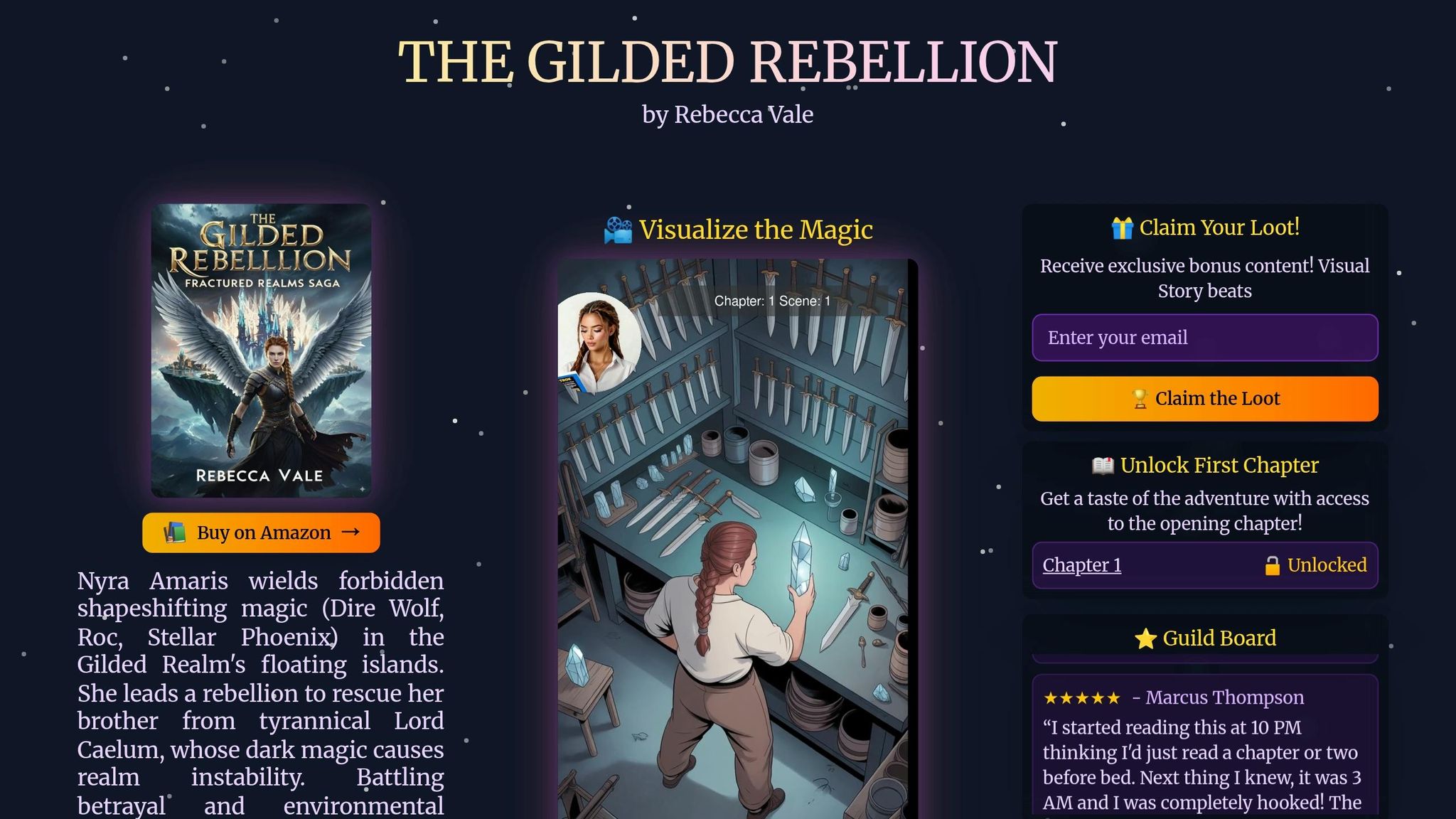
In The Gilded Rebellion, Rebecca Vale crafts a story where stepping into a magical realm becomes a vivid, sensory experience. The protagonist's "Crossing the Threshold" moment is brought to life with rich details - like the feeling of shifting pressure and the metallic tang of magic - that ground the reader in the transition. Once inside this new world, every trial the protagonist faces mirrors a personal struggle, setting the stage for deep transformation by the time they return. This attention to sensory and emotional depth gives the Hero's Journey a fresh dimension, making the classic structure feel both intimate and innovative.
The Lifeline Protocol by Sera Kane
Sera Kane's The Lifeline Protocol takes the Hero's Journey to the next level by embedding it within a LitRPG framework. The protagonist enters a world where RPG elements - like leveling up, skill trees, and measurable progress - are integral to the story. These mechanics provide clear markers for growth, aligning perfectly with the stages of the Hero's Journey. Each milestone in the game mirrors a key narrative moment, creating a dynamic blend of storytelling and interactivity. This approach not only modernizes the journey but also highlights how the monomyth can adapt to new storytelling formats while maintaining its universal appeal.
Conclusion
The Hero's Journey framework gives portal fantasy stories a strong emotional foundation and a clear narrative path. By following its 12-stage roadmap, authors can ensure their stories progress smoothly, with well-timed shifts that feel both grand and deeply personal. This structure resonates because it draws on universal themes of growth and self-discovery, making it relatable to a wide range of audiences.
Crossing into the extraordinary world symbolizes the hero's commitment to change. This "Special World" serves as a symbolic reflection of real-world struggles, offering characters a space to navigate challenges and develop before returning home as transformed individuals.
"The hero's journey is a timeless plot that has been used to create some of the most memorable works of literature and mythology. It speaks to themes of human experience, including self-discovery, transformation, and growth." - Grammarly
The framework's reach goes far beyond fantasy. Studies reveal it shapes over 80% of Hollywood blockbusters, and recent psychological research has even introduced a 21-item "Hero's Journey scale." This scale measures elements like self-awareness and transformative experiences, which are found to be strong predictors of overall well-being.
FAQs
Do portal fantasy stories always follow the full Hero’s Journey?
Portal fantasy stories don’t always stick to the full Hero’s Journey. While this framework often shapes such tales, authors tweak its structure to suit different genres, themes, or the specific needs of their stories. This adaptability lets portal fantasy carve out distinct storytelling approaches while still weaving in key aspects of the hero’s growth and transformation.
What makes a portal different from other fantasy “world-hopping” setups?
Portals are often presented as distinct, physical gateways or devices that characters pass through to access an entirely different reality. These gateways act as a springboard for storytelling, enabling rich exploration and the development of new worlds. On the other hand, some world-hopping scenarios lean on more ambiguous transitions - like dreams or natural events. These methods feel less grounded, as they lack a clear, tangible entry point.
How do LitRPG mechanics fit into the Hero’s Journey in portal fantasy?
LitRPG mechanics bring a fresh layer to the Hero’s Journey in portal fantasy by offering a structured path for character development. Heroes often begin with minimal skills, gradually building their abilities through training, facing challenges, and overcoming failures. This mirrors the timeless "zero to hero" storyline. What makes it even more engaging is how these external skill upgrades are paired with the character's emotional and psychological growth. The result? A transformation that feels richer and more impactful as the hero gains both strength and inner resolve.