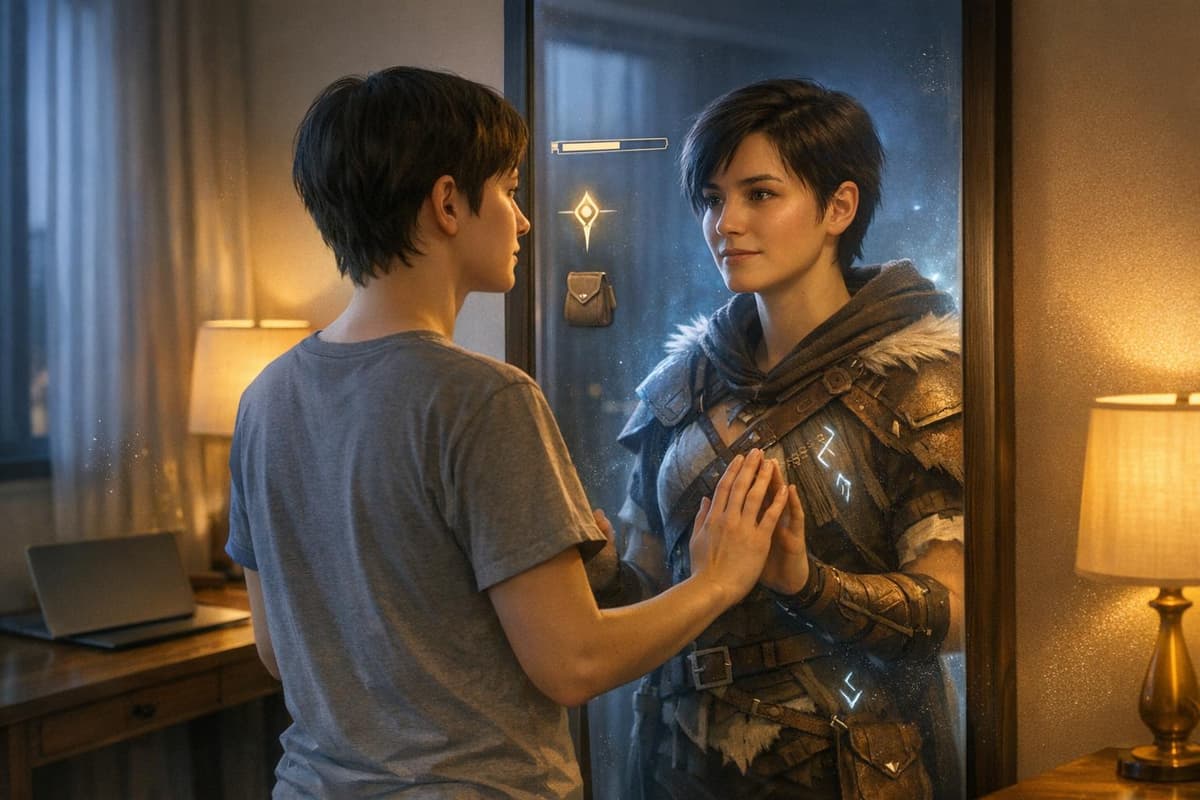
Identity vs. Escapism in LitRPG: Key Themes
LitRPG and GameLit combine video game mechanics with storytelling, creating worlds where characters level up, gain skills, and complete quests. But the genre isn't just about gaming - it explores two major ideas: escapism and identity.
- Escapism: Offers clear goals, predictable rewards, and a sense of control missing in daily life. Readers enjoy watching characters grow through effort, often in power-fantasy settings.
- Identity: Focuses on character growth, moral choices, and the duality between virtual and real lives. It asks: Who do characters become in these structured worlds?
The best Progression Fantasy and LitRPG stories balance these elements. They deliver the thrill of progress while grounding it in personal struggles and meaningful decisions. This balance keeps readers engaged, blending action with emotional depth.
What is Escapism in LitRPG
Escapism in LitRPG offers readers a chance to step into worlds where rules are clear, progress is measurable, and effort leads to visible results. These virtual universes aren't just about escaping the mundane - they're about diving into systems where hard work directly translates into rewards. Characters gain XP, level up, and complete quests, leaving no room for the ambiguity that often clouds real life.
But the genre's appeal goes beyond simple wish fulfillment. LitRPG provides something that everyday life often lacks: predictable systems of reward. In these stories, putting in the grind - whether it's slaying ten slimes or completing a dungeon - yields tangible gains. This cause-and-effect structure satisfies the desire for growth and accomplishment. For readers navigating challenging realities or rigid societal structures, these virtual worlds offer a space where they can feel empowered and in control.
Virtual Worlds and Power Fantasies
LitRPG worlds stand in stark contrast to the unpredictability of real life. As Richard Parry points out, real life has no tutorials, no quest logs, and no celebratory "ding" when you achieve a milestone. Mistakes in life often come with irreversible consequences, and there's no option to reassign your choices. In virtual worlds, however, everything operates within a logical system, offering clear feedback loops and predictable outcomes.
The genre’s power fantasy lies in its transformation arc. Characters often start at the bottom - sometimes literally, as with the "getting trucked" trope - and grow into formidable forces through incremental progress. Unlike traditional fantasy heroes, such as Aragorn, who begin their journeys fully equipped and at peak ability, LitRPG protagonists earn their power through progression fantasy mechanics. Readers witness the grind, making each victory feel deserved.
Why Readers Choose Escapism
With 227 million gamers in the U.S. alone and 2.7 billion mobile gamers worldwide, the mechanics of mana bars, skill trees, and loot systems are familiar to many. This shared understanding allows readers to dive into LitRPG stories effortlessly, tracking stats and strategizing alongside the protagonist.
The genre's psychological pull is equally important. LitRPG replaces the uncertainty of real life with clarity. Instead of vague goals like "improve networking skills" or "build a personal brand", it offers concrete objectives: defeat the boss, reach level 20, or master a specific spell. This clarity satisfies the need for visible feedback - a reward for effort that’s often missing in real-world pursuits. Escapism here isn’t about ignoring reality; it’s about imagining a world where diligence and strategy are always rewarded.
Escapism Examples in LitRPG
The Play to Live series by D. Rus highlights survival-focused escapism, thrusting its protagonist into a virtual world where staying alive is the ultimate goal. This VR-driven narrative immerses readers in a high-stakes environment where every decision matters. Other examples include Sword Art Online, The Legendary Mechanic, and Solo Leveling, which focus on VRMMO power fantasies. Meanwhile, The Wandering Inn and Mother of Learning explore survival scenarios that reward cleverness and persistence.
Modern LitRPG has also shifted from simple survival tales to stories about mastering and even breaking the system. Today’s protagonists don’t just play the game - they exploit its mechanics, min-max their builds, and outsmart the rules to gain an edge. As Parry notes, this evolution reflects a deeper desire among readers: not just to escape into a better world, but to overcome limitations and dominate systems that finally reward intelligence and effort.
While escapism in LitRPG empowers readers with structured rewards, it also opens the door to exploring deeper questions about identity within these virtual spaces.
sbb-itb-2566684
What is Identity in LitRPG
Identity in LitRPG stories goes beyond just escapism; it delves into how characters grow and change internally. In this genre, personal development isn't vague or abstract - it's tied directly to stats and abilities. Characters don't just "grow braver" or "become wiser"; instead, their courage or wisdom is reflected in tangible ways, like leveling up or unlocking new skills. This makes growth easy to see and understand, giving readers a clear view of how characters evolve.
The concept of dual lives adds another layer of complexity. A protagonist might be a celebrated warrior in the virtual world but struggle with real-life challenges like poverty. This contrast forces them to confront a key question: Which version of themselves feels more authentic? By quantifying growth and exploring these dual realities, LitRPG offers a unique way to examine identity.
Character Growth and Dual Lives
In LitRPG, characters grow through persistent effort, but progress is rarely easy. These stories often place protagonists in harsh, demanding worlds where even a small stat gain feels like a major victory. The way characters choose to build their skills also shapes their identity. For instance, someone who invests in heavy armor might develop a protective, resilient personality, while a focus on speed could lead to a more agile and quick-thinking character. These choices aren't just about gameplay - they reflect deeper moral and psychological traits.
The stakes grow even higher when progress comes at a cost. Sometimes, leveling up means sacrificing relationships, ethical values, or even mental stability.
"Power means nothing if it doesn't cost the protagonist something, whether that's relationships, morality, or their own sanity." - Richard Parry, Author
How Technology Shapes Identity
In LitRPG, technology often fills the gaps left by real life, offering clear goals and instant feedback that the real world sometimes lacks. But it also forces characters to rethink what identity really means. For instance, when protagonists interact with sentient NPCs or advanced AI, they have to question the nature of genuine relationships.
Modern LitRPG stories often focus on more than just survival. Characters aim to master the system itself, sometimes bending or rewriting the rules to shape their reality. This shift reflects a deeper theme: the belief that intelligence and effort can overcome any barrier. Through these technological elements, LitRPG explores identity in a way that feels both futuristic and deeply personal.
Identity Examples in LitRPG
Many LitRPG stories revolve around characters redefining their sense of purpose through game mechanics. In tales where characters are trapped in a game, the line between their virtual and real identities often blurs, making every decision a matter of life and death. Choices - whether to prioritize power, morality, or relationships - reveal who they truly are.
Another common theme is the "unintended hero." These protagonists often become forces of nature, like "walking apocalypses", not because they set out to be heroes, but due to chaotic circumstances. Unlike traditional fantasy heroes who are often fully formed from the start, LitRPG characters earn their victories one step at a time. Each level gained represents more than just an increase in power - it's a milestone in their journey of self-discovery.
Identity vs. Escapism: A Comparison
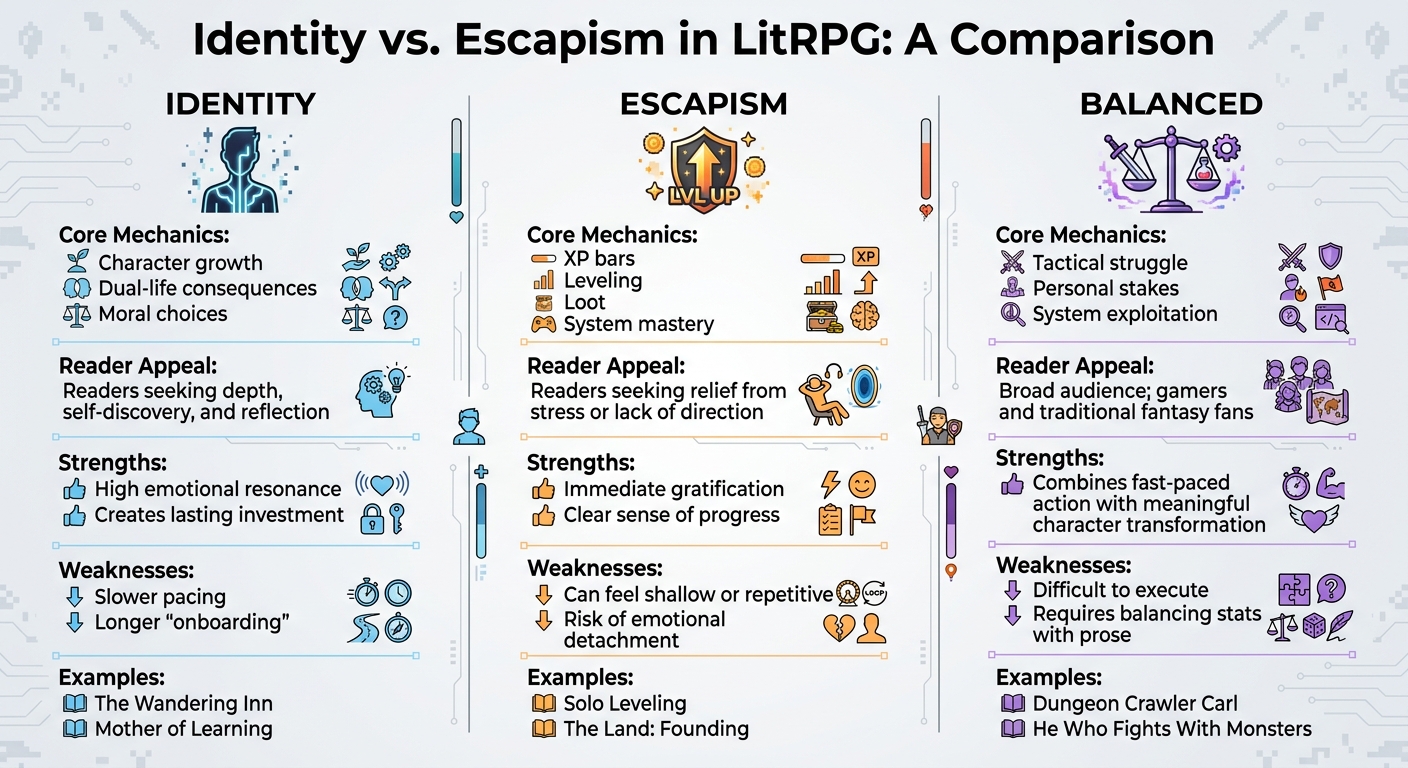
Identity vs Escapism in LitRPG: Key Differences and Examples
Identity and escapism play distinct roles in LitRPG storytelling, each appealing to different reader preferences. Escapism is all about instant gratification - think XP bars, loot drops, and level-ups. It’s like experiencing "real life with a patch that actually works". On the other hand, identity-driven narratives explore deeper psychological themes, where characters grapple with questions of self and reality as the lines between the game world and real life blur.
The key difference lies in what readers gain from these stories. Escapism provides "clarity porn" - clear goals and immediate feedback. Since most readers are already familiar with game mechanics, these stories are easy to dive into with a new fantasy reader checklist. Meanwhile, identity-focused tales demand more patience but reward readers with emotional depth and moral complexity. This contrast highlights how each theme meets different reader expectations.
Comparison Table: Identity vs. Escapism
| Theme | Core Mechanics | Reader Appeal | Strengths | Weaknesses | Examples |
|---|---|---|---|---|---|
| Identity | Character growth, dual-life consequences, moral choices | Readers seeking depth, self-discovery, and reflection | High emotional resonance; creates lasting investment | Slower pacing; longer "onboarding" | The Wandering Inn, Mother of Learning |
| Escapism | XP bars, leveling, loot, system mastery | Readers seeking relief from stress or lack of direction | Immediate gratification; clear sense of progress | Can feel shallow or repetitive; risk of emotional detachment | Solo Leveling, The Land: Founding |
| Balanced | Tactical struggle combined with personal stakes and system exploitation | Broad audience; gamers and traditional fantasy fans | Combines fast-paced action with meaningful character transformation | Difficult to execute; requires balancing stats with prose | Dungeon Crawler Carl, He Who Fights With Monsters |
Trade-Offs Between the Two Themes
The biggest trade-off between identity and escapism is pace versus depth. Escapism-heavy stories deliver quick rewards but risk becoming, as Richard Parry puts it:
"If they're emotionally static, permanently untouchable, and so OP they might as well be the game's end credits boss… then congrats, you've written a spreadsheet, not a story".
While escapism thrives on immediate rewards, identity-driven narratives focus on transformation, often through struggle and sacrifice. However, their slower pacing can alienate readers who prefer fast-paced power fantasies.
Modern LitRPG has shifted from survival tales to stories centered on mastering game systems. This trend leans toward escapism, but the most compelling books find a balance. They give readers the thrill of watching numbers climb while weaving in personal stakes - whether through relationships, morality, or even sanity. Writers face the challenge of blending tactical satisfaction with emotional depth, ensuring the story feels both rewarding and meaningful without tipping too far in one direction.
How to Balance Identity and Escapism in LitRPG
Great LitRPG stories find a way to weave identity and escapism together without forcing readers to pick sides. The most engaging narratives offer the thrill of power fantasies alongside meaningful character growth. The key? Every level-up, stat boost, or new ability must come with real consequences that shape the character’s journey. Victories should feel earned through genuine struggle, not handed out freely. Protagonists need to face challenging obstacles and make tough decisions, even as they grow stronger. This approach not only enhances the excitement of leveling up but also deepens the character's emotional and personal evolution. It’s this blend of tension and growth that gives LitRPG its unique charm, where game mechanics enhance the story rather than overshadow it.
Books That Balance Both Themes
Several standout novels showcase how to strike this balance. Rebecca Vale’s The Gilded Rebellion is a prime example. The protagonist, Nyra Amaris, uses escapist shapeshifting magic - transforming into creatures like a Dire Wolf, Roc, and Stellar Phoenix - while wrestling with her role as a rebellion leader fighting against environmental collapse and tyranny.
In The Lifeline Protocol by Sera Kane, the focus shifts to Quantum Transformation Technology gameplay mixed with intense identity struggles. Myra Steele, the protagonist, faces moral dilemmas in a post-apocalyptic VR world, carrying the weighty task of potentially saving humanity.
Another standout is Life Reset by Shemer Kuznits, which has a 4.28/5 rating from 8,937 reviews. It portrays a VRMMORPG as a rehabilitation tool, where virtual progression becomes a metaphor for redemption. And, of course, works like Ready Player One also exemplify this balance, blending immersive escapism with personal stakes.
Writing Techniques for Balancing Themes
As with balancing pace and depth, certain writing techniques help merge fast progression with meaningful character development. Parry’s Three Pillars of Meaningful Power - struggle, agency, and meaning - serve as a helpful framework. Even when characters are overpowered, they should face challenges that demand difficult choices. Wins should come from clever strategies or sheer grit, and every gain in power should exact a price - whether it’s memories, relationships, or moral compromises.
Some authors use meta-narratives to tie game mechanics to inner conflicts. For instance, in Forging Protocol by Elvira Skarn, "Memory Units" serve as the currency for altering the game world, forcing the protagonist to trade pieces of her identity for greater power. This transforms game mechanics into tools for exploring moral and emotional stakes, rather than just a way to rack up stats.
Another effective technique is what’s known as the Urban Fantasy Effect. By grounding stories in familiar settings or recognizable gaming elements (like XP bars or mana systems), authors can focus more on the characters and the consequences of their choices. When readers already understand the rules of the world, it opens up space to explore the true cost of every in-game decision.
Conclusion
LitRPG thrives on the delicate balance between escapism and identity. Escapism brings the thrill of progress - leveling up, completing quests, and earning rewards - while identity adds emotional depth, tough decisions, and real consequences. Together, these elements create stories that not only entertain but also reflect the struggles and triumphs of real life. When done right, this blend of mechanics and personal growth resonates deeply with readers.
What readers truly crave are characters who earn their victories through authentic struggles. It's the challenges they face and the choices they make that give meaning to their triumphs. This is what makes their journey relatable and their growth compelling. Struggle adds weight to success, while choices shape characters in ways that feel genuine.
But this balance is tricky. Leaning too far into escapism without grounding it in identity risks creating shallow stories. As Ursula K. Le Guin aptly put it:
"I call this escapism: a sensationalist raising of a real question, followed by a quick evasion of the weight and pain and complexity involved in really, experientially, trying to understand and cope with that question".
On the flip side, focusing too much on identity at the expense of engaging game mechanics can strip LitRPG of what makes it special. The genre's unique charm lies in its ability to merge these two aspects seamlessly.
The best LitRPG stories prove that it's possible to combine immersive power fantasies with meaningful character development. Every level gained should come with a cost, and every victory should feel earned. This balance is what makes characters relatable and their journeys unforgettable. In the end, the interplay of identity and escapism is what defines LitRPG's enduring appeal.
FAQs
How can I tell if a LitRPG is more about identity or escapism?
To figure out if a LitRPG leans more toward identity or escapism, take a closer look at its story and character development. If the plot revolves around themes like self-discovery, emotional challenges, or personal growth, it’s likely focused on identity. On the other hand, if the narrative prioritizes leveling up, gaining power, or achieving external goals, it’s more about escapism. While many LitRPGs mix these elements, a heavier emphasis on internal transformation indicates identity, whereas a focus on external accomplishments signals escapism.
What makes leveling up feel meaningful instead of repetitive?
Leveling up becomes truly rewarding when it blends outward progress with personal growth, creating a sense of real accomplishment and character evolution. Stories that intertwine power progression with emotional resonance make triumphs feel earned and struggles unforgettable. By introducing diverse challenges, meaningful milestones, and occasional setbacks, the narrative gains depth, ensuring every level adds to the character's journey rather than feeling empty or routine.
How do authors keep game stats from overpowering the story?
Authors keep game stats from overshadowing the story by blending them naturally into the plot and character development. Instead of relying on long-winded explanations or overly intricate mechanics that might disrupt the flow, they use stats to support the narrative. This approach helps highlight progression and raise the stakes, all while keeping the reader engaged without feeling overwhelmed.